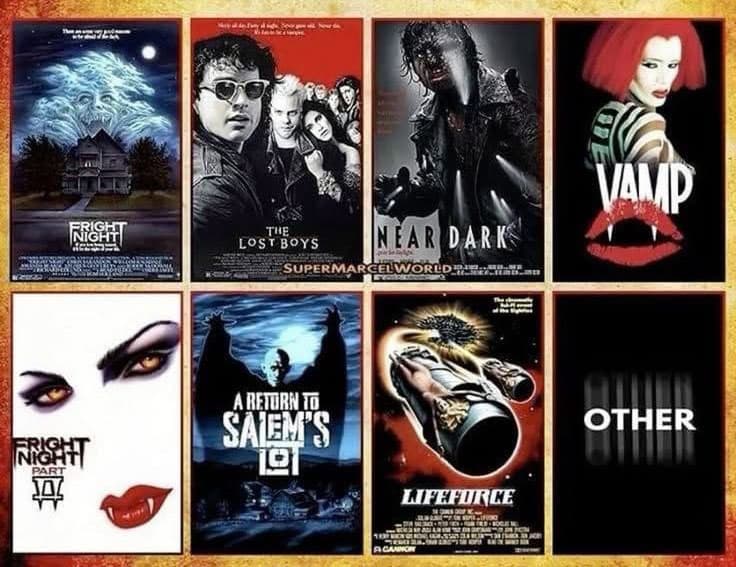
Why 80s Vampire Movies Were So Damn Good
The decade gave vampires leather jackets, nightclubs, motorbikes and a completely new attitude.
THE REINVENTION
The vampire desperately needed the 1980s
There was a point in the 1980s when vampires stopped looking like they'd slept in a coffin for 400 years and started looking like they might nick your girlfriend outside a nightclub.
Dracula hadn't disappeared. The castles, crosses and old rules were still lurking somewhere in the background. But the best vampire films of the 80s dragged the monster out of Transylvania and dumped him into the modern world.
Vampires lived next door. They hung around amusement parks. They rode motorcycles. They went to nightclubs. They wore sunglasses at night and somehow got away with it.
Most importantly, they became cool. And that's a huge part of why 80s vampire movies were so damn good.
FRIGHT NIGHT
Fright Night brought the vampire to suburbia
That's what makes Fright Night such an important piece of the puzzle. Jerry Dandrige doesn't arrive surrounded by fog in a horse-drawn carriage. He moves into the house next door.
Charley Brewster isn't some fearless vampire hunter either. He's a teenage horror fan who becomes convinced that his charming new neighbour is murdering people. Nobody believes him. And why would they?
That's where Fright Night has so much fun with the genre. Charley knows the rules because he's watched the movies. Unfortunately, knowing how vampires work and convincing everyone that there is actually a bloody vampire next door are two very different things.
Then there's Peter Vincent: a washed-up television horror host being asked to become the thing he spent his career pretending to be. Fright Night doesn't laugh at old vampire movies. It loves them. It simply asks what would happen if one of those old-fashioned monsters wandered into 1980s suburbia.
THE LOST BOYS
Then The Lost Boys made vampires cool as hell
If Fright Night brought vampires into the 1980s, The Lost Boys gave them a complete bloody makeover.
Joel Schumacher's vampires didn't look like ancient aristocrats. They looked like a band you weren't cool enough to get backstage with. David and his gang had leather jackets, motorbikes, earrings, attitude and absolutely magnificent hair.
Kiefer Sutherland's David doesn't need a cape. He's got a mullet. Somehow that's considerably more threatening.
But beneath all that style is one of the smartest things The Lost Boys understands about vampires: being a vampire might actually be tempting.
Don't grow old. Don't follow the rules. Stay out all night. Join the gang. Do whatever you want. Live forever. The vampires aren't merely hunting Michael. They're recruiting him.
TEMPTATION
80s vampires had sex appeal
The decade also stopped pretending there wasn't something inherently sexual about the vampire myth.
Tony Scott's The Hunger went straight at it. Stylish, cold, erotic and very different from the crowd-pleasing energy we'd later get from The Lost Boys, it showed just how far the vampire could travel from the traditional gothic image while remaining recognisably vampiric.
Catherine Deneuve and David Bowie aren't presented as decomposing monsters hiding from society. They're beautiful, sophisticated, desirable and dangerous.
The vampire had always represented temptation, but the 80s increasingly put that temptation front and centre. Sometimes becoming one of the undead didn't look like a punishment. It looked like an invitation.
NEAR DARK
Near Dark made vampires dirty again
Then there's Near Dark. Kathryn Bigelow's 1987 film goes in almost the opposite direction to The Lost Boys while arriving at an equally modern vampire.
These aren't glamorous nightclub immortals or suburban seducers. They're drifters: a nomadic family moving through America's back roads and small towns, surviving from one night to the next.
Take away the supernatural element and they could almost belong in a western. That's precisely what makes the film interesting.
Near Dark demonstrates that by the late 80s the vampire movie didn't even need to look like a vampire movie anymore. The mythology had become flexible enough to blend with westerns, road movies, romance and brutal horror. No castle required.
THE MONSTERS
Practical effects made the transformations hurt
And then there were the faces. God, the faces.
One thing modern vampire films can struggle to replicate is the wonderfully tactile nastiness of 80s practical effects. When an 80s vampire transformed, it often looked uncomfortable.
Foreheads changed. Eyes changed. Teeth erupted. Skin stretched. Faces became something recognisably human and completely monstrous at the same time.
Fright Night is particularly glorious at this. The film doesn't merely give Jerry a pair of fangs and call it a day. When the supernatural finally comes out, it really comes out.
The Lost Boys similarly understands the value of holding back the monster until it's time to let the makeup artists have some fun. The vampires can be sexy and charismatic for most of the movie, but underneath there's still something horrible waiting to emerge.
THE FUN
The 80s understood that horror could be fun
This might be the biggest ingredient of all. A lot of the best 80s vampire movies are fun.
Not comedy instead of horror. Fun with horror. There's a difference.
Fright Night can make you laugh and then give you something genuinely grotesque. The Lost Boys can spend time with the Frog brothers being ridiculous and still make David intimidating.
Even The Monster Squad understands that affection for classic monsters and actually being frightened by monsters aren't mutually exclusive.
You could have horror, comedy, romance, teenage drama, practical effects, music and adventure all occupying the same VHS tape. Nobody seemed terribly concerned about which shelf the video shop was supposed to put it on.
PURE 80S
MTV changed what a vampire movie could feel like
You can't separate 80s vampire cinema from the way the decade looked and sounded.
Music had become an enormous part of youth identity. MTV arrived. Music videos pushed lighting, editing, fashion and performance into increasingly stylised territory.
And vampire movies were perfect for it. Smoke. Neon. Backlighting. Leather. Nightclubs. Big hair. Bigger songs.
The Lost Boys might be the ultimate example because its soundtrack isn't merely sitting underneath the movie. It's part of the movie's identity.
You can almost hear Cry Little Sister just looking at an image of Santa Carla. That's powerful filmmaking and extraordinarily powerful nostalgia.
UNDER THE SURFACE
They were really movies about belonging
Strip away the fangs and something else starts appearing. A surprising number of these movies are about belonging.
Michael wants somewhere to belong in The Lost Boys. Charley desperately needs someone to believe him in Fright Night. Caleb is pulled between his old life and a new family in Near Dark.
Vampirism becomes more than immortality. It's membership.
That's particularly effective when your protagonists are teenagers and young adults because few periods of life are more obsessed with the question: where do I fit?
The vampire offers an answer. Come with us. You'll never be alone again. Of course, there's usually a small-print issue involving murder and drinking people's blood. Nothing's perfect.
THE RULES
The movies respected the old rules while breaking them
Perhaps that's the secret. The 80s didn't destroy the vampire. It remixed it.
Crosses still mattered. Sunlight still mattered. Blood certainly mattered. But filmmakers stopped treating the mythology like something that had to remain locked inside a gothic period piece.
A vampire story could be a teenage comedy. A western. An erotic thriller. A suburban horror movie. A youth movie with one hell of a soundtrack.
The monster survived because filmmakers were willing to change its clothes. Literally, in some cases.
VAMPIRE HUNTERS
And then there were the Frog brothers
We cannot talk about 80s vampires without acknowledging perhaps the decade's greatest contribution to professional vampire hunting: Edgar and Alan Frog.
Two teenage comic-book nerds running around Santa Carla behaving like hardened paramilitary vampire killers.
Absolutely ridiculous. Absolutely brilliant. And somehow exactly right for The Lost Boys.
They're another example of something 80s genre cinema did particularly well: completely commit to an idea that probably sounded insane when somebody first said it aloud.
The movie doesn't apologise for the Frog brothers. It gives them stakes and lets them get on with it. God bless the 1980s.
THE LEGACY
Why we're still talking about these movies
Nearly forty years later, The Lost Boys and Fright Night haven't disappeared. People still watch them. Still quote them. Still argue about which one is better. New generations keep discovering them.
And it's not simply nostalgia. The best 80s vampire movies have personality.
You can recognise them from a single frame. You can recognise their music, their characters, their monsters and their attitude.
They came from a period when filmmakers were taking an incredibly old creature and asking what else they could possibly do with it.
The answer turned out to be: quite a bloody lot.
THE VERDICT
So why were 80s vampire movies so damn good?
Because for one glorious decade, the vampire was allowed to be almost anything.
Sexy. Funny. Terrifying. Romantic. Rebellious. Grotesque. Cool. Sometimes all within the same film.
The 1980s took one of cinema's oldest monsters, dragged it through neon lights, gave it a leather jacket, put a cassette in the stereo and sent it out into the night.
And somehow, nearly four decades later, we still haven't found a better look for it.
Keep reading
More features
Movies
10 Movies That Defined 1985
From time machines to pirate treasure, 1985 might have been one of the most ridiculously entertaining years in movie history.
Read the feature →
Music
The Greatest Movie Soundtracks of the 80s
The decade when a movie soundtrack could become almost as famous as the film itself.
Read the feature →