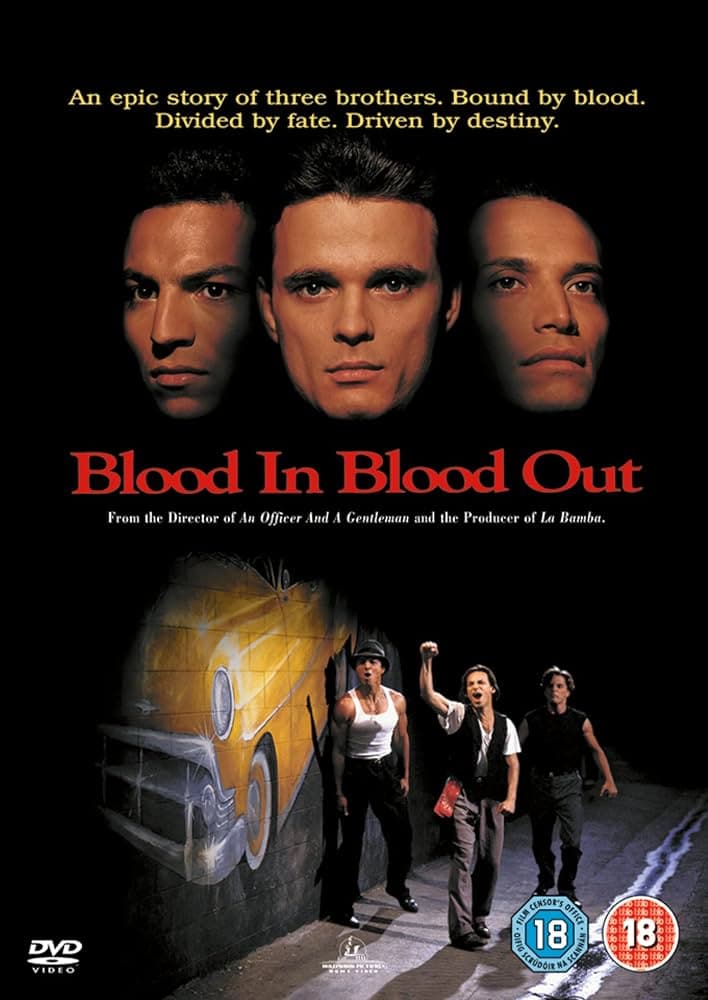
Blood In Blood Out
Three cousins, one barrio — and Miklo walks the tightrope between belonging and betrayal.
// The setup
PLAYBACK STARTED
Blood In Blood Out is the kind of three‑hour neighbourhood epic that trusts characters over cleverness. Taylor Hackford stages a sprawling tale of cousins from East Los Angeles whose lives split into art, the police and prison, and at its centre is Miklo Velka: a young man trying to buy himself a place to belong. If you haven't seen it, or haven't watched it since the 90s, it's the patient, sometimes messy commitment to those lives that keeps the film talking.
THE MOVIE
Miklo Velka is still the reason this movie works
Blood In Blood Out follows three relatives from an East L.A. barrio as the 1970s roll into the early 80s, and it’s the way their lives tangle and then pull apart that gives the film its push. Taylor Hackford built a big canvas — the theatrical cut runs around three hours — and he fills it with choices about family, identity and loyalty rather than tidy resolutions.
From the film’s opening beat in 1972 we meet Miklo Velka back in the barrio after growing up with his white father; his return is the moment the story tests what it costs to belong. Miklo’s struggle isn’t an abstract crisis — his lighter skin and mixed parentage make belonging a repeated, painful question for him.
Damian Chapa plays Miklo, and the film wears its ambitions plainly: this is a crime drama about people who try to survive by sticking together, even when the world puts pressure on that very idea.
THE SETUP
The idea that sets Blood In Blood Out in motion
The film sets a simple, effective engine in motion: three young relatives in a tight barrio are nudged onto very different trajectories. Miklo drifts toward the Vatos Locos as a way of proving he belongs; that choice, and a violent run‑in with a rival, lands him charged with murder and eventually inside San Quentin — a place the story uses as a pressure cooker.
Cruz Candelaria starts on a different path: he wins an art scholarship but is later undone by a family tragedy that leads him into heroin, a fall that shapes his options and his relationship with the others. Paco Aguilar takes the third route — he skips a jail term by enlisting, ultimately becoming an LAPD narcotics officer working undercover, which puts him on an inevitable collision course with Miklo after parole and criminal activity.
Those three arcs — art, law enforcement and prison — keep returning to the same questions about where loyalty lies and what belonging costs. The setup works because the choices feel like variations on the same problem rather than separate stories shoehorned together.
A final production note: the studio tested the film’s original title and renamed the theatrical release to Bound By Honor, a reminder that this was a big, careful project with marketing watching the fallout as closely as the story wanted your attention.
THE CHARACTER
Why Miklo Velka matters
Miklo Velka is not a symbol — he’s a person with a bargain to strike. He returns to the barrio wanting acceptance, and the painful centre of the film is how much he will change to buy it. That need for belonging colours almost every decision he makes.
His situation is specific: raised for a time by his Caucasian father, Miklo’s lighter skin and mixed ancestry put him on the wrong side of belonging even as he fights to prove himself. That friction — wanting family and yet being questioned by it — is what keeps him interesting.
Because the movie is so much about family and loyalty, Miklo’s choices carry weight beyond his own fate. He’s the character who tests those loyalties, and the film asks us to watch what happens when identity and allegiance collide.
Put simply: Miklo matters because the story is built around what it costs a person to be accepted, and he is where that cost is paid.
THE PERFORMANCE
Why Damian Chapa's performance matters
Contemporary coverage and later looks back at the film singled out the three leads — Jesse Borrego, Benjamin Bratt and Damian Chapa — as the movie’s breakout Latino talents. That’s worth flagging because the film depends on the sense that these are new voices given a big frame.
The casting choice is central to the movie’s ambitions: Hackford and his collaborators put relatively fresh faces into a sprawling, character‑driven story and asked audiences to invest in them for the long haul.
That decision shaped how Blood In Blood Out landed with viewers at the time and how it has stuck in memory: the film reads as a platform for those actors within a story built around identity and loyalty.
So when people talk about the film’s staying power, part of the case is that it introduced names who felt like they belonged inside this barrio world rather than being parachuted in from somewhere else.
UNDER THE SURFACE
Blood In Blood Out has more on its mind than the plot suggests
On the surface this is a crime drama that follows violent choices and their consequences. Underneath, the film is repeatedly asking who gets to belong and on what terms. Questions of identity — especially within Chicano culture and where mixed ancestry sits — run through every argument and decision.
Family and loyalty are the film’s consistent beat: whether through blood ties or gang bonds, people keep returning to the idea that loyalty can save you or kill you. That tension is the engine for much of the drama.
The prison sections of the film aren’t just set dressing; they’re a study of power structures. San Quentin and the dynamics inside it become a magnified version of the barrio’s conflicts, where honour, betrayal and shifting allegiances are made painfully obvious.
And because betrayal and honour recur as counterpoints, the story feels less like a morality play and more like a ledger: the characters add up debts and decide whether to pay them in cash or conscience.
THE FILMMAKING
How Blood In Blood Out was put together
There’s a big‑picture craftsmanship to how the film was assembled: Gabriel Beristain is credited as director of photography, and the editing was handled by Fredric and Karl F. Steinkamp. Those are the practical building blocks that let a three‑hour story breathe without collapsing.
A film of this length needs a steady pair of hands in the cutting room; the editing credit points to the kind of editorial discipline required to keep the multiple lives and timelines moving coherently.
Hackford’s role as director and producer also marks the film as a deliberate construction rather than a thrown‑together genre picture. The production choices aim to balance scale with character work.
All of which is to say: the filmmaking credentials are in place to support a sprawling narrative — the personnel credits show it wasn’t an accidental achievement.
PRACTICAL EFFECTS
The effects work that gives Blood In Blood Out its physical personality
When the film needs a sense of institutional reality, it leaned on real places and people. Production was granted permission to shoot inside an operating state prison, which gave the San Quentin sequences an uncommon level of authenticity onscreen.
To keep control over larger sequences and interior logistics, the crew also built a full prison block on sound stages at Raleigh Studios. That hybrid approach — real prison access plus purpose‑built sets — let the production stage scenes that would have been difficult or unsafe in a live environment.
The production also used hundreds of inmates as background performers during the San Quentin sequences, which is one of the practical reasons those sections feel crowded, dangerous and lived‑in.
PURE 80S
Blood In Blood Out could not belong to any other decade
The film’s length and sprawling subject matter placed it in conversation with a specific early‑1990s Hollywood moment that was suddenly willing to make large dramas about Latino communities and the prison system. It’s a product of that moment in its willingness to take time and space.
That same moment also saw other contemporary Hollywood films examine Latino gang and prison culture; Blood In Blood Out sits alongside those projects as a sibling rather than a stray. The context helps explain why the studio took big swings with both story and marketing.
The decision to give a long running time to a barrio‑centred epic — and to let multiple characters carry the narrative — is a distinctly early‑90s production choice. It’s the era’s appetite for weighty, issue‑driven drama married to genre energy.
Seen this way, the film feels of its time because the industry briefly allowed serious, extended stories about communities that had previously been sidelined.
WATCHING IT NOW
What has aged — and what hasn't
The things that feel most immediate today are the human questions — identity and belonging, and the tug of family and loyalty. Those beats are straightforward and don’t rely on period tricks, so they still cut through in modern viewings.
Music and some production flourishes are part of the package — Bill Conti is credited as the composer on the film’s production and home‑video credits — but what really carries is how the story keeps returning to personal costs rather than abstract moralising.
Where the film shows its age is mostly in scale: the three‑hour ambition can feel indulgent to viewers who expect leaner storytelling, and some viewers might find that patience tested. But if you’re prepared to sit with it, the core conflicts still register.
In short: the emotional questions remain clear, and the film’s commitment to those questions is the main reason it can still engage an audience now.
THE LEGACY
Why Blood In Blood Out still matters
The film did not open as a runaway hit, but over time it built a strong reputation with Latino audiences and has been the subject of anniversary screenings and a making‑of book. That gradual reappraisal is part of its afterlife.
The production materials and stories around the film were later compiled into a published book by the director and contributors, and the movie has been revisited in museum and university screenings. Those activities keep the conversation around the film alive and archival.
All of which means Blood In Blood Out matters not simply because of its story but because it became a film people kept returning to, studying and celebrating in specific communities and institutions.
Its reputation is therefore a grassroots kind of legacy: steady, particular and connected to the audiences who found something in the film that mainstream coverage initially missed.
THE VERDICT
Does Blood In Blood Out still hold up?
Yes — with reservations. If you want a tight, modern crime thriller you’ll find the running time and the sprawling structure trying. But if you’re after a film that insists on the messy business of identity, family and the choices that split people apart, it still delivers.
The three central arcs — Miklo returning to the barrio and ending up charged and in San Quentin, Cruz’s early promise undone by personal tragedy and addiction, and Paco’s route into the Marines and later undercover work as an LAPD narcotics officer — form a coherent moral triangle. That triangle keeps the film honest about how different decisions grow out of the same pressures.
The movie’s focus on identity — Miklo’s mixed parentage and need for acceptance — and the shifting power inside the prison, with figures like Montana steering outcomes, give the film thematic muscle. Contemporary and later coverage also singled out Jesse Borrego, Benjamin Bratt and Damian Chapa as breakout Latino talents, which matters because their presence is the film’s human anchor.
So should you watch it today? If you’re willing to sit with a long, character‑driven drama and want a story that treats questions of belonging seriously, it’s worth the time. Blood In Blood Out isn’t flawless, but its willingness to linger on people trying to belong gives it a particular kind of force that still lands.
Share this movie
// Keep watching
More movies from the 90s
If Blood In Blood Out is your kind of movie, there's plenty more on the shelves worth rewinding.
1993 // VHS
Schindler's List
A businessman who keeps a list — and keeps changing the kind of man he is.
1999 // VHS
10 Things I Hate About You
Sibling rules, a rooftop serenade and one very stubborn Kat — Shakespeare in a school corridor.
1999 // VHS
American Beauty
Lester Burnham, suburban rot and a midlife argument that still stings.