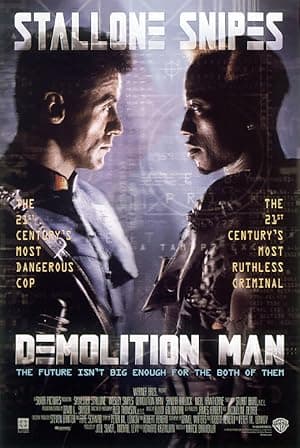
Demolition Man
A hard‑nosed cop thawed to face a sanitised future — and civilisation doesn't know what hit it.
// The setup
PLAYBACK STARTED
Demolition Man trots out a very simple, very 90s bait: freeze a pair of opposites in time and drop them into a world that thinks it's solved all problems. What keeps it interesting is John Spartan — the cop who built his nickname by breaking things — and the film's appetite for poking corporate civility with a sledgehammer. Marco Brambilla may have come from commercials, but he chose a premise that still makes the future look like a conversation worth having.
THE MOVIE
John Spartan is still the reason this movie works
Demolition Man begins with a neat parlor trick: a near‑past hostage rescue gone wrong that lands both its hero and villain in cryogenic limbo. Twenty‑plus years later the villain is loose in a tidy, corporate‑run San Angeles and the film thaws its protagonist to do something the future’s rules won’t — namely, break things to fix things.
That protagonist, John Spartan, is written as a hard‑edged, risk‑taking officer whose knack for collateral damage earned him the nickname that doubles as the movie’s title. The story is held together by that mismatch: a cop bred in violent improvisation against a society that has sanitised almost every human friction point.
Marco Brambilla directed Demolition Man as his first feature after a career making high‑budget commercials, and the result wears that background on its sleeve: the film is as interested in bright, branded surfaces as it is in the argument hiding underneath them.
THE SETUP
The idea that sets Demolition Man in motion
The engine is simple and economical. A 1996 prologue strands both John Spartan and Simon Phoenix in cryogenic prison after a botched rescue; Phoenix escapes in 2032 and Spartan is thawed to bring him down. Cryo is the plot device that lets the movie slam two different eras into each other without fuss.
That fish‑out‑of‑water feeling is the film’s shorthand for conflict. Spartan’s improvisational, often violent policing collides with a future that has traded brawn for behavioural controls and corporate order. It’s not just a clash of tactics; it’s a clash of assumptions about what keeps people safe.
The screenplay leans on consumer jokes and branded set pieces to make that future tangible. Those recurring commercial jingles and sponsorship gags aren’t throwaways — they’re the film’s way of showing that civility in San Angeles runs through tills and logos as much as through laws.
And so the story works because it keeps the stakes immediate — a loose, dangerous villain in a society that believes it no longer needs dangerous answers — while giving the audience somebody rugged and noisy enough to question whether that belief is true.
THE CHARACTER
Why John Spartan matters
John Spartan is the movie’s living, noisy proof that a story can be about both spectacle and argument. He’s introduced as the kind of cop whose instincts are to smash a problem until it stops being a problem — the very reason he earned the name 'Demolition Man' and the cryogenic sentence that sets the whole plot in motion.
That simple trait — willingness to take risks, consequences be damned — makes him more than an action figure. He’s the counterweight the future needs; not just to apprehend Simon Phoenix, but to remind the audience that a peaceful system still requires muscle and moral friction.
The screenplay couches Spartan’s presence as necessary disruption. In a society organised around consumer comfort and behavioural constraints, the arrival of someone who doesn’t recognise those limits obliges the film to ask whether safety without agency is any safety at all.
You don’t need to reduce him to a slogan. He matters because the story keeps insisting that civilisation isn’t just about neat streets and polite rules — sometimes it needs someone prepared to make a mess to protect those things.
THE PERFORMANCE
Why Sylvester Stallone's performance matters
Contemporary and later critical summaries commonly single out the film’s leads as scene‑carrying presences. Stallone is named alongside Wesley Snipes and Sandra Bullock in that company.
That’s a useful touchstone because it keeps the focus where the movie wants it: on energy and presence rather than subtle realism. The film needs a frontman who can plausibly be the kind of cop who once made a city afraid of him, and critics’ phrasing reflects that casting fit.
Put another way: the role calls for someone who can be unmistakably blunt — a dramatic blunt instrument rather than an interior study — and the contemporary responses catalogue the film’s reliance on that shape of performance.
Acknowledging the critical consensus doesn’t solve the movie’s contradictions, but it does explain why audiences often remember the characters first and the debate they’re in second.
UNDER THE SURFACE
Demolition Man has more on its mind than the plot suggests
On the surface it’s an action film: thaw a cop, stop a criminal. Underneath, it’s a satire that uses branding and consumer culture to sketch how a future society organises itself. Corporate sponsorship and advertising are woven into the worldbuilding to suggest that commerce has become a kind of civic grammar.
That brand saturation matters because it’s how the film dramatizes control. When jingles and tie‑ins stand in for civic rituals, the joke is also a warning: a city that outsources its rituals to corporations has handed them a lot of power.
Alongside that sits a satirical jab at sanitisation and political correctness. The screenplay frames future norms as something the audience should look at twice — there’s comfort in the rules, yes, but also an absence where capacity to respond to mess once was.
So the movie’s real quarrel is with complacency. It asks whether a low‑crime, polite society that has domesticated violence has also domesticated the means to defend itself when real disorder returns.
THE FILMMAKING
How Demolition Man was put together
Marco Brambilla arrived from a background in high‑budget commercials, and that pedigree steers the film toward big, clean visuals and a world that looks designed as much as lived in. This is a director who understands spectacle as shorthand for argument.
Credits on the production include Alex Thomson as cinematographer, Stuart Baird as editor and David L. Snyder as production designer — names that point to a mainstream, technical approach rather than an experimental one.
The production design favourites a metallic, branded near‑future look. That choice isn’t merely decorative: it’s how the film turns satire into something you can see. When the city feels packaged, the screenplay’s jokes about consumerism land with visual support.
In short, the filmmaking choices serve the central conceit — the future’s neatness and polish are meant to feel engineered, which makes Spartan’s messier methods feel not just lawless but necessary.
PRACTICAL EFFECTS
The effects work that gives Demolition Man its physical personality
The movie’s cryo sequences used hands‑on techniques. Stallone’s freezing was staged with an underwater performance in a clear fluid tank — originally glycerin, later water — with composited flashes and optical or CG elements layered in to sell the quick‑freeze.
To represent the frozen protagonist the production built anatomically complete dummies encased in clear plastic. Multiple copies were produced and some later turned up on public display, which is a neat reminder that props can outlive their scene.
Even the marketing leaned practical: the studio staged a real‑world implosion event tied to the film’s demolition imagery as a publicity stunt. The idea was to make the film’s demolition talk feel like an event outside the screen as well as on it.
Those tactile decisions — bodies in tanks, physical dummies, an actual implosion for promotion — give the movie a physical personality that matches its noisy premise.
PURE 80S
Demolition Man could not belong to any other decade
Although released in 1993, Demolition Man is a product of its early‑90s moment: it was developed and assembled as a big studio action/sci‑fi tentpole under Joel Silver’s Silver Pictures and distributed by Warner Bros.
Its satirical near‑future and brand‑saturated cityscape reflect conversations of the time about corporate culture, commodification of public life and the rise of political correctness as a public argument. The movie caught those anxieties and dressed them up as spectacle.
That mixture of loud action and topical satire is very of its era: a studio film that wanted to entertain and to poke at the cultural debates that were current then.
And the fact it’s been kept in the conversation enough to receive boutique restorations and reissues shows it retained a place in how the decade’s cinema gets remembered.
WATCHING IT NOW
What has aged — and what hasn't
One thing that still reads cleanly is the movie’s literary wink: the screenplay and production lean into an explicit nod to Aldous Huxley via the character name Lenina Huxley. That reference keeps the satire anchored to a recognisable dystopian lineage.
Another practical marker: Demolition Man has remained visible enough to warrant boutique home‑video restorations and reissues in the 2020s. That’s not a seal of artistic immortality, but it does mean the film’s particular mix of ideas and spectacle still finds an audience.
Where it trips for modern viewers is less about concept and more about tone. The movie’s jokes about sanitisation and corporate life can feel unevenly pitched to contemporary sensibilities, but the central debate — whether a comfy society has the tools to face violence — still functions.
So, bits of it are stubbornly of their time; other bits keep humming because the question at its centre is still recognisable.
THE LEGACY
Why Demolition Man still matters
Demolition Man opened on October 8, 1993 and became one of those 90s action pictures that kept popping up in cultural references — partly because of its jokes (the 'three seashells' gag and the brand‑satire elements are the stuff of later conversation) and partly because the premise is instantly repeatable.
Its afterlife is practical as well as referential: the film has received home‑video reissues, including a boutique 4K Ultra HD release in the 2020s, which keeps it available for new viewers and collectors alike.
There’s also industry noise around its business history: in 2017 Sylvester Stallone filed a lawsuit claiming unpaid profit participation related to the film, a dispute that was reported to have been settled in 2019. It’s a reminder that the film’s life continued offscreen in ordinary studio ways.
Taken together those elements explain why people still bring Demolition Man up: it’s a movie with memorable beats, a premise that invites repeat quotation, and a commercial afterlife that keeps it on shelves and streams.
THE VERDICT
Does Demolition Man still hold up?
Short answer: yes — if you come for the idea as much as the explosions. The film’s engine is a clear one: a 1996 prologue freezes two antagonists, Phoenix’s escape in 2032 forces the future to confront an old kind of violence, and Spartan is thawed to do the messy work the polite city prefers not to see.
What keeps it watchable is the culture‑clash at its heart. The central conflict between Spartan’s improvisational policing and a nonviolent, consumer‑oriented order embodied by technocratic control still makes for good drama. It’s a cartoon at times, but the question it poses — can sanitised civility respond to real danger? — is still a worthwhile one.
Critics then and now point to the leads as scene‑carrying presences, and that matters: a movie that leans on its star power to sell its premise needs people who read clearly in those parts, and Demolition Man does that job.
So, should you watch it? If you want a 1990s action film that pulls a satirical thread through its spectacle and doesn’t apologise for being loud about its ideas, give it a go. It’s not subtle, but it’s interested — and that interest is exactly why John Spartan still matters.
Share this movie
// Keep watching
More movies from the 90s
If Demolition Man is your kind of movie, there's plenty more on the shelves worth rewinding.

1993 // VHS
Schindler's List
A businessman who keeps a list — and keeps changing the kind of man he is.

1999 // VHS
10 Things I Hate About You
Sibling rules, a rooftop serenade and one very stubborn Kat — Shakespeare in a school corridor.

1999 // VHS
American Beauty
Lester Burnham, suburban rot and a midlife argument that still stings.