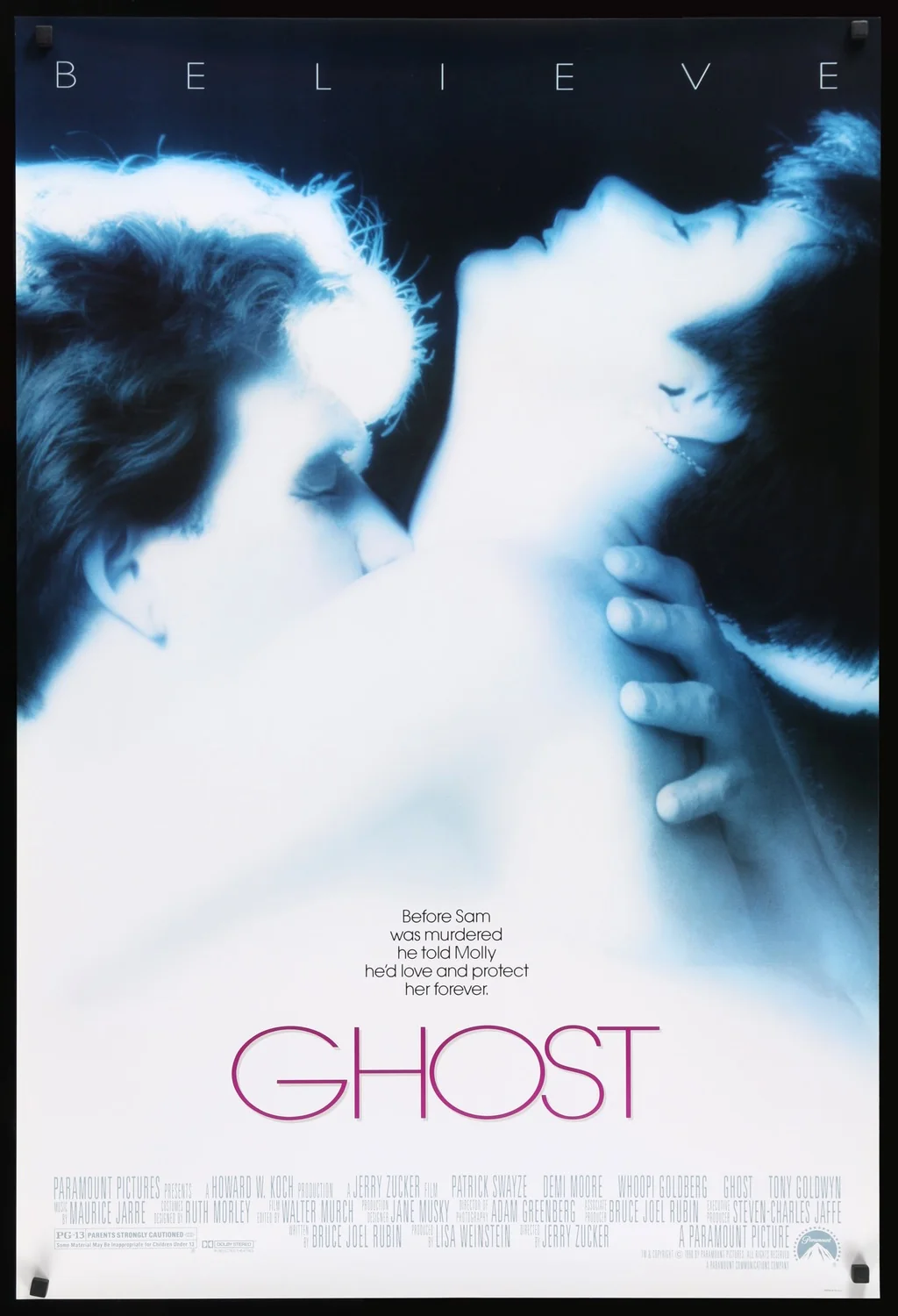
Ghost
A murder mystery disguised as a love story — with a man who won’t stop watching over the person he loves.
// The setup
PLAYBACK STARTED
Ghost is the kind of movie that hooks you with one simple promise: love can keep going, even after the lights go out. Jerry Zucker’s film spins that promise into a thriller-romance where a murdered banker refuses to be a passive spectator of the life he left behind.
THE MOVIE
Sam Wheat is still the reason this movie works
You can describe Ghost as a romance that borrows fantasy and thriller tricks, but that understates the very particular stubbornness at its centre: Sam Wheat keeps acting. He’s a New York investment banker who dies early on and, rather than fold into the scenery, spends the rest of the film trying to protect the person he loves.
That premise gives the film a clear spine. Sam’s death turns the story into a puzzle — how does someone who can’t be seen anymore reach the living? The movie answers that by routing emotion through an awkward, reluctant medium and a community of ghosts who watch but mostly cannot interfere.
Jerry Zucker directs a 127-minute picture that hinges on a small group of performers — Patrick Swayze as Sam, Demi Moore as Molly and Whoopi Goldberg as the woman who hears him — and on the simple idea that love might survive whatever comes next.
THE SETUP
The idea that sets Ghost in motion
At heart Ghost is economical: a young couple settle into a loft and are brutally interrupted by one late-night murder. That single event flips the film into ghost mode — Sam can see the world but, for the most part, the world cannot see him.
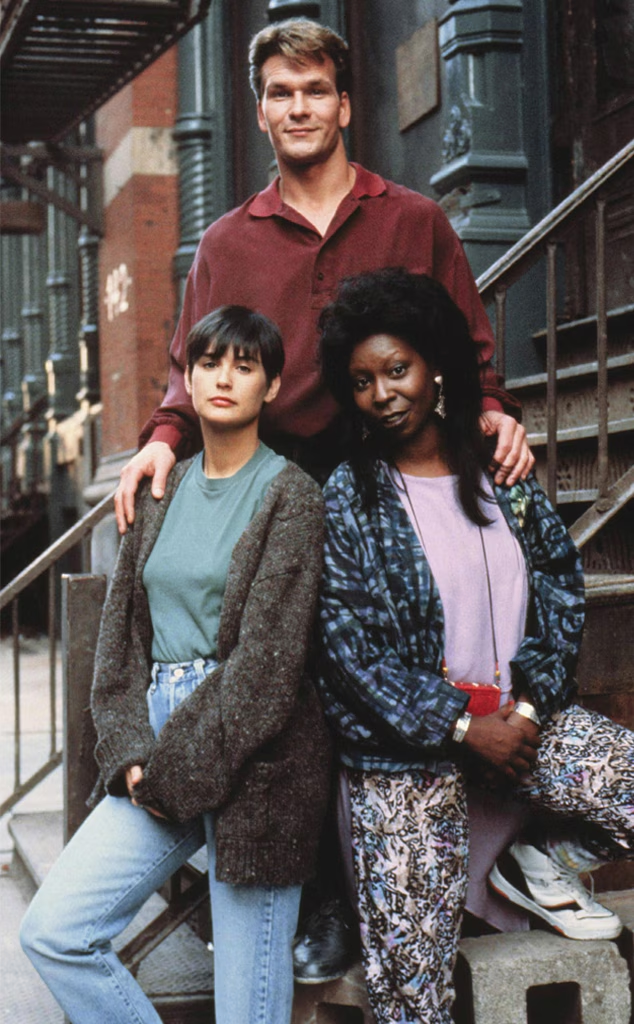
The narrative stakes are straightforward. Sam wants two things: to shield Molly from whatever danger is closing in, and to find out who arranged his death. Those aims keep the story moving without turning it into a procedural; the emotional urgency is constant.
The movie’s mechanics keep things tidy. There’s a visible community of ghosts who observe the living, a medium who’s meant to be a fraud but who ends up hearing Sam, and a financial mystery at Sam’s workplace that ties into the murder.
It’s a setup that lets the film shift tones without losing focus. One moment it’s a grieving couple; the next it’s a whodunnit; after that it’s a supernatural negotiation about how to communicate across the divide.
THE CHARACTER
Why Sam Wheat matters
Sam isn’t just the victim; he’s the engine. He was an investment banker with something to lose, and death doesn’t turn him into a passive symbol — it changes how he can act. He still has agency, but the rules are different now.
That mismatch — wanting to do things you no longer can — is where the movie finds its dramatic tension. Sam’s urgency makes everyday moments tense: a touch he can’t make, a warning he can’t shout. The limit on his power keeps the stakes human rather than metaphysical.
His connection to Molly is the emotional lodestone. She’s an artist left vulnerable by loss, and Sam’s attempts to reach her are the film’s constant concern. Protecting her gives his ghostly existence shape and purpose.
Around him are people whose loyalties matter: a medium who becomes the bridge for his voice, and a friend at work whose relationship to Sam grows suspicious. Those ties keep the mystery personal rather than abstract.
THE PERFORMANCE
Why Whoopi Goldberg's performance matters
Oda Mae Brown starts as a small-time psychic with more hustle than credibility and ends up being the only person who can hear Sam. That structural role makes her the film’s practical and emotional connector.
Contemporary coverage and later retrospectives singled out the character as a crucial element of why the film worked, and that attention was formalised when Whoopi Goldberg won the Academy Award for Best Supporting Actress.
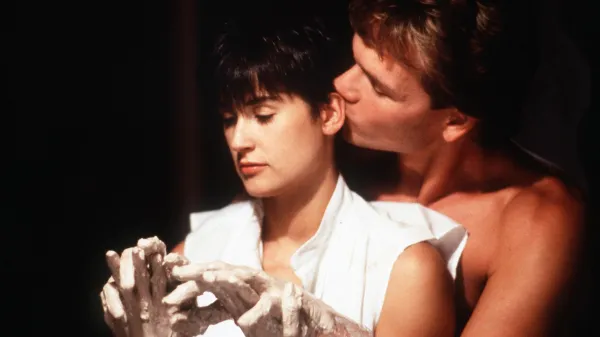
Because she is the mouthpiece for Sam, Oda Mae does the heavy lifting of translating supernatural information into human terms. The screenplay leaves space for those moments to land, and the result is a throughline the audience can follow.
Put bluntly: without a credible channel for Sam to reach the living, large parts of the plot would collapse. Oda Mae provides that channel and the film’s tonal pivot between grief, humour and revelation.
UNDER THE SURFACE
Ghost has more on its mind than the plot suggests
On the surface Ghost is a love story with a mystery attached. Underneath it’s quietly preoccupied with how people survive loss — the rituals of grief, the way memory keeps a person present and the stubborn hope that connection can endure.
Love beyond death is the obvious theme, but the film pairs that with a practical question: how do you communicate when the usual channels are gone? That concern lets the movie examine both longing and the mechanics of reaching out.
There’s a cynical counterpoint too. The murder plot threads in betrayal and corruption, which make the supernatural beats feel grounded in human wrongdoing rather than abstract fate.
The result is a mix of moods — tenderness, anger, suspicion — stitched together by the central problem of whether the dead can meaningfully influence the living and how the living cope when they can’t.
THE FILMMAKING
How Ghost was put together
Ghost’s craft side reads like a who’s who of experienced hands: the director of photography, the editor and the production designer are all credited on the film, and that matters because the story asks for believable shifts between the ordinary and the supernatural.
Practical choices are also visible in the credits. The editing and production design had to make transitions between life and afterlife feel clear — a technical requirement that keeps emotional beats coherent across the film’s varied moods.
Contemporary production notes point out that several of the supernatural sequences were achieved with animated and optical techniques rather than large-scale miniatures, a choice that shaped how the death and ‘heavenly’ moments read on screen.
Those craft decisions were recognised in awards season: the film received nominations beyond acting and screenplay, including a nod for film editing and original score, which underlines how much the movie relied on its technical assembly to sell the premise.
PRACTICAL EFFECTS
The effects work that gives Ghost its physical personality
When Ghost needs to show the border between life and death it usually does so with optical and animated touches rather than physical miniatures. Production notes from the time stress those choices for sequences such as Sam’s death and the scenes that suggest otherworldly light.
The film also stages a visible ghost community — moments in a subway or cemetery where ghosts occupy spaces but remain unseen by most of the living. Composition and optical work were used to sell those interactions.
Because the ghosts largely observe rather than intervene, the effects have to be subtle: they mark separation without turning the screen into spectacle for spectacle’s sake.
Those techniques keep the supernatural readable and support the movie’s emotional focus. The effects are there to explain rules and preserve intimacy, not to dominate the frame.
PURE 80S
Ghost could not belong to any other decade
Ghost arrived at a moment when studios were comfortable blending genre ingredients. The film’s mix of romance, fantasy and thriller sensibilities sits neatly with the early 1990s appetite for mid-budget stories that aimed for mainstream audiences without fitting a single pigeonhole.
That hybridity matters because it lets the film move between tender domestic moments and genuine suspense without losing its audience. The era’s appetite for that kind of cross-genre storytelling gave Ghost room to breathe.
It’s also why the movie could carry both a sentimental throughline and a plot about corruption; the studio system then was willing to bank on emotion as well as plot twists.
Seen this way, Ghost feels of its time in structure rather than trappings — it’s a product of an industry moment when mixing tones was commercially acceptable and narratively useful.
THE LEGACY
Why Ghost still matters
Part of Ghost’s afterlife is literal — the screenplay went on to be adapted into a stage musical that opened in London and later on Broadway — but its staying power is also tied to awards and a soundtrack moment.
Whoopi Goldberg’s win for Best Supporting Actress and Bruce Joel Rubin’s Oscar for Best Original Screenplay are formal acknowledgements that the film struck a chord beyond box-office tallies.
The soundtrack, particularly the film’s use of 'Unchained Melody,' produced renewed commercial attention for The Righteous Brothers’ recording, a detail that helped the film lodge in popular memory via a song as much as via a plot.
So Ghost lives on in a handful of concrete ways: awards, a soundtrack revival and a stage life — modest but definite footprints that explain why people still return to it.
THE VERDICT
Does Ghost still hold up?
Yes—if you come for the central promise it delivers. The movie asks a straightforward question: what happens when someone who loves you refuses to disappear? Sam Wheat’s murder launches that question and the film spends its time finding credible, often moving answers.
The mechanics help: a medium who can hear Sam, a ghost community that observes but cannot fully act, and a workplace mystery that ties the emotional beats to a tangible betrayal all keep the story moving without weakening its heart.
You’ll also watch for the connective tissue. The film is anchored by its cast — Patrick Swayze’s Sam, Demi Moore’s Molly and the audible presence of Oda Mae — and it was recognised in awards season for both performance and screenplay, which speaks to the effectiveness of its construction.
If you’re deciding whether to watch today, treat Ghost as a particular kind of 1990 film: sentimental without being soft, plot-driven without being procedural. It’s a movie about refusing to leave a person you love — and that refusal is still persuasive.
Share this movie
// Keep watching
More movies from the 90s
If Ghost is your kind of movie, there's plenty more on the shelves worth rewinding.
1990 // VHS
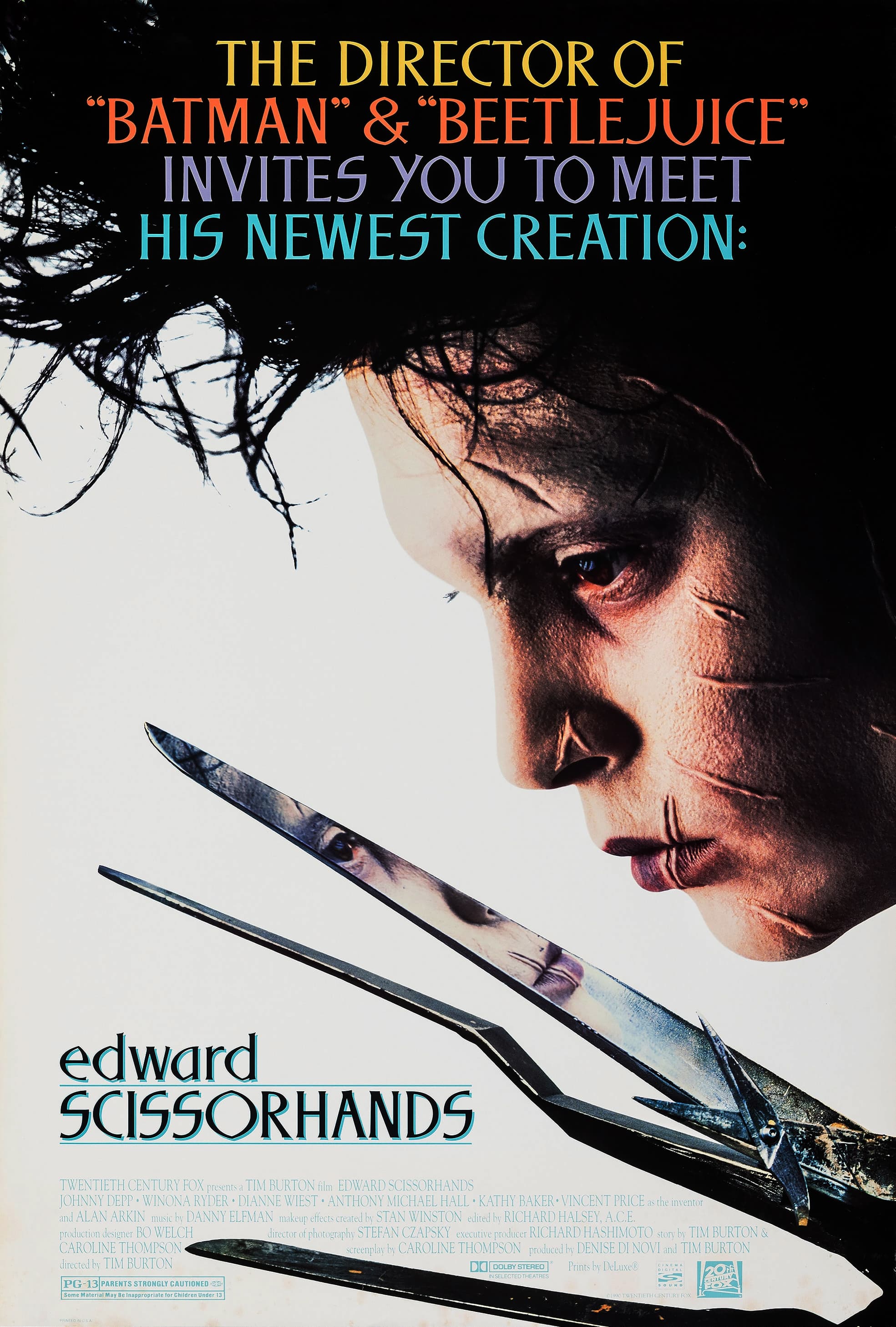
Edward Scissorhands
A fairy tale about a man who can’t quite touch the world — and the neighbourhood that can’t quite handle him.
1990 // VHS
Total Recall
Memory, muscle and a very faulty holiday package — with Mars on the itinerary.
1990 // VHS
Tremors
Handymen, Graboids and small‑town stubbornness — Tremors is a monster movie with a practical heart.