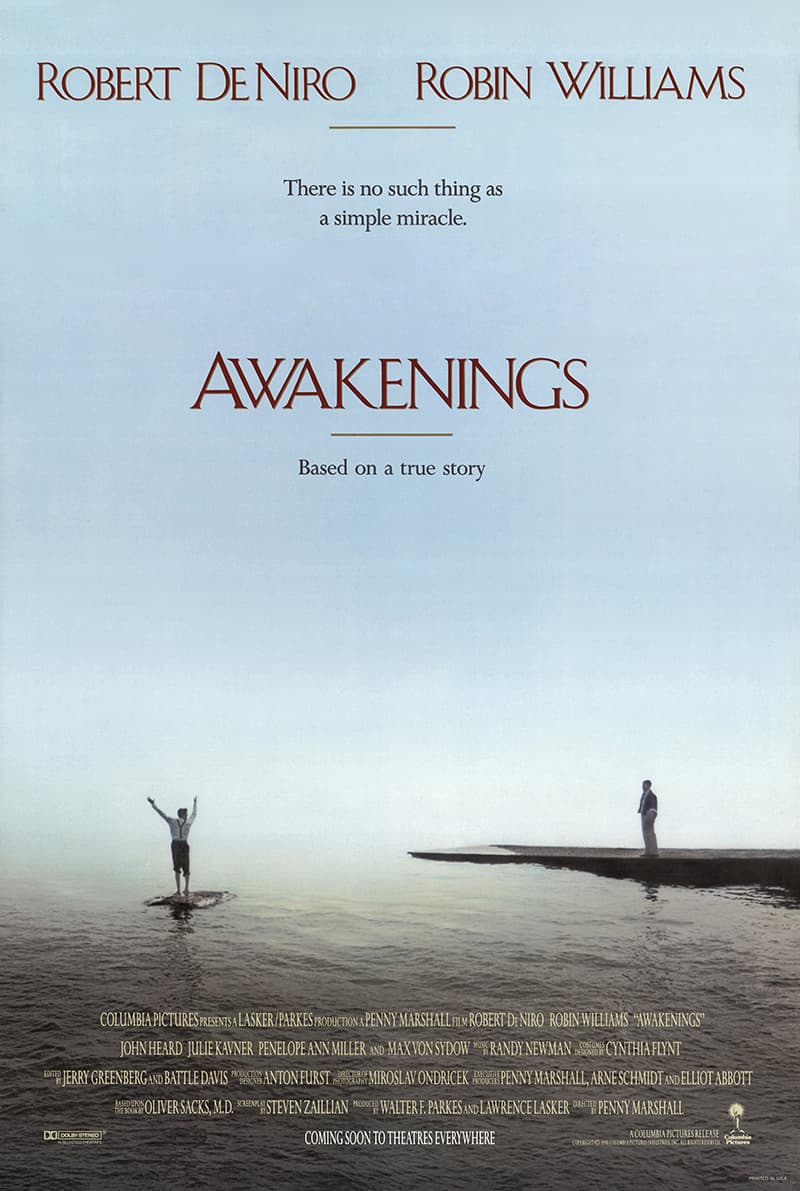
Awakenings
A true bedside melodrama: tenderness, difficult choices and one unforgettable patient.
// The setup
PLAYBACK STARTED
Awakenings still moves people because it keeps returning to one simple, stubborn fact: a human being waking up matters. Penny Marshall takes Oliver Sacks’s clinical case notes and turns them into a drama about what it feels like when life is returned — briefly — to someone who had been lost to the world. At its heart are two figures: Dr Malcolm Sayer, the quiet doctor who insists on care as curiosity, and Leonard Lowe, the patient whose return to speech and movement becomes everyone’s test.
THE MOVIE
Leonard Lowe is still the reason this movie works
Awakenings begins with a clinical problem — chronic catatonia among survivors of an encephalitis epidemic — and quietly grows into a question of what any of us owe one another when a life is at stake. That clinical spine comes from Oliver Sacks’s real case histories, and Penny Marshall adapts that material into a human drama rather than a medical lecture.
Robin Williams’s Dr Malcolm Sayer is not a flashy discoverer; he’s an introverted, curious neurologist whose bedside instincts and compassion push him to try an experimental treatment. The film sets up the experiment and then, patiently, shows the consequences when patients like Leonard Lowe start responding.
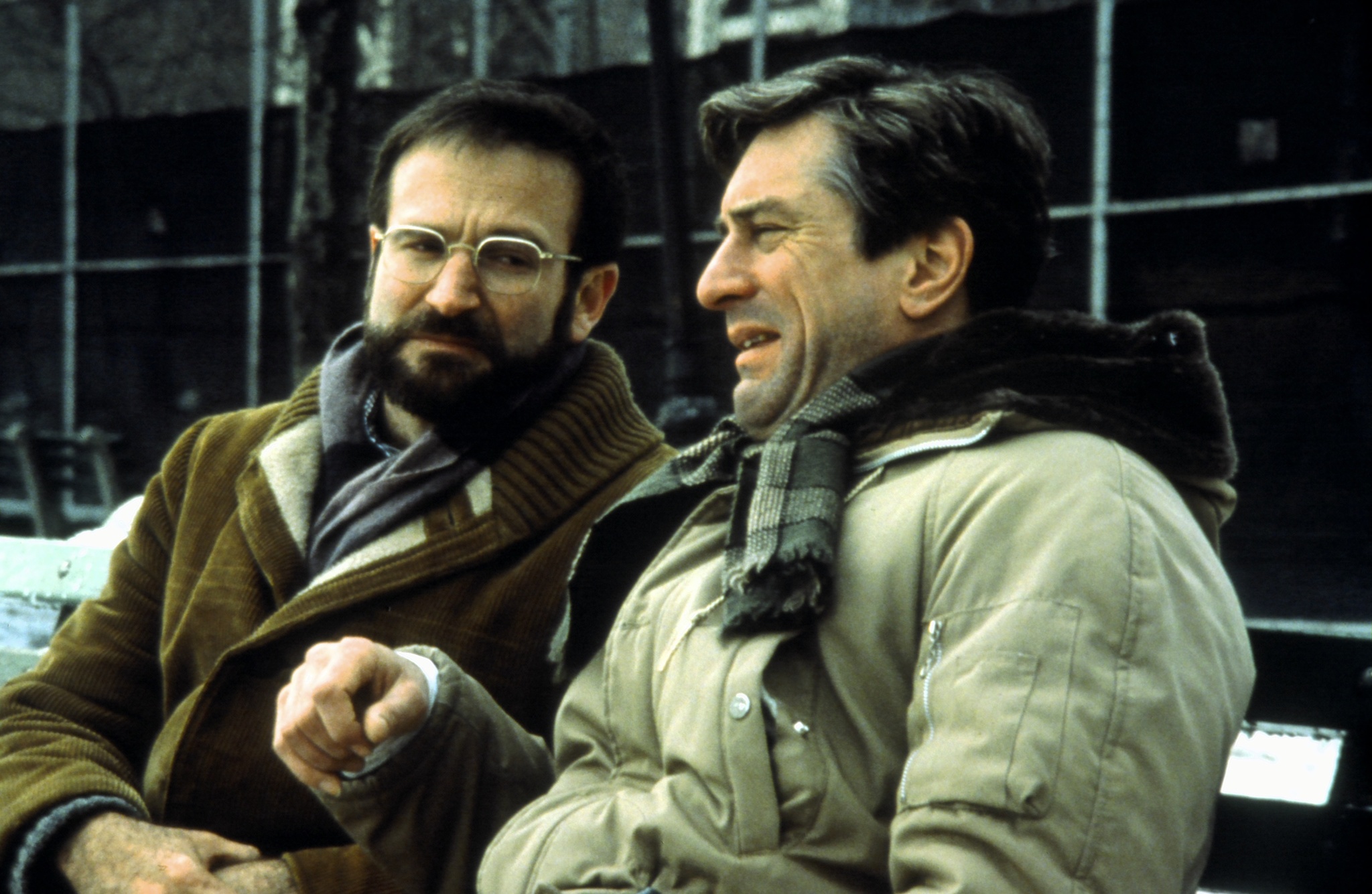
Robert De Niro is Leonard Lowe, the film’s focal patient, and much of Awakenings’ emotional weight hangs from his regained mobility and personality. For a 121-minute drama released at the end of 1990, that concentration on one patient’s return to life — and the ripple effects it causes — is the film’s clearest reason to be revisited.
THE SETUP
The idea that sets Awakenings in motion
The film’s engine is straightforward: an introverted neurologist encounters a ward of long-term catatonic patients and decides to try an experimental treatment. That premise — a treatment producing sudden ‘awakenings’ — is the plot’s starting pistol, but the movie is less interested in medical spectacle than in what those awakenings demand of everyone involved.
Practically, the story uses sensory cues — music, touch, familiar prompts — to test whether patients respond. Those small bedside techniques are the scaffolding for a clinical trial that begins with one patient and then expands, drawing in staff, donors and hospital administrators as the stakes rise.
The central conflict arrives when the newly awakened must face a world that moved on without them. Personal relationships and social realities have changed, and the film forces viewers to sit with the ethical questions: what are the risks of intervention, and who pays for hope when it might not last?
That tension — experimental success on one hand and fragile sustainability on the other — is why the premise works. It turns a medical case study into a drama about reintegration and the price of trying to restore a life.
THE CHARACTER
Why Leonard Lowe matters
Leonard Lowe isn’t just another patient on a ward; he’s the film’s fulcrum. When Leonard regains movement and speech, those changes supply the narrative and emotional momentum that push the story forward and make other characters react — and change.
His relationships shape the movie’s moral geometry. The bond between Leonard and Malcolm becomes a kind of mentor–confidant relationship; Leonard’s dependence on his mother forces the film to confront family obligations; and Sayer’s interactions with hospital staff and donors spotlight the tension between care and institutional pressures.
Because the drama privileges Leonard’s return as the visible proof the experiment might work, his experience magnifies every ethical question the film wants to ask. He is the hinge on which the film swings from clinical curiosity to human consequence.
That centrality is recognised by the film’s awards attention: Leonard’s arc is the performance and story that most of the film revolves around.
THE PERFORMANCE
Why Robert De Niro's performance matters
Contemporary critics made a point of noting the film’s two central turns: Robin Williams unusually restrained as Dr Sayer, and Robert De Niro as the man rediscovering life after decades of immobility. That company of contrasts is part of what gives the movie its emotional clarity.
De Niro’s Leonard is the anchor; the film asks us to watch him relearn simple things and to feel, through that relearning, how sudden recovery can look miraculous and fragile at once. When the camera lingers on Leonard, the story tightens and the stakes feel immediate.
Importantly, reviewers singled out both leads as central strengths of the film at the time of release. That contemporary response shaped how audiences received Awakenings: as a performance-driven drama rather than a dry medical procedural.
So even if you come for the medical premise, you stay because the actors turn the clinical material into people you care about.
UNDER THE SURFACE
Awakenings has more on its mind than the plot suggests
At face value the film charts a medical experiment. Beneath the surface, it’s fixated on empathy — the small, determined acts of presence that a doctor or nurse offers at a bedside. Those gestures are presented as a force almost as decisive as any drug.
It’s also a film about limits. The treatments produce dramatic improvements, but the movie is honest about fragility: recovery can be temporary, and progress is never guaranteed to hold. That uncertainty keeps the viewer off-balance in all the right ways.
Identity and reintegration are threaded through the awakenings. Patients who return must confront relationships, memories and a social world that has moved on, which raises quiet questions about who we become when memory and movement come back to us.
Put together, those themes make Awakenings less a case study and more a conversation about what recovery costs, what it restores, and how human connection makes medical care something more than technique.
THE FILMMAKING
How Awakenings was put together
Penny Marshall’s direction keeps the camera close to people rather than procedures. The cinematographer’s approach favours controlled interiors and intimate close-ups that foreground patient responsiveness, which helps the drama feel like a series of lived moments.
That choice matters: by limiting spectacle and emphasising faces and small gestures, the film turns clinical scenes into human encounters. We watch doctors and nurses listen, touch, play music and wait — and those quiet actions become the filmmaking beats.
The result is a film that feels carefully assembled around its actors and their interactions. The visual restraint gives larger emotional beats room to breathe.
So while Awakenings is about a medical discovery, its filmmaking repeatedly invites you to stay with people rather than with procedures.
PRACTICAL EFFECTS
The effects work that gives Awakenings its physical personality
Awakenings relied on location work to feel lived-in: production used two floors of the working Kingsboro Psychiatric Center, putting many of the film’s practical departments on site. That decision gives some sequences a grounded, tactile quality because the crew were literally working where the story takes place.
Having hair, makeup and set departments operating in the same building as the scenes being shot can tighten the sense of place. It’s a practical choice that pays off in the movie’s physical presence.
The production records also record a blunt on-set moment: during filming Robin Williams accidentally broke Robert De Niro’s nose. It’s the kind of odd, human production anecdote that reminds you these are people making difficult emotional work, not a polished apparatus running itself.
Those bits of practical reality — locations, on-site departments, the occasional unintended knock — all help the film keep its focus on the human material rather than on studio gloss.
PURE 80S
Awakenings could not belong to any other decade
Awakenings sits at an interesting moment: producers Walter F. Parkes and Lawrence Lasker first optioned Oliver Sacks’s book in the early 1980s and carried the project through most of that decade, finally releasing it at the tail end of 1990. That gestation gives the film something of an 80s-to-90s sensibility — mature studio drama with an up-to-date awards-season polish.
The journey from optioning in the early 80s to release in 1990 also helps explain why Penny Marshall, known for her earlier work, chose to steer a medically grounded, actor-led drama at that point in her career. It’s a film that reflects a studio willingness to back intimate, serious stories at scale.
So while Awakenings is a 1990 release, its roots and development tie it to the previous decade’s production realities and ambitions, making it feel like a bridge between two eras of mainstream filmmaking.
THE LEGACY
Why Awakenings still matters
Awakenings was recognised by the industry: it earned three Academy Award nominations, including Best Picture and a Best Actor nod for Robert De Niro. That attention confirmed the film’s status as more than a modest medical drama.
The film also performed substantially above its production budget worldwide and is commonly mentioned among Penny Marshall’s dramatic films alongside Big and A League of Their Own. It sits, therefore, in the director’s catalogue as an earnest attempt at serious storytelling.
Steven Zaillian’s screenplay is another piece of the legacy. His adaptation of Oliver Sacks’s book helped him build a reputation for handling weighty material, which fed into his further recognition later in the decade.
Between awards attention, box-office success relative to budget, and its place in Marshall’s filmography, Awakenings endures as a film people return to when they want a humane, performance-driven drama about recovery and its costs.
THE VERDICT
Does Awakenings still hold up?
Yes — but with a small, important caveat. Awakenings works now when you want a film that foregrounds people over procedure: a true clinical episode becomes a drama about what it is to be noticed, remembered and helped back into a world that has moved on. That central premise — a doctor trying L‑DOPA and producing a first major awakening in Leonard Lowe — remains the film’s most powerful engine.
The film’s strengths are clear in its construction. Leonard’s regained mobility provides the emotional fulcrum that forces other characters to confront ethical dilemmas about risk, sustainability and responsibility. Those conflicts still read as honest and affecting because they come from the patient’s experience rather than from abstract debate.
There’s also the matter of preparation and reception. Oliver Sacks served as a consultant and observed that De Niro studied real awakening footage; contemporary critics singled out both De Niro and Williams as central strengths. That combination of careful grounding and performance focus gives the drama credibility and keeps the emotional beats honest.
If you’re after a medical thriller, this isn’t it. If you want a quietly moving, performance-led film about empathy, identity and the fragility of recovery — and you don’t mind a story that refuses easy triumph — Awakenings is still worth your time.
Share this movie
// Keep watching
More movies from the 90s
If Awakenings is your kind of movie, there's plenty more on the shelves worth rewinding.

1990 // VHS
Edward Scissorhands
A fairy tale about a man who can’t quite touch the world — and the neighbourhood that can’t quite handle him.
1990 // VHS
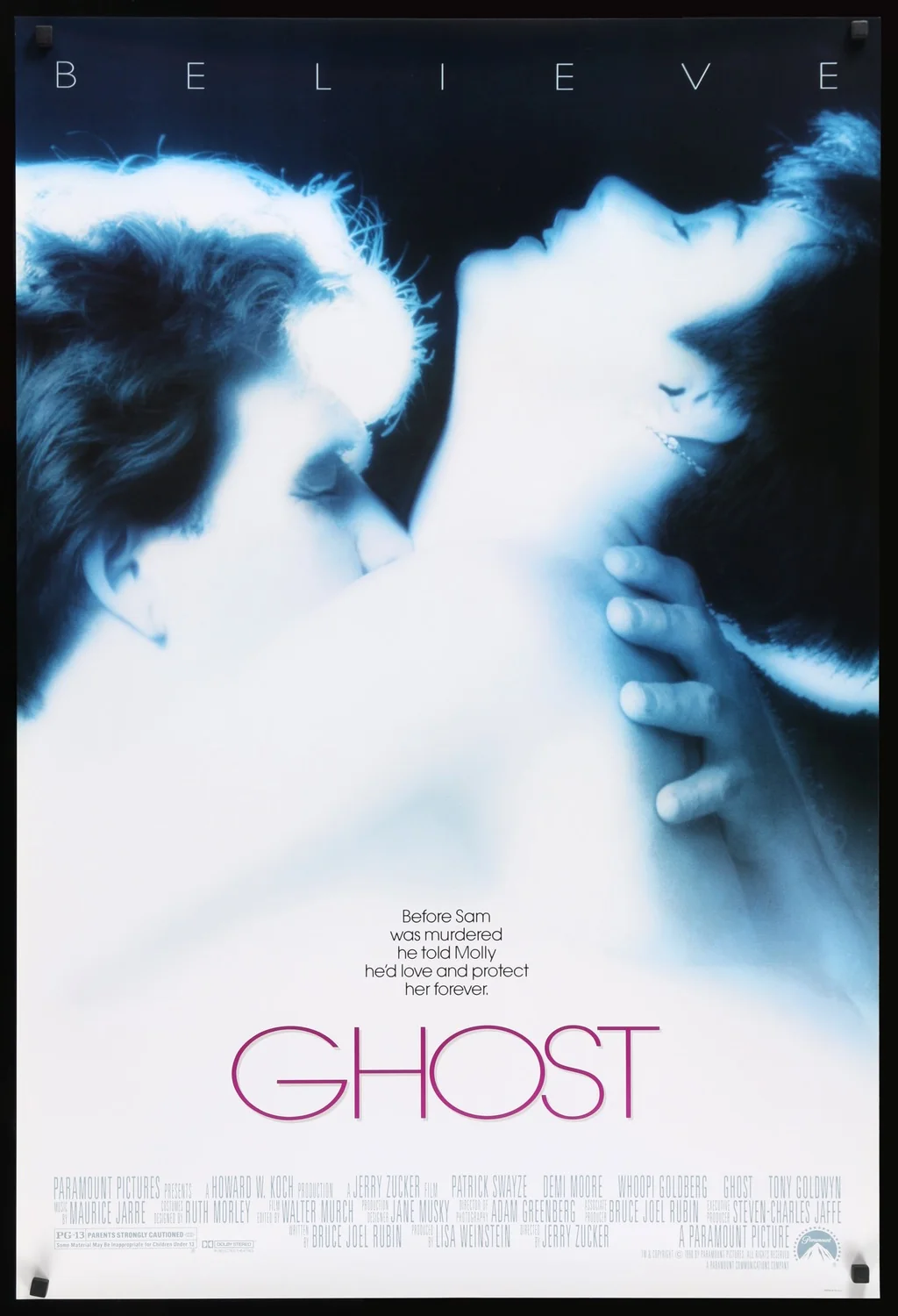
Ghost
A murder mystery disguised as a love story — with a man who won’t stop watching over the person he loves.

1990 // VHS
Total Recall
Memory, muscle and a very faulty holiday package — with Mars on the itinerary.