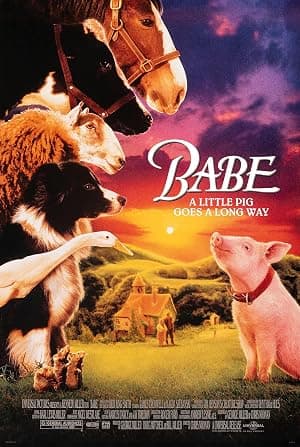
Babe
A polite pig, a taciturn farmer and a farm that won't fit the rules — and somehow it all feels perfectly sensible.
// The setup
PLAYBACK STARTED
Remember the moment a small pig refuses to be only what everyone expects? Babe still finds that warm, slightly absurd place where children’s-book logic meets grown-up emotional honesty. Revisit Chris Noonan’s 1995 family fable and you’ll see why its gentleness — and a very determined pig — keep the film from feeling dated.
THE MOVIE
Babe (voice) is still the reason this movie works
You could describe Babe as a talking-animal family film and be absolutely right. But that description misses the quieter trick: the entire film is organised around one polite piglet who asks questions rather than demands answers.
The story begins with a runt piglet won at a county fair and taken to live on Farmer Hoggett’s place. He bonds with Fly, a motherly border collie, and — against every expectation of farm life — learns to herd sheep. That odd little premise gives the whole film its emotional engine.
Chris Noonan directs this 1995 family comedy-drama with a clear sympathy for its source material, and Christine Cavanaugh provides the voice for the pig who carries the story. The result is an unshowy 92-minute picture that makes belonging and identity feel like everyday business rather than grand pronouncements; it’s quietly persuasive.
THE SETUP
The idea that sets Babe in motion
Babe is told like a storybook — the film even breaks into named chapters — which keeps things simple and friendly without feeling childish. That structure lets the movie move from gentle domestic moments to bigger set-pieces without losing its tone.
At its engine is a straightforward conceit: animals communicate in ways the audience understands, which turns routine farm chores into scenes with stakes and personality. Once the film agrees to that premise, everything else follows naturally.
The central mechanics are tidy: a pig raised among other animals learns to herd sheep, this upsets the farm’s established order, and the narrative builds toward a herding competition where the pig’s unusual talents are publicly tested.
It works because the stakes are small but clear. The film asks whether a creature defined as ‘other’ can find a place by being useful in an unexpected way — and whether compassion can rewrite the rules of a community.
THE CHARACTER
Why Babe (voice) matters
In a family film adapted from a children’s book, the titular figure has to be more than cute — he needs to be someone an audience can follow without getting bored. That’s the job Babe is written to do.
Christine Cavanaugh provides the voice for Babe, so the pig’s personality arrives as a clear through-line for the whole movie: this is the character the plot swivels around and the other animals react to.
Because the film is squarely in the family lane, Babe’s role is deliberately accessible. He’s the focal point for themes of belonging and identity, written to carry the story’s warmth so that both younger viewers and adults can take something from it.
Put simply: Babe matters because the film gives its central figure room to ask questions and to change the farm by doing so — and everything else revolves around him.
THE PERFORMANCE
Why James Cromwell's performance matters
The production chose to give the farmer a quiet centre rather than a loud foil, and that decision paid off in recognition: James Cromwell earned an Academy Award nomination for his role as Arthur 'Farmer' Hoggett.
That nomination is a neat, practical piece of evidence: the industry singled out the human anchor in a film otherwise full of talking animals, which suggests his presence helped make the story believable.
Within the film’s economy, the farmer’s restraint does important work. He’s the steady hand who allows the pig’s oddness to become the plot’s turning point, and that stability gives the final public vindication real emotional weight.
So while the pig gets the headlines, the farmer is the quiet reason the audience can care when the rules of the farm are challenged.
UNDER THE SURFACE
Babe has more on its mind than the plot suggests
On the surface Babe is a small comic drama about a pig who discovers an odd talent. Beneath that, it’s quietly committed to questions of belonging and identity: how someone labelled ‘other’ might find a place through unexpected skills and simple decency.
Compassion runs through the film as a moral choice. The story favours humane treatment and rejects the idea that creatures should be valued only for their utility — which gives the film a conscience that never turns preachy.
There’s also a gentle interrogation of social roles. The farm’s order depends on everyone sticking to their job, and Babe’s presence shows how those rules can be unsettled — often for the better.
Because the film trusts these ideas rather than lecturing about them, they feel lived-in: belonging is earned through small acts, and identity is something the characters negotiate rather than announce.
THE FILMMAKING
How Babe was put together
Babe’s look and rhythm are very deliberate: the production leaned into a storybook aesthetic. That choice isn’t just decorative — it helps the audience accept the film’s premise without fuss.
Andrew Lesnie served as director of photography and Roger Ford as production designer, which gave the film a consistent visual personality suited to its source material.
The editing (credited to Marcus D'Arcy and Jay Friedkin) and the chaptered structure, complete with iris-like transitions and other silent-era devices, keep the film moving like a book being turned; that helps the film balance quiet character moments with broader comic set-pieces.
In short, the filmmaking choices are tailored to the story’s tone: simple storytelling techniques that give the fable a charming, measured pulse.
PRACTICAL EFFECTS
The effects work that gives Babe its physical personality
Babe’s talking animals were achieved through a mix of well-trained live animals, animatronics and digital assistance — a pragmatic blend rather than spectacle for spectacle’s sake.
Jim Henson’s Creature Shop and specialist teams produced animatronic doubles used during close-ups, which let the filmmakers get the facial moments they needed without endangering animal performers.
Digital visual-effects houses such as Rhythm & Hues were brought in to subtly alter and re-project muzzle and mouth movements so the animals could appear to speak, combined with traditional compositing methods.
Dangerous or violent sequences were handled with animatronics and careful editing, and the production was monitored by the American Humane Society — a reminder the film prioritised animal safety while still delivering convincing on-screen behaviour.
PURE 80S
Babe could not belong to any other decade
Babe arrived in a mid-1990s marketplace that still had room for smaller, character-driven family films produced outside the giant studio tentpoles. It bears the fingerprints of that moment: modest ambitions, careful craft and a feel for broad family audiences.
Produced by Kennedy Miller (George Miller’s company), the film represents a kind of independent-minded family picture that could still find mainstream attention in 1995.
Its Academy Award recognition — particularly the win for Best Visual Effects and multiple nominations — underscored a changing attitude: effects work in family films could be both tasteful and award-worthy in the mid-90s.
So while Babe wears the sensibilities of a children’s book adaptation, it also belongs to a decade when technical craft and modest storytelling could happily co-exist on the same bill.
WATCHING IT NOW
What has aged — and what hasn't
If you watch Babe today, its storybook tone and visual design are the first things that stand out — and those are the features most frequently noted in later reappraisals. The film wears its warmth openly, and that sincerity still lands.
As a family film, it keeps things clean and focused: stakes are personal rather than cynical, which helps the emotional beats remain straightforward and affecting for new viewers.
Themes of belonging and identity — a creature finding a place through empathy and skill — remain easy to recommend to families: they’re simple messages told without heavy-handedness.
Put simply: the film’s tone and moral centre are what carry it today. Those are the elements critics and audiences return to when they find themselves enjoying Babe a second time.
THE LEGACY
Why Babe still matters
There are practical reasons this film remains part of the conversation: it received seven Academy Award nominations and won for Best Visual Effects, and James Cromwell earned a nod for his supporting turn.
Beyond trophies, Babe continues to be mentioned in discussions about early, effective combinations of practical creature work and digital enhancement — a hybrid approach that helped the animals feel real while allowing them to ‘speak’ on screen.
The film has also found its way into retrospective lists and institutional recognitions that celebrate cinema’s crowd-pleasing, feel-good moments; those placements keep it visible in the cultural memory.
All of this means Babe endures not as a blockbuster artefact but as an example of careful family filmmaking where technical ingenuity and quiet storytelling met at the gate.
THE VERDICT
Does Babe still hold up?
Yes — Babe still works. The simple bones of the film remain persuasive: a runt piglet taken in by Farmer Hoggett, taught by Fly the border collie, who then learns to herd sheep and upends expectations. That premise is small, clear and oddly stubborn.
The film’s storybook structure and chaptered pacing keep the tone steady, and the decision to treat animal communication as intelligible to the audience lets emotional moments land without fuss. Babe (voiced by Christine Cavanaugh) stays the steady heart throughout.
The supporting architecture matters too: a taciturn, practical farmer whose compassion proves pivotal, a maternal mentor in Fly, and an antagonistic dog in Rex who makes the community’s resistance feel real — those relationships give the finale its meaning.
If you want a family film that combines gentle moral logic with clever technical work (trained animals, animatronics and subtle digital effects), Babe still delivers. It’s not grand, but it is sincere — and sometimes that’s the best kind of stubborn.
Share this movie
// Keep watching
More movies from the 90s
If Babe is your kind of movie, there's plenty more on the shelves worth rewinding.
1995 // VHS
Toy Story
A pull‑string cowboy, a deluded space ranger and a small, very particular war over being loved.
1999 // VHS
10 Things I Hate About You
Sibling rules, a rooftop serenade and one very stubborn Kat — Shakespeare in a school corridor.
1999 // VHS
American Beauty
Lester Burnham, suburban rot and a midlife argument that still stings.