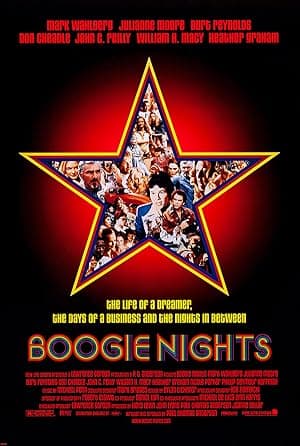
Boogie Nights
A glittering rise, a ragged fall — and a dishwasher who becomes the film's electric centre.
// The setup
PLAYBACK STARTED
Boogie Nights still feels like a party you stumble into and can’t leave. Paul Thomas Anderson’s big-hearted, messy ensemble makes the San Fernando Valley sex industry feel like its own orbit, and Eddie Adams — reborn as Dirk Diggler — is the magnetic person you watch because everything else happens around him.
THE MOVIE
Eddie Adams / Dirk Diggler is still the reason this movie works
People still talk about Boogie Nights because it gives you a door into a world and then hands that door to a specific, irresistible character. Eddie Adams — the dishwasher who’s found by Jack Horner and remade as Dirk Diggler — is the movie’s human hinge: he’s the one through whom we enter the household, the business and the loyalties that bind them.
That entrance itself is staged like a show: the opening nightclub sequence throws the principal players together in a single, kinetic beat and hands Eddie over to Jack Horner’s care. From there the film becomes less about a single plot and more about how a community rearranges itself around new talent, ambition and the desire for legitimacy.
Paul Thomas Anderson directs all of this with a clear appetite for ensemble dynamics — a period drama that runs long enough to luxuriate in characters and consequences (the film runs for 155 minutes) and to let its themes — found family, rise and fall, commodified performance — land with some weight.
THE SETUP
The idea that sets Boogie Nights in motion
At its simplest, Boogie Nights follows Eddie Adams, a dishwasher in the San Fernando Valley who’s scooped up by porn director–producer Jack Horner and reborn as Dirk Diggler. That discovery is the engine — an outsider becomes a star and the group rearranges around him.
But Anderson refuses a straight single-protagonist telling. Instead the film uses an ensemble structure to keep redirecting attention: the Dirk story is central, yet it shares space with other performers, crew and hangers-on. That crowded approach makes the film feel lived-in rather than theatrical.
Structurally, Boogie Nights leans on montage-driven career sequences and time jumps to register industry change. Those mechanics let the screenplay sketch long stretches of rise and decline without getting bogged down in day-to-day detail.
There’s a tonal gearshift midway through — the early euphoric ascent moves toward darker decline — and those editing choices turn the film’s momentum into a kind of inevitability: success and collapse feel like two sides of the same machine.
THE CHARACTER
Why Eddie Adams / Dirk Diggler matters
Eddie is the key because he’s the audience’s way in. Mark Wahlberg’s Eddie Adams becomes Dirk Diggler and in that transformation the film finds its dramatic motor: someone newly lifted from obscurity, eager for acceptance and dazzling the people around him.
In an ensemble this matters: rather than flattening the crowd into background, Eddie’s arrival reshuffles social hierarchies inside Jack Horner’s circle. He’s a lodestar for the group’s hopes and anxieties — the person who makes the household rearrange itself.
The film’s found-family theme gives Eddie more than a career arc; it gives him relationships that are genuinely reciprocal. He isn’t just a commodity to be exploited, at least at first — he’s someone who fits into a makeshift, protective domesticity.
Seen as part of a bigger mapping of characters, Eddie works because he lets the ensemble show its colours. He’s both central and porous: the movie moves through him, but he also absorbs the film’s social dynamics.
THE PERFORMANCE
Why Burt Reynolds's performance matters
Burt Reynolds’s Jack Horner occupies the paternal seat in the household: a producer–impresario trying to keep some dignity in an industry that wants spectacle. Contemporary observers noticed that the role sat well with Reynolds’ strengths.
Roger Ebert singled out the ensemble and described Reynolds’ Jack Horner as one of his stronger screen turns in years, which is useful evidence when weighing how the role functions in the film’s network of relationships.
Industry recognition followed: awards campaigns and attention led to an Academy Award nomination for Reynolds in the supporting-actor category, confirming that his portrayal registered beyond just publicity headlines.
All of which matters because Jack Horner isn’t merely a plot device. The part of the film that cares about legitimacy, mentorship and the cost of being a pater familias in a precarious business rests on the credibility of that role — something contemporary coverage clearly picked up on.
UNDER THE SURFACE
Boogie Nights has more on its mind than the plot suggests
On the surface it’s about stardom in an unlikely place. Underneath it’s quietly, insistently about how sex becomes a commodity — performance turned into product, packaged and sold as the market shifts.
That commodification sits beside a found-family story: the performers and crew form a household where belonging and dependency often replace traditional support structures. The film cares about how those bonds are tested when money and fame enter the room.
There’s also a rise-and-fall current that’s unavoidable: success amplifies personality traits already present, and the same industry that builds a star can also discard them when tastes change.
Finally, the screenplay keeps nudging at identity and performance. People in the movie perform for pay and also perform to be accepted; those two acts bleed into one another, especially as technology and distribution alter what the business values.
THE FILMMAKING
How Boogie Nights was put together
Boogie Nights is a craft-forward ensemble piece, and the credits tell you why it holds together: Robert Elswit on cinematography, Dylan Tichenor editing and music by Michael Penn all shape the film’s rhythm and atmosphere.
Those three departments are the scaffolding for Anderson’s appetite: cinematography and editing carry the montages and time jumps that let the film sweep across years, while the music choices help stitch disparate moods into a single experience.
Saying the names doesn’t explain everything, but it does point to a deliberate technical collaboration. The film’s energy depends as much on how scenes are cut and scored as on what happens inside them.
Put simply: Boogie Nights feels like a movie made by people who know which levers to pull to move an ensemble — and those levers are named in the credits.
PURE 80S
Boogie Nights could not belong to any other decade
Although released in 1997, the story is rooted in the late 1970s and early 1980s and is centred on the porn industry’s seismic shift as home video takes over. That specific technological change is baked into the plot and the characters’ fates.
The fact that this period story arrived with substantial studio backing from New Line in the late 1990s matters: Boogie Nights sits among the era’s independent–studio hybrids and announced Paul Thomas Anderson as a director with commercial and critical ambitions.
Critics also drew comparisons between Anderson’s multi-thread ensemble and the large-scale industry maps of earlier cinema — a lineage that frames the film as part of a continuing American tradition of ensemble storytelling.
So it’s a 1997 film that’s simultaneously a period piece and a product of its decade — a young filmmaker making a sprawling, adult-centred ensemble with enough polish to reach wider audiences.
WATCHING IT NOW
What has aged — and what hasn't
Some core elements of Boogie Nights age gracefully because they’re structural, not decorative. The found-family angle still rings true: the way people lean on one another in precarious work feels immediate and recognisable.
The ensemble mapping of multiple characters across an industry also holds up. The screenplay’s willingness to track different lives through time jumps and montages gives the film a generous, panoramic feel that rewards patient viewers.
The specific industry shift the film foregrounds — the arrival of home video and the destabilising effects of drugs and changing markets — still reads as a clear narrative force. That arc explains why success turns brittle and why characters’ loyalties restructure as the business changes.
Taken together, those elements mean the movie’s dramatic architecture still communicates: the relationships and the industrial pressures that shape them remain legible to modern audiences.
THE LEGACY
Why Boogie Nights still matters
Part of the film’s afterlife comes from its awards-era visibility: Boogie Nights earned three Academy Award nominations, including recognition for screenplay, supporting actor and supporting actress.
More than trophies, the movie mattered because it established Paul Thomas Anderson as a high-profile filmmaker — a commercial and critical breakthrough that opened conversations about his ambitions and scale.
Discussions of 1990s ensemble filmmaking also keep returning to Boogie Nights: its casting and formal bravura are frequently referenced when people talk about how American cinema handled large casts at the end of the century.
Finally, the film remains a reference point because it combines an industry portrait with a human household: Eddie, Jack, Amber and Reed Rothchild anchor a story that’s both about show business and about people trying to belong.
THE VERDICT
Does Boogie Nights still hold up?
Yes — but with a small rider. If you want a film that stages a rise-and-fall within an industry and makes a found family feel palpably real, Boogie Nights still delivers. The story that begins when a dishwasher is discovered and remade as Dirk Diggler remains a compelling spine for the ensemble.
The opening nightclub sequence still works as an inciting moment: it throws everyone together and hands Eddie over to Jack Horner’s orbit in a way that reads immediately and cheaply — which is to say, effectively. From there the film’s montage-driven career passages, time jumps and the mid-film tonal gearshift keep the narrative propulsive across its 155-minute running time.
The movie’s themes — commodification of sex, technology-driven industry change and identity as performance — remain clear and relevant. Eddie’s arc is the focal point: the film ties his ascent to traits that make him a star and to the insecurities that set him up for decline, so the emotional through-line feels inevitable rather than arbitrary.
Ultimately, Boogie Nights is worth watching today as both a period piece and an ensemble drama that announces a young director with a big appetite. It still dazzles when it needs to, and it still hurts when the party falls apart — which, for this movie, is exactly the point.
Share this movie
// Keep watching
More movies from the 90s
If Boogie Nights is your kind of movie, there's plenty more on the shelves worth rewinding.
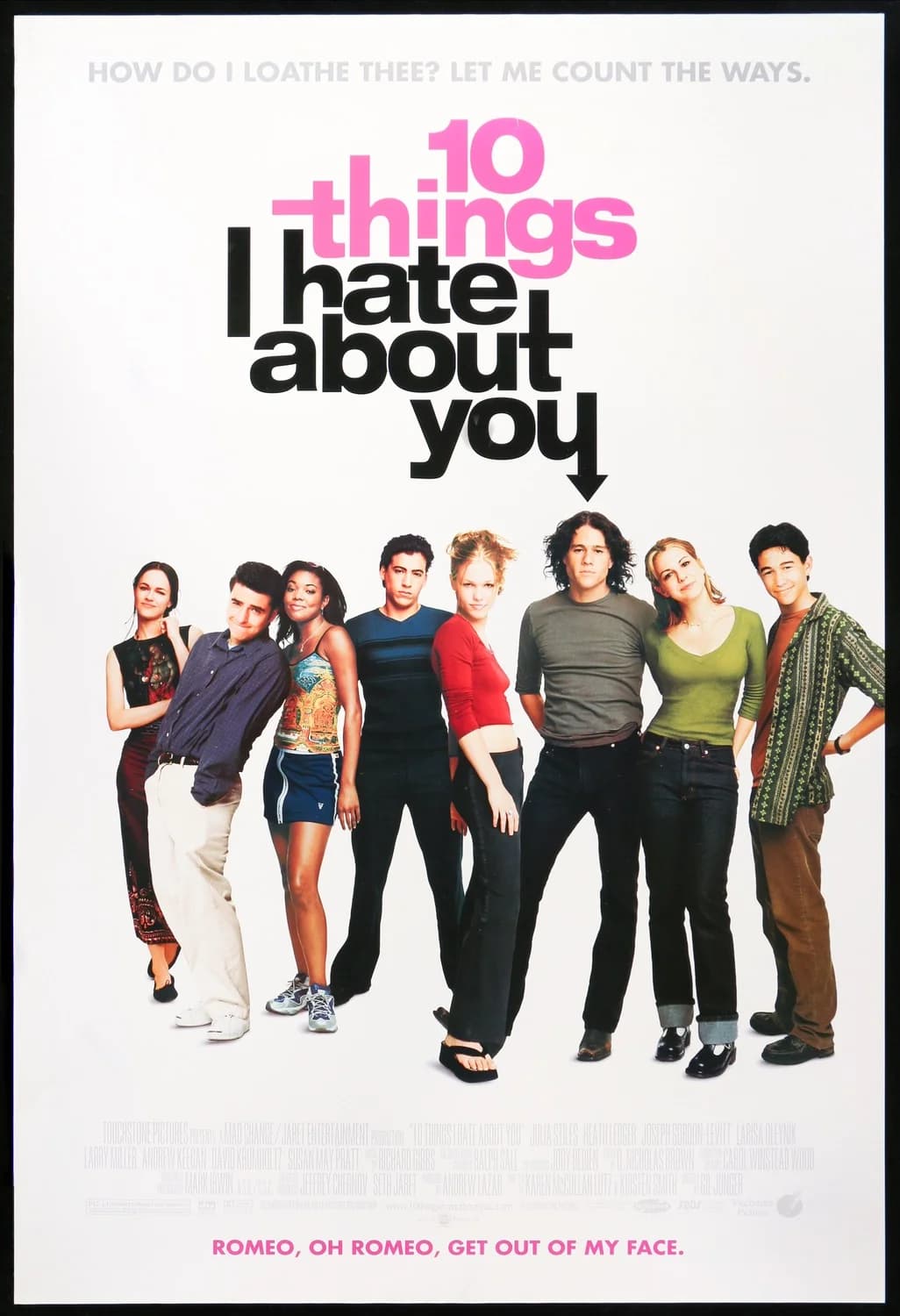
1999 // VHS
10 Things I Hate About You
Sibling rules, a rooftop serenade and one very stubborn Kat — Shakespeare in a school corridor.
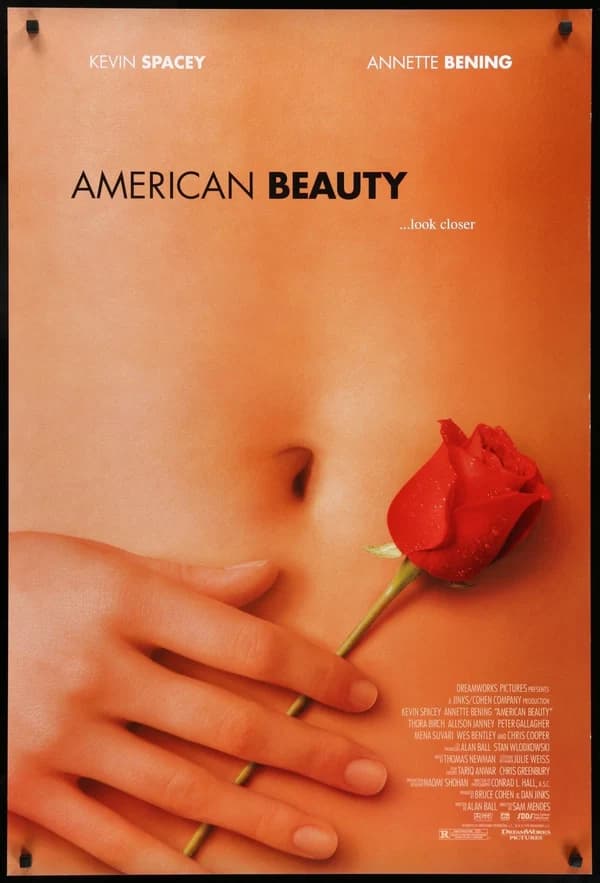
1999 // VHS
American Beauty
Lester Burnham, suburban rot and a midlife argument that still stings.
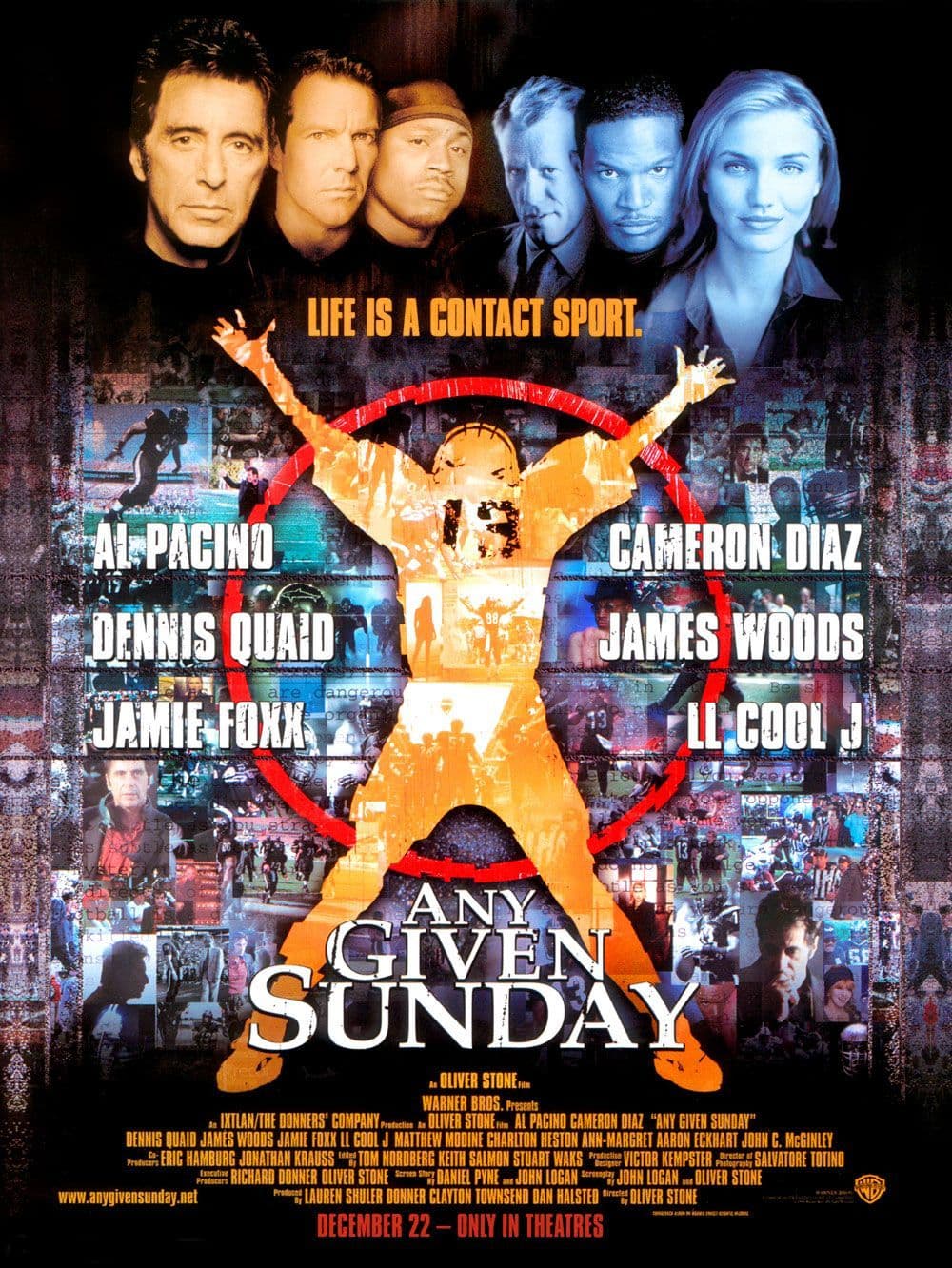
1999 // VHS
Any Given Sunday
Al Pacino's coach anchors the chaos of a film about football turned into product — loud, messy and oddly persuasive.