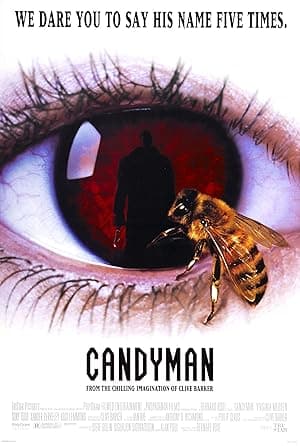
Candyman
A mirror ritual, a housing project and a scholar who asks one question too many.
// The setup
PLAYBACK STARTED
Candyman still lands because it trusts one central choice: make the curious woman the engine of the horror. Helen Lyle’s investigations turn a story into something dangerous, and that knot—research colliding with myth, and myth colliding with a bruised history—keeps the film sharp in ways a simple jump-scare movie never could. Revisit it for the idea as much as for the sting.
THE MOVIE
Helen Lyle is still the reason this movie works
You can describe Candyman in lots of efficient ways — mirror ritual, hook-handed revenant, bees — but none of that gets beneath the skin the way its central decision does: the movie makes a grad student named Helen Lyle the person who brings the myth back to life. Her research into urban legends pushes her into Cabrini-Green and into the specific local tale of Candyman.
That setup matters because the film stages belief as an active thing. Helen doesn’t stumble on a ghost; she investigates a story, asks questions about it and, by doing so in public, becomes part of the very circulation that gives the legend power. Her repeated probing is what catalyses the revenant’s reappearance and the chain of violent events that follow.
All of it sits in Bernard Rose’s 1992 picture, played out over a tight 99 minutes with Virginia Madsen as Helen and Tony Todd as the figure she studies. The combination of a forensic curiosity and a supernatural force that feeds on attention is what makes the film worth revisiting.
THE SETUP
The idea that sets Candyman in motion
At heart, Candyman is a tidy premise: an empiricist — Helen Lyle, a graduate student — goes looking into urban folklore and bumps up against something that refuses to be reduced to data. The film turns a research project into a thriller engine.
That engine is belief. The movie makes the Candyman’s existence depend, narratively, on whether people keep telling and believing the tale. This turns gossip into a weapon: say his name in front of a mirror and something answers back.
There are practical mechanics to that premise too. The mirror ritual is the obvious one, but the story also leans on the social setting — the Cabrini-Green housing project — and on the real-world consequences characters face when they drag a neighbourhood’s story into the open.
It works because the stakes are simple and human. This isn’t an abstract metaphysical argument so much as a small set of acts — asking questions, repeating a name, making a claim in public — that have lethal consequences when placed in a particular place.
THE CHARACTER
Why Helen Lyle matters
Helen Lyle isn’t flavour text. The narrative turns on her particular mix of academic method and personal curiosity: she’s the sort of researcher who wants to prove or disprove a story, and the movie treats that need as morally complicated rather than merely admirable.
That complication is the point. Helen’s choices push her into morally ambiguous territory — she moves through vulnerable communities as an observer, and her publicising of the legend has consequences beyond her intentions.
Her husband Trevor functions as a practical yardstick: he’s the more straightforward skeptic and someone who becomes personally implicated as the story swells. That contrast helps the film measure how Helen’s professional instincts bleed into private life.
Everything centres back on Helen investigating Candyman and encountering Daniel Robitaille; she is the character through whose curiosity the myth becomes a palpable threat rather than just a creepy tale.
THE PERFORMANCE
Why Virginia Madsen's performance matters
Contemporary critics noticed that the film needed a credible centre, and Virginia Madsen’s Helen provided it. Reviews at the time singled her out as a strong-willed lead — a necessary anchor for a story that alternates between folklore and violence.
That kind of attention from reviewers matters in a film like this because the plot asks the audience to follow a character who keeps making risky intellectual choices. If the lead didn’t register as determined and believable, the narrative’s moral questions would feel academic instead of urgent.
So, whether you remember the bees or the hook, remember that the film depends on someone who can sell the story’s emotional logic: that curiosity can be brave, useful and also dangerously intrusive.
Madsen’s role is the movie’s fulcrum — critics noticed it then, and that observation still explains why Helen remains the character people talk about after the shocks have faded.
UNDER THE SURFACE
Candyman has more on its mind than the plot suggests
On the surface, Candyman is a piece of supernatural horror about a name and what happens when people say it. Underneath, it’s concerned with how stories carry real harm — how tales about a place can be another form of violence when they intersect with an already brutal history.
The film explicitly plays with racial violence and historical injustice, using the Candyman story as a revenant of that past. It doesn’t treat the horror as purely supernatural; there’s a social lineage to the menace that the movie asks us to acknowledge.
Gentrification and spatial marginalisation are part of the film’s setup too: by placing the local legend in Cabrini-Green, the narrative connects the circulation of story to the social and legal pressures on certain neighbourhoods. A tale can mark a place as dangerous and justify outside interventions.
Finally, the film makes belief itself a theme. Helen’s empirical approach bumps up against a folkloric logic: belief sustains the myth. The ethical consequences of a researcher’s intrusion into vulnerable communities become one of the film’s central tensions.
THE FILMMAKING
How Candyman was put together
Bernard Rose shepherded the project as writer-director with a compact running time and a clearly defined premise. The credits remind you that this was a crafted, collaborative piece: Anthony B. Richmond is listed as director of photography, Dan Rae as editor and Jane Ann Stewart as production designer.
Those names matter because they point to a conventional studio-grade production rather than a rough-and-ready indie — a feature with clear technical responsibilities and a team assigned to shape each element.
The result is a film that feels deliberately assembled: story, performances and technical roles all have distinct jobs to do, and the credits underline that Candyman was made with a crew aware of genre needs and of the specific social material it was handling.
That professionalism is part of why the movie still reads as purposeful rather than scattershot — the idea was clear, and the production roles reflect a game plan to realise it.
PRACTICAL EFFECTS
The effects work that gives Candyman its physical personality
Candyman’s commitment to physical detail shows up most famously in the bee sequences. The production used real honeybees, with an entomologist brought in to manage them and reduce stinging behaviour through pheromone techniques.
That commitment reached the actors: the production notes record that Tony Todd performed with bees on his person and even in his mouth during filming, and that stings did occur. The decision to work with live insects gives those scenes a tactile edge you don’t get from a purely simulated approach.
Makeup and prosthetics also played a clear part: the hook prosthesis and dental/inside-mouth protection were practical measures used on set, and the special-effects and makeup teams were credited for delivering those elements safely.
Taken together, these practical choices make the movie physically specific. The bees and prosthetics aren’t just party tricks; they’re tangible commitments to making the horror feel like something present and dangerous in the world of the film.
PURE 80S
Candyman could not belong to any other decade
Released in 1992, Candyman is of a particular moment in American conversation: early-1990s debates around inner-city public housing and the fate of projects like Cabrini-Green frame the story’s social concerns.
Putting the local legend in that environment ties the supernatural to a contemporary political reality. It means the horror can’t be read in isolation from the place the film chooses as its stage.
The film also arrives at a time when horror was increasingly comfortable wearing its ideas on its sleeve. Candyman fits the era’s move toward mainstream horror that mixed ghost stories with social commentary rather than treating scares as pure spectacle.
In short, both the choice of Cabrini-Green as setting and the thematic ambition link the film to its moment: it’s very much a product of the early 1990s, in subject and in sensibility.
THE LEGACY
Why Candyman still matters
On the simplest level, Candyman’s afterlife is visible in the fact that it generated two studio sequels in the 1990s and then returned as a direct sequel in 2021, showing the story’s capacity for continuation.
The film’s Philip Glass score and the Candyman figure themselves have kept appearing in retrospectives, festival line-ups and academic discussions — elements that help maintain a persistent cultural profile for the movie.
There’s also a preservation story: restorations and special-edition home releases with new interviews and production featurettes have helped document the film’s making and reception, keeping it available for fresh appraisal.
Taken together, the sequels, the continuing conversation around the score and the figure, and the care given to archival releases explain why Candyman remains a title people return to when talking about horror that aims to do more than frighten.
THE VERDICT
Does Candyman still hold up?
Yes — with a rider. Candyman remains worth watching because its central collision is still a provocative one: Helen Lyle’s empirical curiosity versus a folkloric force that thrives on belief. The film poses a question that’s not merely about scares but about the ethical fallout of telling certain stories.
Virginia Madsen as Helen and Tony Todd as the figure she investigates are the narrative anchors; contemporary critics noticed Madsen’s role as a strong-willed lead, and that grounded presence is what allows the premise to function. The mirror ritual and the social setting of Cabrini-Green give the film a simple, effective set of mechanics that still register.
Practical choices — including the notorious bee sequences that used live insects under expert supervision and the makeup and prosthetic protections employed on set — give the movie physical immediacy. Those elements keep the horror tactile rather than merely TV-shaped.
So watch Candyman for its idea more than for nostalgia. It keeps a clear ethical question in view: when you turn a neighbourhood’s pain into a story, who owns that story — and who pays for it? That’s a fright that doesn’t end when the lights come up.
// Featured in
More about Candyman
Share this movie
// Keep watching
More movies from the 90s
If Candyman is your kind of movie, there's plenty more on the shelves worth rewinding.
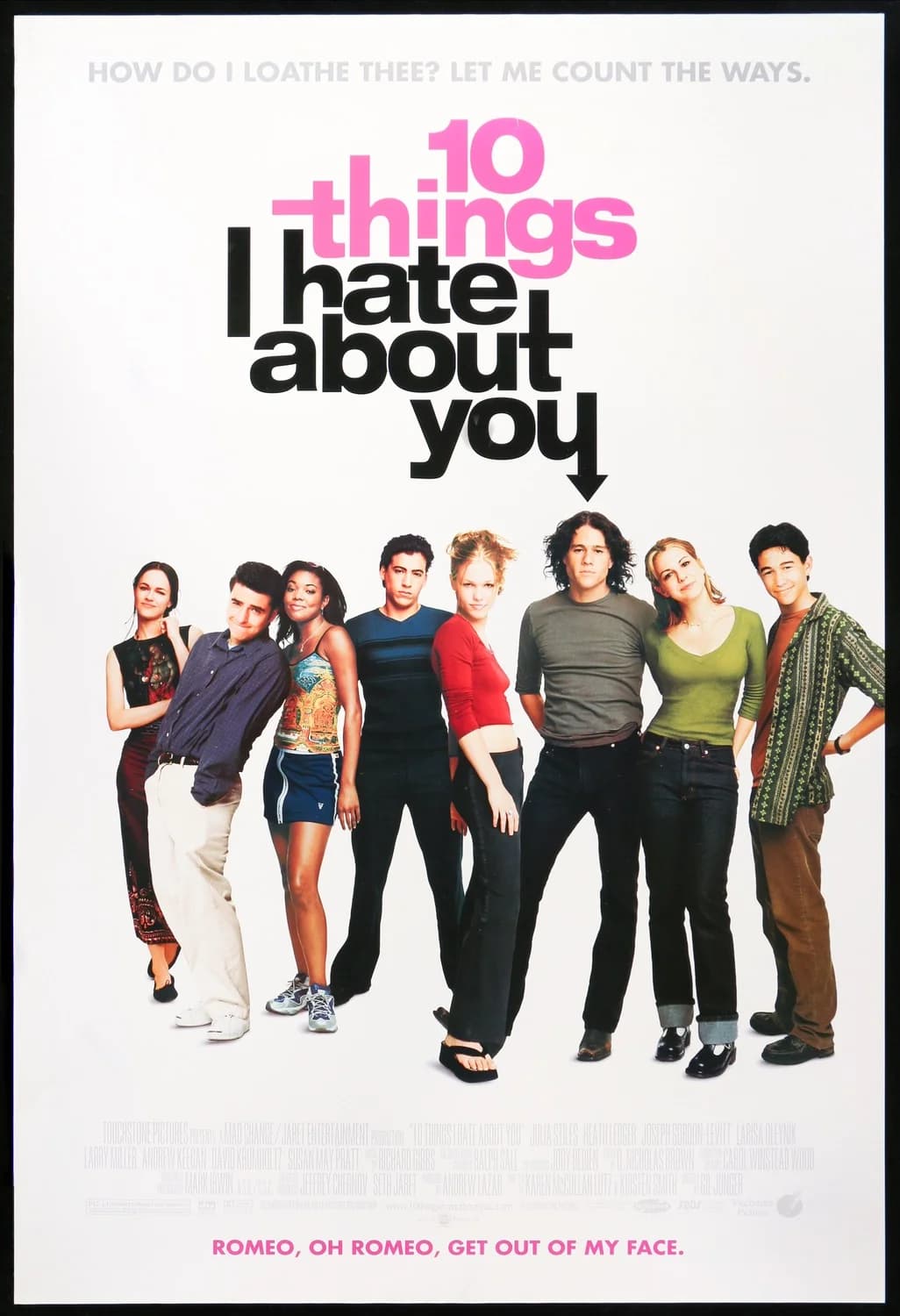
1999 // VHS
10 Things I Hate About You
Sibling rules, a rooftop serenade and one very stubborn Kat — Shakespeare in a school corridor.
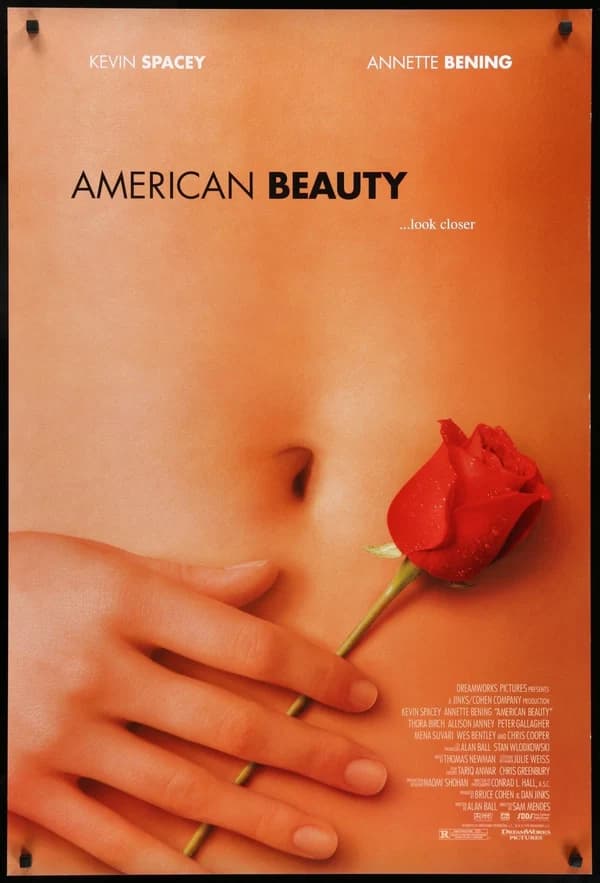
1999 // VHS
American Beauty
Lester Burnham, suburban rot and a midlife argument that still stings.
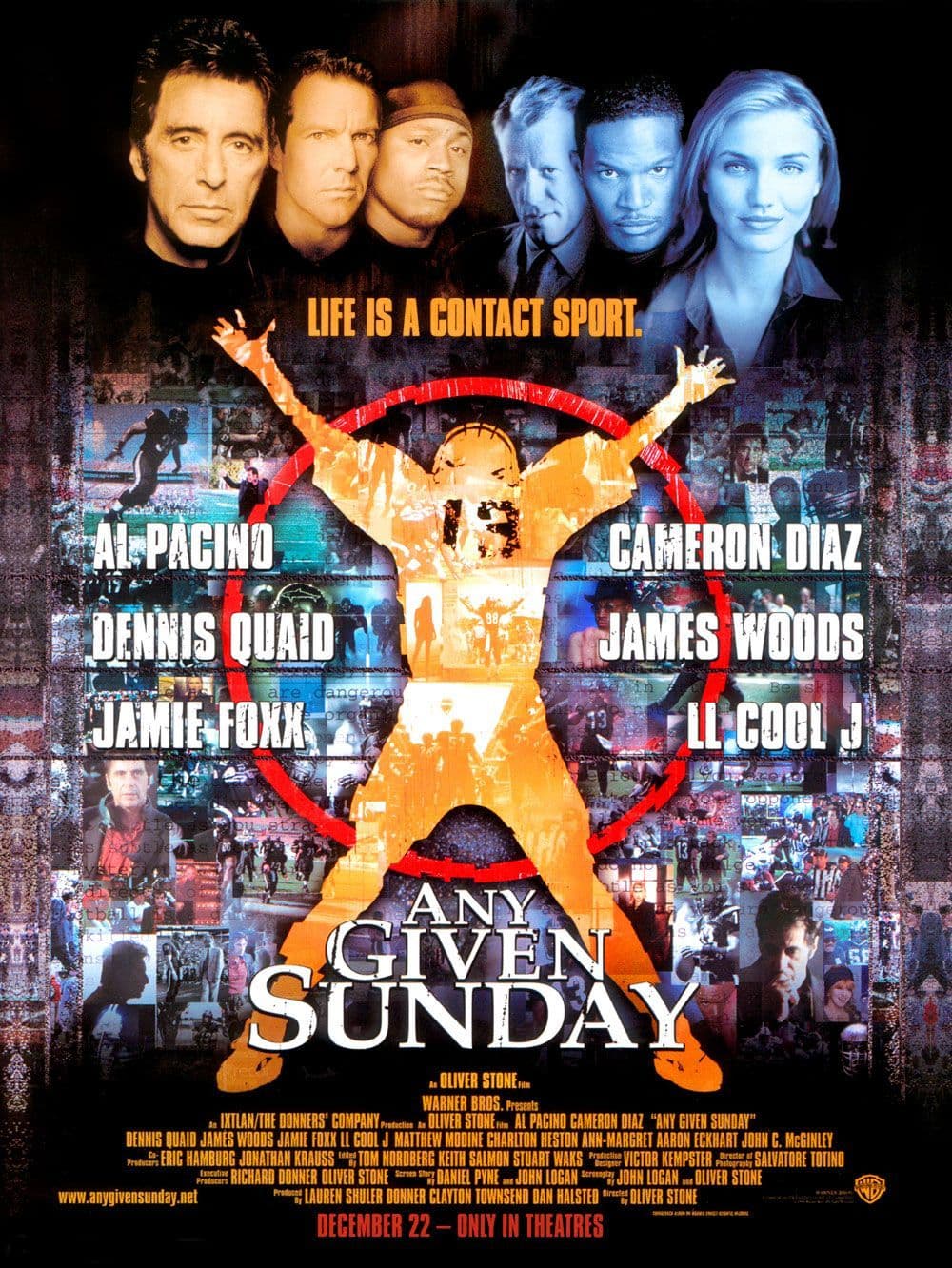
1999 // VHS
Any Given Sunday
Al Pacino's coach anchors the chaos of a film about football turned into product — loud, messy and oddly persuasive.