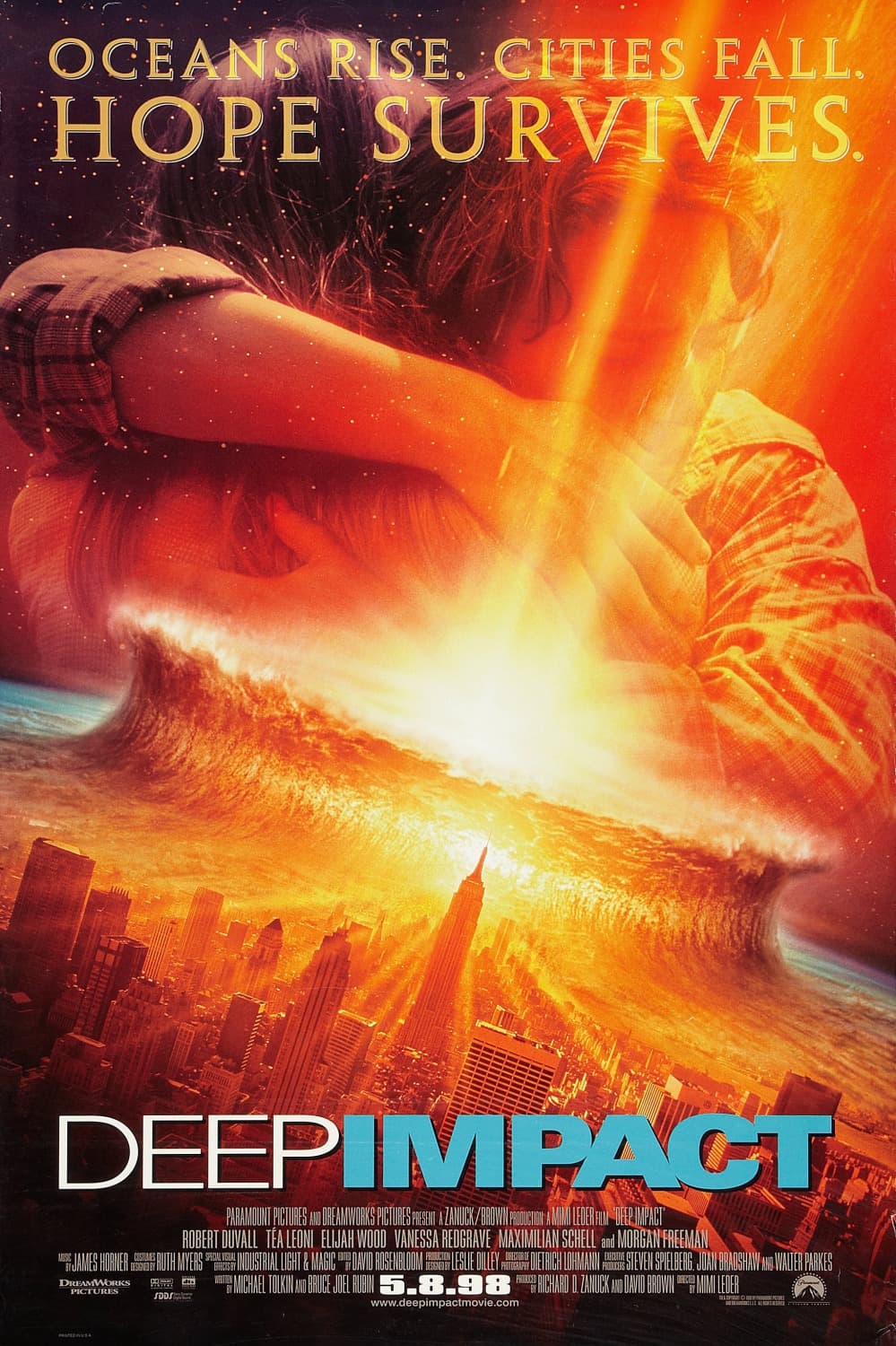
Deep Impact
A comet, a reporter and a country finding out what matters when the clock is real.
// The setup
PLAYBACK STARTED
Deep Impact still lands because it trusts people over spectacle. Mimi Leder’s 1998 disaster drama pairs an extinction-level premise with a newsroom who opens the door, a teenage discoverer who starts the clock, and private families trying to live while the world prepares to die.
THE MOVIE
Jenny Lerner is still the reason this movie works
There are disaster films that pile on spectacle until you forget the people; Deep Impact begins by remembering the person who will tell the story. Jenny Lerner — an MSNBC reporter played by Téa Leoni — is the one who pries open a government story and turns a private crisis into public knowledge.
The narrative hinge is satisfyingly plain: a teenage amateur astronomer spots an object that turns out to be a comet on a collision course with Earth, and the nation responds by building and launching an orbital spacecraft called the Messiah to try to alter that course with nuclear weapons. It’s urgent, concrete and depressingly simple in the best way: there’s a clock, and everyone has to decide what to do with the time they have.
Directed by Mimi Leder and released in 1998, Deep Impact keeps returning to how people behave when the unthinkable is suddenly thinkable — grief, denial, the practical logistics of survival, and small acts of intimacy. That human thread, anchored to a reporter who insists on answers, is why the film still grabs attention more than two hours in.
THE SETUP
The idea that sets Deep Impact in motion
Deep Impact isn’t coy about its engine: someone finds a comet, the government tries to deal with it, and the attempt doesn’t quite end the problem. After the Messiah intercept, the comet splits and the larger fragment still threatens Earth — an extinction-level scenario that changes everything overnight.
Rather than following a single hero, the film cuts between three registers: the national response led by the President and his team, the reporter who forces information into the open, and ordinary families making private decisions as the crisis evolves. That triptych gives the disaster a political spine and a domestic heartbeat.
Having MSNBC in the story matters because the film makes disclosure and the public’s right to know part of the drama. The reporter’s investigation is not window dressing: it’s the mechanism through which the country learns what it faces.
There’s economy to this setup. The comet gives the plot its urgency; the parallel storylines give it moral texture. You get the mechanics — orbital interception, the Messiah mission and then the grim fact that the threat remains — without turning the story into a round-the-world effects reel.
THE CHARACTER
Why Jenny Lerner matters
Jenny Lerner isn’t just a plot device who asks the right questions; she’s the story’s cultural entry point. Her investigation into a government official becomes the route through which the public learns about the E.L.E., so she’s both witness and translator — the person the audience can follow from newsroom scepticism to national emergency.
That position forces the film to juggle journalism and responsibility. Because Jenny uncovers the truth rather than being handed it, the movie frames disclosure as an ethical choice, which keeps the crisis about accountability as much as survival.
Jenny’s storyline sits inside a family arc, too — the Lerners have recurring domestic drama that runs against the larger catastrophe. The film keeps returning to those private threads so that the disaster never flattens every character into an archetype.
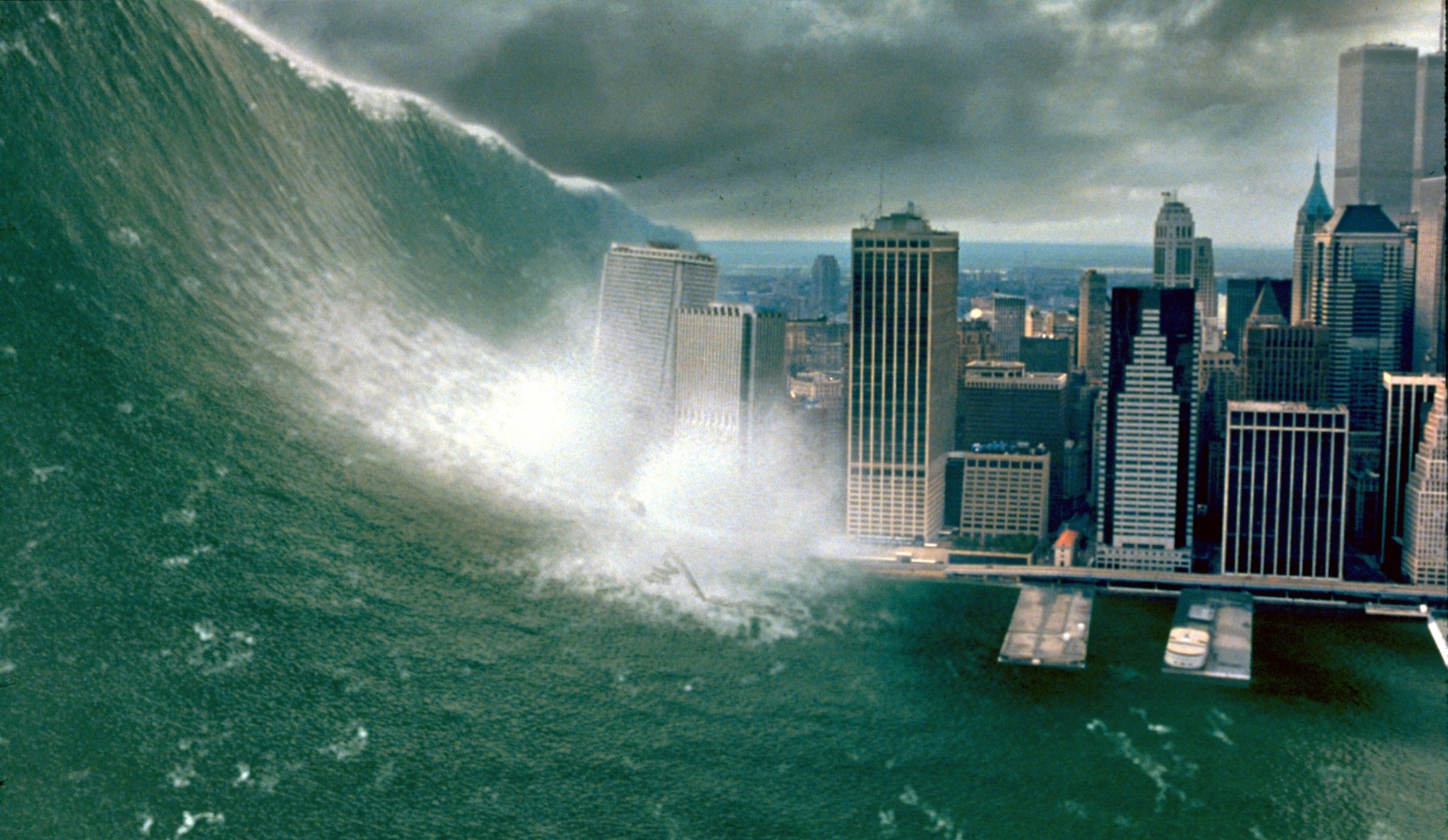
The production deliberately pairs this character-driven drama with large-scale effects, including an ocean-impact/tsunami sequence, which means Jenny’s work and the family moments keep the audience rooted while the spectacle does its job.
UNDER THE SURFACE
Deep Impact has more on its mind than the plot suggests
Underneath the comet chase, Deep Impact keeps nudging the viewer toward questions that feel uncomfortably ordinary: who gets saved when you cannot save everyone, and how do people live with the choices made on their behalf? The film stages difficult ethical trade-offs rather than hand-waving them.
Government secrecy and public disclosure are constant points of friction. The drama is as much about whether officials should withhold information as it is about the mechanics of interception; the movie uses that tension to dramatise trust at a national scale.
Media responsibility is treated seriously. Because a reporter uncovers the truth, the film asks whether telling people the full picture helps them prepare or simply plunges them into panic — a question that keeps the moral argument lively rather than melodramatic.
And at a more intimate level the film is about sacrifice and survival: households reconciling, small acts of intimacy against the background of an existential threat. Those quieter elements are what stop Deep Impact feeling like a pure effects exercise.
THE FILMMAKING
How Deep Impact was put together
Cinematography was handled by Dietrich Lohmann, and the film’s credits bear a dedication to his memory. That quiet production fact gives the movie a slightly different aftertaste — you feel the decisions were made with a tangible respect for craft.
Production design, led by Leslie Dilley, keeps the domestic and political spaces believable. The movie mixes large special-effects set-pieces with practical interior locations so the big moments never float free of a lived-in world.
Mimi Leder’s direction ties those pieces together. The choices to cut between the White House, the newsroom and ordinary homes shape how we feel the stakes: the filmmaking keeps the action comprehensible rather than piling on disorienting spectacle.
Altogether, the film’s construction is loyal to its premise: treat the extraordinary as if it is happening to ordinary people, and the audience will stop counting explosions and start counting breaths.
PRACTICAL EFFECTS
The effects work that gives Deep Impact its physical personality
ILM provided the film’s large disaster visuals by combining miniature photography with digital compositing, so many of the hero shots sit at the junction between old-school model work and newer digital techniques.
Model-shop miniatures were used alongside emerging particle and fluid-simulation tools to build convincing water and debris for the ocean-impact/tsunami sequences. The result is disaster imagery that reads as materially present rather than purely CGI spectacle.
For crowd and rooftop evacuation moments the team experimented with particle-based simulation techniques to suggest distant people at scale — a practical solution for scenes that needed population without turning every close-up into a logistical headache.
The overall effect is cinematic in a tactile sense: you can see where a model ends and a composited element begins, but because the work is carefully blended the audience stays inside the disaster rather than being distracted by it.
PURE 80S
Deep Impact could not belong to any other decade
Deep Impact is very much a product of the late 1990s studio system, when big practical effects still shared the stage with a new wave of CGI. The film exemplifies that transitional moment: model work and physical sets sitting alongside digital compositing.
That mix is not accidental. The movie’s visual strategy reflects an era when effects houses were stretching into particle and fluid simulation while studios still relied on miniature craftsmanship for spectacle that needed to feel physical.
1998 is the year that put those two approaches in direct conversation on a huge scale, and Deep Impact’s construction is a textbook example of how filmmakers were negotiating the changing tools at their disposal.
Because of that, the film reads now as a kind of technical snapshot — not nostalgia for nostalgia’s sake, but a clear record of how disaster cinema looked when practical and digital methods were learning to share the same frame.
WATCHING IT NOW
What has aged — and what hasn't
There’s practical evidence someone still cares: the film has been given home-video restorations and a 4K Blu-ray 25th-anniversary edition, which suggests a persistent appetite from distributors and an audience that wants to revisit it.
The elements that hold up best are the human ones. The Lerner family reconciliation and the quieter domestic beats sit comfortably alongside the effects, so the movie still feels emotionally immediate in moments that don’t rely on spectacle.
Technically, the tsunami and ocean-impact sequences remain watchable because they were built from a hybrid of miniatures and digital work; they don’t read as purely retro effects tricks and still carry physical threat.
What ages less cleanly is the film’s self-assuredness about institutions and decisions made on behalf of citizens; modern viewers bring different assumptions to governments and media. But even then the central questions about honesty, sacrifice and survival stay useful.
THE LEGACY
Why Deep Impact still matters
The film keeps turning up in writing about the crowded 1998 summer of space-disaster movies; it’s part of the conversation precisely because it arrived in the unusual circumstance of sharing an object-from-space premise with a direct competitor.
Commercially, Deep Impact was a success — grossing over $349 million worldwide and ranking among the year’s highest earners — so it mattered to studios as a proof that films could combine drama with spectacle and still find an audience.
Technically, industry coverage singled the movie out as a notable ILM project: the water and particle simulations and ambitious compositing that helped sell the big disaster beats got attention within trade and technical conversations.
Taken together, that legacy is pragmatic rather than mythical: Deep Impact remains a reference point for how studios handled big disaster storytelling at the end of the millennium, and for the VFX industry’s move into more sophisticated simulations.
THE VERDICT
Does Deep Impact still hold up?
Yes — with a rider. Deep Impact’s combination of a clear, plausible premise (a teenage discovery, an attempted Messiah interception with nuclear devices, and the grim aftermath when the comet splits) and serious interest in how ordinary people respond keeps it watchable and often affecting.
The movie doesn’t try to be every corner of the globe at once; it limits its scope to a national response, a reporter who forces the story into daylight, and families making painful choices. That narrower approach is one of its strengths: spectacle supports the human story instead of drowning it.
If you’re watching now, you’ll find certain technical moments pleasantly solid — a hybrid of miniatures and digital work — and you’ll find the Lerner arc and Leo Biederman’s discovery still give the plot moral weight. The film asks the kinds of questions — about secrecy, disclosure and selection — that are still interesting to argue about.
So put it this way: Deep Impact is worth a watch if you want a disaster movie that remembers to be about people. It’s not only about what blows up; it’s about why anybody keeps breathing afterwards.
Share this movie
// Keep watching
More movies from the 90s
If Deep Impact is your kind of movie, there's plenty more on the shelves worth rewinding.

1998 // VHS
The Wedding Singer
A love story wrapped in 1980s pop — and carried by one very earnest wedding crooner.

1998 // VHS
There's Something About Mary
Romantic obsession, awkward masculinity and a hair‑gel gag you can't unsee.

1999 // VHS
10 Things I Hate About You
Sibling rules, a rooftop serenade and one very stubborn Kat — Shakespeare in a school corridor.