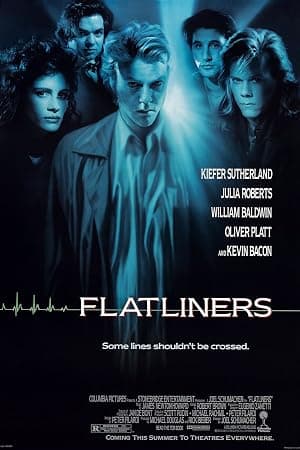
Flatliners
Curiosity, culpability and a heartbeat of hubris — Nelson Wright drags you across the line.
// The setup
PLAYBACK STARTED
Flatliners is the sort of film that still makes people wince and argue in equal measure: a handful of med students gamble with clinical death to see what comes after, and what returns is less a neat revelation than a series of personal reckonings. Joel Schumacher’s 1990 thriller packs scientific bravado, moral scrapes and one very persuasive instigator into a compact, unnerving package.
THE MOVIE
Nelson Wright is still the reason this movie works
What keeps Flatliners interesting is not a cosmic answer to death but the personality that kicks the whole experiment off. Nelson Wright is the student who persuades his classmates to let him flatline — literally stop his heart — so they can observe whatever lies beyond. That brash curiosity is the film’s engine; it turns a campus dare into a moral experiment.
Because the premise is simple — five Chicago medical students induce clinical death, are brought back and then begin to experience escalating, personalised apparitions — the story gives Schumacher and his cast somewhere compact and combustible to play. It’s a science-fiction thriller that folds horror and drama into a single, repetitive question: what happens when you poke at the thing everyone’s scared to name?
Schumacher directs, the runtime sits at a tidy 114 minutes, and the film deliberately trades on the tension between scientific ambition and the fallout it can cause. That tension is why Flatliners still makes for a gripping evening even if you’ve forgotten the finer plot beats.
THE SETUP
The idea that sets Flatliners in motion
You don’t need a manual to understand the film’s promise. Nelson convinces the group to let him flatline so they can watch, scientifically, what happens. That simple instigating act funnels the rest of the picture: repeatable near‑death experiments, each one staged and reversed by defibrillation.
The mechanics are deliberately clinical — sedation, induced clinical death and jolts to restart the heart — and those details keep the film from drifting into pure fantasy. Each near‑death episode becomes an opportunity to reveal a character’s backstory: the visions are not a universal afterlife but private echoes tied to memory and guilt.
That design is why the structure often feels cyclical. The movie stages several of these episodes for different characters, and the payoff is less about solving an otherworldly mystery and more about watching moral debts come due.
It’s neat in concept, and when it works the format gives the film a relentless, mounting pressure: each return to life raises the stakes for the next descent.
THE CHARACTER
Why Nelson Wright matters
Nelson Wright isn’t simply the trigger for the plot — he’s its moral juggling partner. He’s the student who wants answers badly enough to push rules, colleagues and safety to the edge. That mixture of curiosity and ambition colours everything the others do.
Because Nelson brings them the idea, his risks infect the group’s dynamic: friendship and ambition are braided together, so one person’s appetite becomes everyone’s problem. It makes the story feel less like a collection of episodes and more like a single experiment with interpersonal consequences.
You leave the film thinking about the person who starts the trouble as much as the trouble itself. That’s why Nelson matters: he’s the reason the ethical question at the heart of the film feels personal rather than abstract.
UNDER THE SURFACE
Flatliners has more on its mind than the plot suggests
On the surface it’s a medical students’ thriller. Underneath, it’s a film worried about what happens when curiosity becomes arrogance. The scientific tampering at the centre — deliberately pushing people past death — allows the film to interrogate consequences rather than collect spooky set pieces.
The visions that haunt the characters are tied to private memory and unfinished business, not a single, tidy afterlife. That choice turns the apparitions into judgements: each encounter forces a reckoning with past sins or trauma, so the supernatural becomes a form of moral bookkeeping.
Friendship and ambition keep appearing as counterweights. The study’s group dynamic shows how peer pressure and competitive drive can turn an intellectual exercise into something reckless and, eventually, damaging.
Put together, those ingredients mean Flatliners isn’t only asking ‘what’s beyond?’; it’s asking whether some doors should be left closed at all.
THE FILMMAKING
How Flatliners was put together
The film’s physical identity leans heavily on production craft. Eugenio Zanetti oversaw production design and the crew actually built a large lakeshore promenade on the Loyola University campus; matte paintings were then used to stitch that set into the wider campus exteriors.
Those choices matter because they give the unreal moments something tangible to play off. The constructed sets stop the near‑death scenes from feeling purely studio-bound and let the movie move between hospital interior and eerie exterior without losing a sense of place.
Jan de Bont is credited as director of photography and Robert Brown as editor — the combination of design, photographic choices and editing pace is what lets Schumacher push the film from clinical experiment to thriller without ever losing the medical scaffolding that grounds it.
In short: Flatliners looks like a film that’s been carefully assembled to make its premise believable on screen.
PRACTICAL EFFECTS
The effects work that gives Flatliners its physical personality
Flatliners leans on solid, physical filmmaking rather than leaning entirely on optical trickery. The lakeshore promenade was a tangible set piece, and matte paintings were used to integrate that built environment with the rest of the campus.
Crucially, the near‑death scenes relied on practical staging and makeup to produce the apparitions. Those sequences were created using prosthetic and physical-performance techniques rather than being invented in post, which gives the manifestations a tactile nastiness.
You can tell, on rewatch, which moments are built and which are composited — and that blend helps the film sell the idea that these visions are intrusions into ordinary life, not just effects-driven jolts.
That practical approach is part of why the visuals were singled out by critics at the time: they felt worked, not slapped together.
PURE 80S
Flatliners could not belong to any other decade
Flatliners sits comfortably in a late‑80s/early‑90s wave of mainstream films that were suddenly interested in death and what might follow it. It’s part of a conversation cinema was having at the time — not alone in the subject, but distinct in its clinical framing.
That era’s fascination with mortality let movies mix genre elements; Flatliners borrows thriller pacing, horror set pieces and a science‑fiction premise to create a hybrid that felt contemporary in 1990.
So while it’s tempting to pin nostalgia on fashion or music, the film’s decade belongs to its preoccupation: why mess with death when so many films were already asking what it means to live afterwards?
In short: the film’s concerns and its appetite for mixing tones make it feel of that moment, not merely dressed like it.
THE LEGACY
Why Flatliners still matters
Flatliners arrived at the box office with some momentum: it opened at number one in the U.S. and went on to take roughly $61.5 million domestically, a tidy haul for a genre picture of its time. That commercial success helped keep the title visible beyond its initial run.
The film’s production and visual design have enjoyed continued attention: restorations and anniversary releases have included interviews and commentaries from crew members, which speaks to a lasting interest in how it was made as much as what it says.
The fact a 2017 reimagining returned to the premise — and even placed Kiefer Sutherland in the cast again — is another sign the idea still has purchase. Not everything that’s remembered becomes a classic, but Flatliners has stayed in the conversation enough to invite revisitation.
So its afterlife is pragmatic rather than mythical: people keep coming back because the concept is nimble and the production details reward closer looks.
THE VERDICT
Does Flatliners still hold up?
Yes — with a caveat. If you watch Flatliners for a tight answer to the afterlife, you’ll be frustrated. The film’s repeated clinical‑death beats are designed to probe character and guilt rather than hand you a metaphysical roadmap. That premise continues to have teeth: experiments that produce escalating, personalised apparitions make for satisfying, tense sequences.
Where it falters is in its tendency to become didactic; contemporary critics noted that the screenplay’s repetitive structure and moralising tone could blunt the impact of individual scenes even as the visuals and cast kept the engine running. The design, the production craft and the core idea still land — but the film does sometimes wear its thesis on its sleeve.
If you’re drawn to moral thrillers about consequences, or you want to see a compact, period piece about scientific hubris and atonement anchored by one decisive instigator, Flatliners is worth your time. It’s not perfect, but it stages its question well enough that you leave thinking about who was brave — or foolish — enough to ask it.
And Nelson Wright remains the cleanest reason to watch: he’s the spark that makes the rest of the experiment possible, and the film is better for having someone willing to push the boundaries.
Share this movie
// Keep watching
More movies from the 90s
If Flatliners is your kind of movie, there's plenty more on the shelves worth rewinding.

1990 // VHS
Edward Scissorhands
A fairy tale about a man who can’t quite touch the world — and the neighbourhood that can’t quite handle him.
1990 // VHS
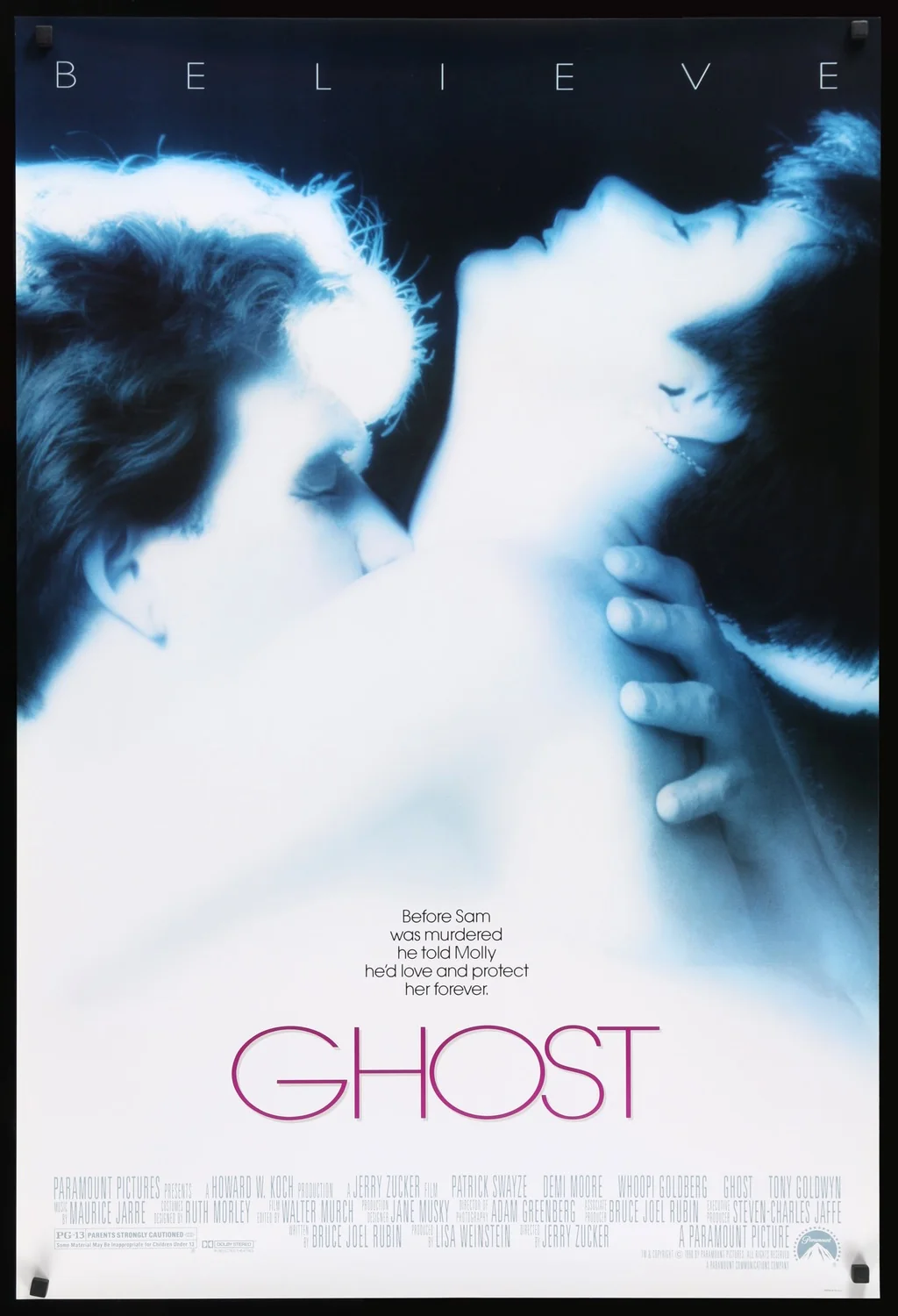
Ghost
A murder mystery disguised as a love story — with a man who won’t stop watching over the person he loves.

1990 // VHS
Total Recall
Memory, muscle and a very faulty holiday package — with Mars on the itinerary.