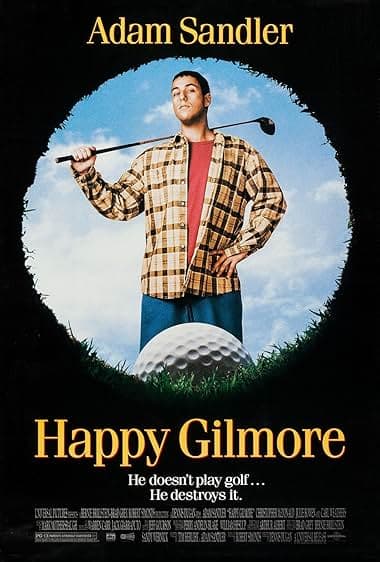
Happy Gilmore
A foul-mouthed hockey player who accidentally becomes golf's most disruptive hero.
// The setup
PLAYBACK STARTED
Happy Gilmore still feels like being let into a joke you only half-understand — loud, rude, and strangely loyal. It’s a sports comedy built on one obvious gag (a hockey man who can smash drives) and a surprisingly steady moral engine: save Grandma’s house. Directed by Dennis Dugan and fronted by Adam Sandler, it’s the sort of film that trades polish for personality and, for better or worse, gets a lot done in 92 minutes.
THE MOVIE
Happy Gilmore is still the reason this movie works
Start with the obvious: Happy Gilmore is a temper-prone former minor-league hockey player who can belt golf balls extraordinary distances. That single mismatch — a punchy, rowdy athlete jammed into golf’s prim world — is what gives the film its comic electricity.
What turns the gag into stakes is simple and sharp: Happy isn’t chasing trophies for glory but to stop his grandmother’s house from being repossessed after an IRS seizure threat. That makes his anger useful; it’s fuel rather than mere noise.
All of this is wrapped in a mid-1990s studio comedy package — Dennis Dugan directing, Adam Sandler in the title role, and a brisk 92-minute runtime that makes sure the joke never outstays its welcome.
THE SETUP
The idea that sets Happy Gilmore in motion
The film’s engine is plain and economical: a failed hockey player discovers he can drive the ball like nobody’s business and takes that talent onto the professional golf circuit. It’s a premise designed for comic friction rather than realism.
That friction is personified by Shooter McGavin — the tour’s polished star who treats the game as decorum and ratings, and who sees Happy as both an embarrassment and a threat. Their clash sets up the film’s outsider-versus-establishment energy.
Happy’s technique — a hockey-style, power-driven swing — gives him an immediate edge, but it also creates as many problems as it solves. Etiquette, temperament and the expectation that professionals behave a certain way become obstacles as much as the other players on tour.
Along the way he meets Chubbs Peterson, a retired pro who becomes a mentor figure, and bursts into the public spotlight with a celebrity pro-am that erupts into one of the movie’s best-remembered set pieces.
THE CHARACTER
Why Happy Gilmore matters
Happy isn’t a subtle creation, and that’s the point. He’s a one-man disruption: angry, competitive and oddly devoted. His mission to raise tournament money to stop his grandmother’s house from being repossessed gives the pratfall energy a moral spine.
Grandma functions as the film’s emotional anchor. Her plight turns what could be a pure-joke vehicle into something you can root for; Happy’s rage gets translated into responsibility rather than mere spectacle.
Around him the film assembles familiar comedy supports — a devoted caddie, a PR-minded love interest, and celebrity guests who amplify the public spectacle of his rise. They exist to react, to mock, to help and to underline why Happy’s presence matters to the world he’s stormed.
Put simply: Happy matters because he’s not just loud. He’s loud with a reason, which keeps the film tethered when it wants to skewer golf and enjoy itself at the same time.
THE PERFORMANCE
Why Adam Sandler's performance matters
Contemporary and later reviewers identified Adam Sandler’s central persona as the film’s motor: high-energy, deliberately excessive and keyed to broad comic beats. The movie leans on that engine — it wouldn’t run without it.
Sandler’s presence gives the film its appetite for chaos; the plotting and set pieces are arranged around the kind of comic noise his style produces.
Because the movie is written by Sandler and Tim Herlihy, that persona isn’t accidental — it’s built into the screenplay’s rhythms and the sort of jokes the film prioritises.
So whether you find it funny or grating depends largely on how much you want comedy to be allowed to be loud and unrefined for the sake of immediate laughs.
UNDER THE SURFACE
Happy Gilmore has more on its mind than the plot suggests
On the surface it’s a silly sports comedy; underneath it’s a story about outsiders barging into closed rooms. The film enjoys turning golf’s decorum upside down — which is to say it treats establishment manners as something to be mocked and challenged.
There’s also a tidy mentorship line: a fallen pro coaching a young, undisciplined talent. That relationship gives the comic streaks a little heart, and a route to redemption that the movie can sell without ever slowing down.
Family loyalty is surprisingly central. The scheme to save Grandma’s house gives Happy’s bad behaviour stakes and, crucially, a reason to be serious when the film asks him to be.
And the film plays repeatedly with masculinity and performative aggression — it stages anger as both comedy and spectacle, asking the audience to laugh while occasionally reminding them that the roar has consequences.
THE FILMMAKING
How Happy Gilmore was put together
Happy Gilmore was assembled as a studio comedy vehicle: production design credit goes to Perry Andelin Blake and the picture was produced for and distributed by Universal Pictures. That’s the framework the jokes move through.
The film’s construction is pragmatic: it keeps scenes compact, centres the comic set pieces, and organises supporting players and cameos so the lead persona always has room to dominate.
Put another way, the filmmaking choices favour clarity over flourish: everything exists to showcase the idea and the performers rather than to call attention to cinematic invention.
That efficient design is part of why the movie still gets watched — it’s clear what it’s trying to be from shot one, and it rarely wanders off-course.
PURE 80S
Happy Gilmore could not belong to any other decade
Happy Gilmore is very much a mid-1990s Adam Sandler feature, produced during his early film partnership with writer Tim Herlihy and producer Robert Simonds. It sits where studio comedy met star-driven personality.
The movie fits a 1990s pattern: take a single-sport premise and bolt a broad comedy star to it. The format was familiar then — digestible, marketable and built for mainstream theatrical audiences.
Universal Pictures’ involvement underlines that positioning: this was a studio deciding to back a comedy built around a performer rather than a high-concept franchise or art-piece.
That era-specific production logic explains a lot about the film’s tone and why it still reads as very of-a-time: it’s the result of a particular moment when studios let star personas steer the ship.
WATCHING IT NOW
What has aged — and what hasn't
Retrospectives and re-releases show the film keeping a loyal fanbase; it still delivers the character-driven, broad Sandler-era beats that people expect from that period of his work. If that style works for you, the film still lands.
The family-loyalty plotline — the scramble to save Grandma’s house — remains a surprisingly solid anchor. It gives the film a simple emotional through-line that helps the jokes land without feeling hollow.
Chubbs’ backstory (the lost hand from an alligator attack) is an odd little detail that keeps the mentor relationship oddly specific and oddly memorable; those small narrative quirks are the sort that survive time better than a throwaway gag.
What hasn’t aged as universally is the appetite for aggressive, public spectacle as humour; the movie’s big set pieces are designed for maximum noise and that feels very much of its moment.
THE LEGACY
Why Happy Gilmore still matters
Certain moments have outlived the rest: the Adam Sandler–Bob Barker fight became one of the movie’s most-cited sequences and keeps turning up in pop-culture conversations.
The film crops up regularly in retrospectives and anniversary pieces, and its lines and images keep being used in memes and re-release coverage — it has a steady cultural visibility even if it isn’t a grand claim for influence.
That visibility helped the property return to mainstream attention years later, culminating in a feature sequel that was developed and released on Netflix decades after the original.
So Happy Gilmore matters less as a revolution and more as a durable pop-comedy with a few very loud, very memorable moments that people keep coming back to.
THE VERDICT
Does Happy Gilmore still hold up?
Yes — with a caveat. If you respond to pumped-up, personality-first comedy, Happy Gilmore’s premise still hooks: a hockey man who can hit absurdly long drives and who’s trying to raise money to keep his grandmother’s house from being repossessed gives the film both its comic and emotional reason to exist.
The outsider-versus-establishment conflict — best personified by Shooter McGavin — is straightforward and satisfying because the stakes are honest and small. The story keeps returning to that central clash and lets it drive the jokes.
Key beats — the mentor figure in Chubbs, the qualifying pro-am, and the celebrity brawl that becomes a set piece — all do the job of moving a simple story along while delivering the moments people remember.
So watch it if you want a compact, loud, character-led comedy from 1996. It isn’t serious cinema, and it never pretends to be; it’s a film that knows what it is: a vehicle for a particular brand of comedy, anchored by a plain, human reason to care.
Share this movie
// Keep watching
More movies from the 90s
If Happy Gilmore is your kind of movie, there's plenty more on the shelves worth rewinding.
1999 // VHS
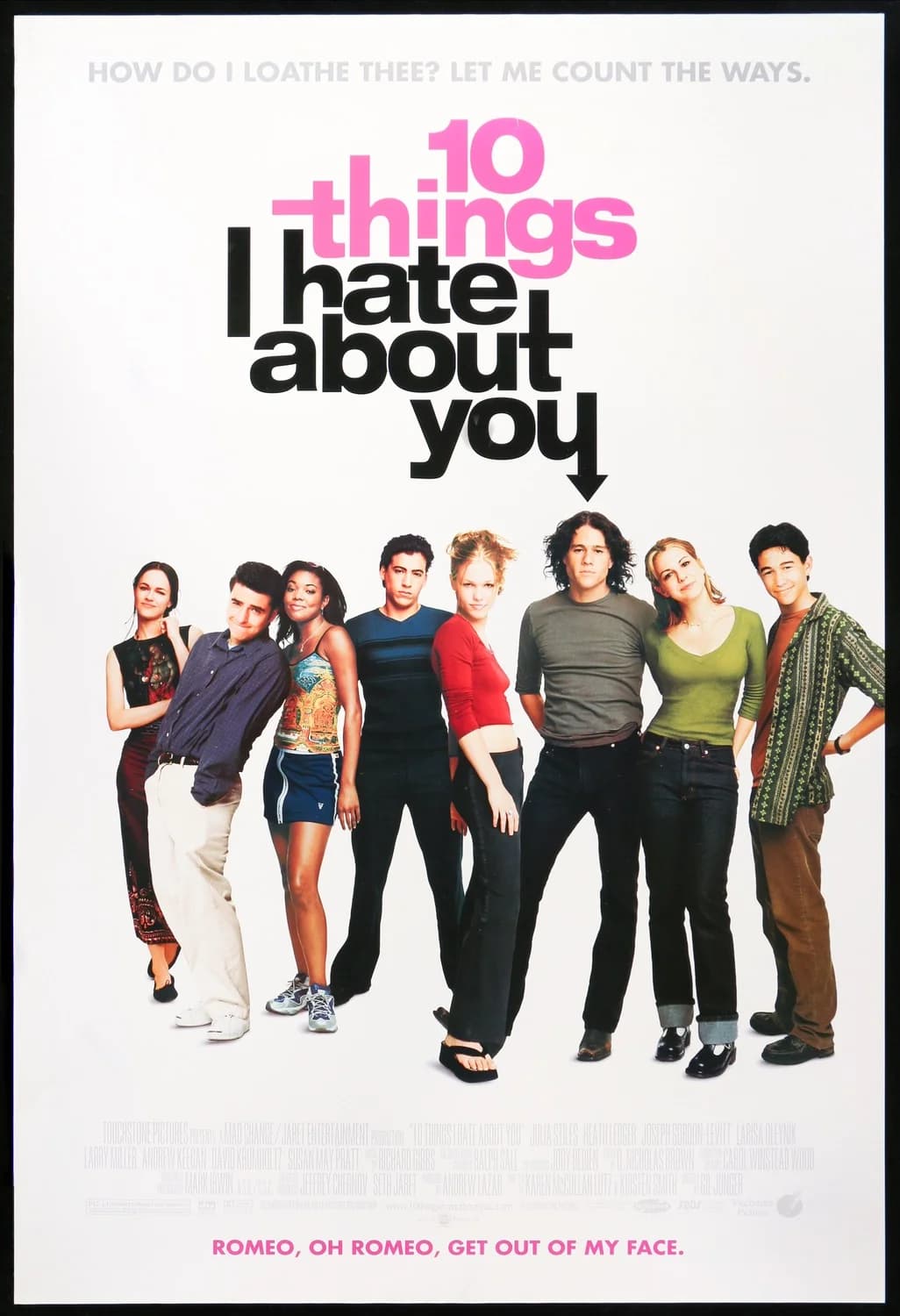
10 Things I Hate About You
Sibling rules, a rooftop serenade and one very stubborn Kat — Shakespeare in a school corridor.
1999 // VHS
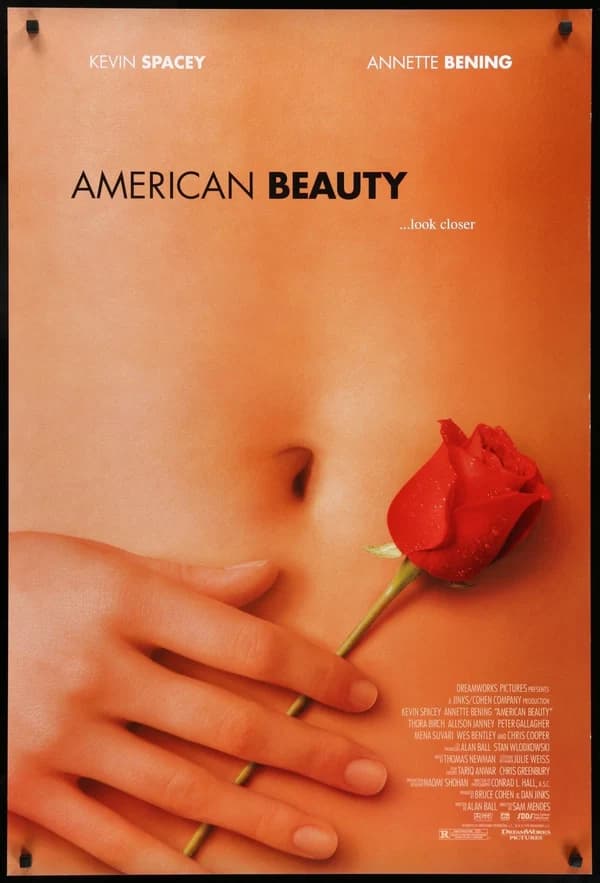
American Beauty
Lester Burnham, suburban rot and a midlife argument that still stings.
1999 // VHS
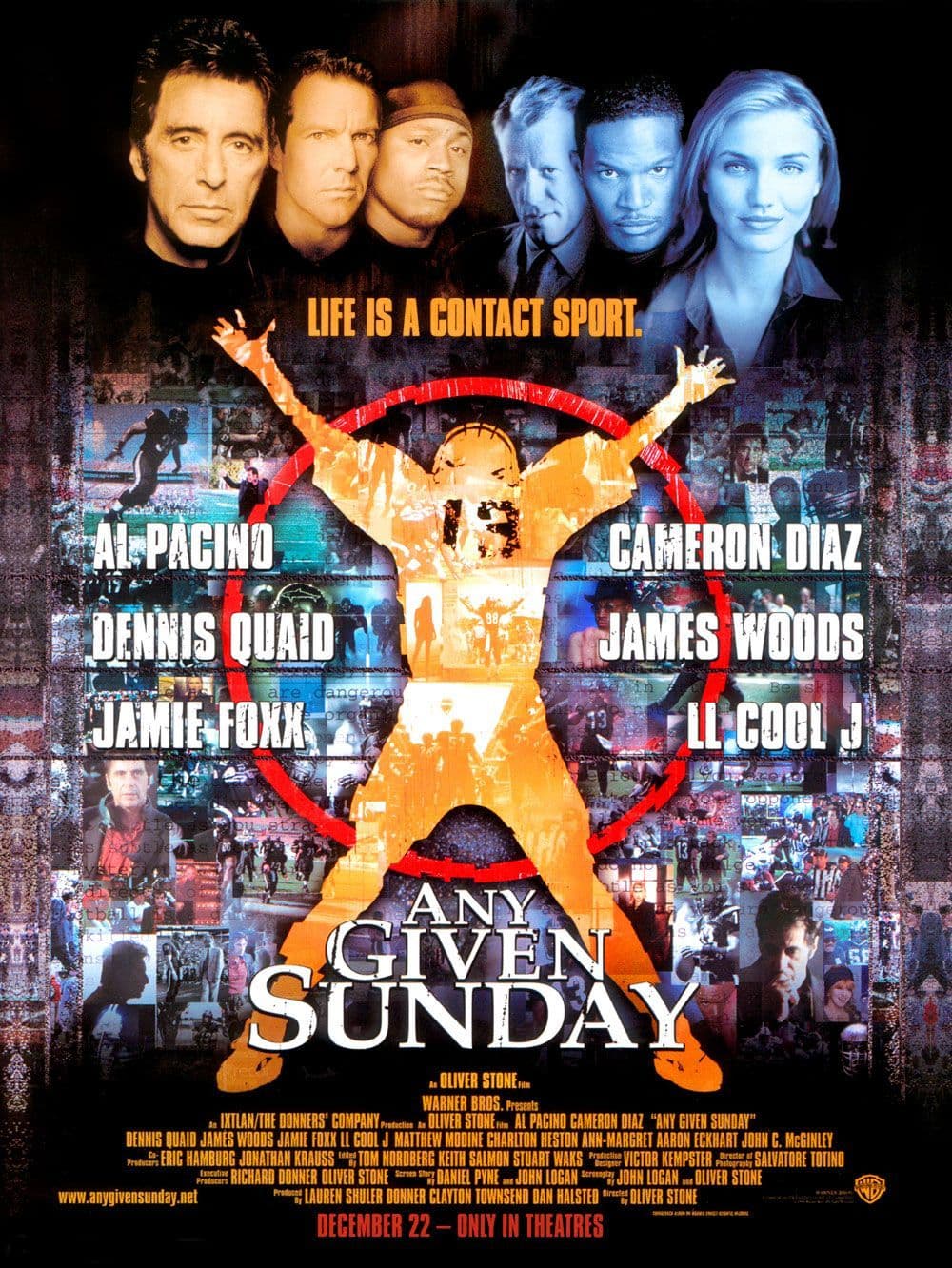
Any Given Sunday
Al Pacino's coach anchors the chaos of a film about football turned into product — loud, messy and oddly persuasive.