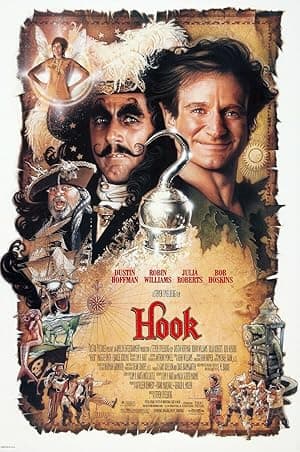
Hook
A grown man who forgot how to fly — and the long, noisy, sentimental attempt to teach him again.
// The setup
PLAYBACK STARTED
Hook is one of those studio-sized fairy tales that arrives like a question: what happens to the boy who refuses to grow up when he actually does? Steven Spielberg took that question, planted it in Neverland, cast it as a beleaguered workaholic, and let the argument play out across enormous sets, pirate fights and a very noisy score. Revisit it and you’ll find a film that’s tugging about memory, fatherhood and whether imagination can be relearned.
THE MOVIE
Peter Banning / Peter Pan is still the reason this movie works
There’s an image in Hook that lodges: an adult who was once magic, who now files papers and has forgotten he could fly. That gap between a life lived for deadlines and the part of you that used to play is the engine of Spielberg’s big, earnest picture.
The film pivots on a single, manageable stunt of plotting: Captain Hook kidnaps Peter Banning’s children, and the only way to rescue them is for Peter to go back to Neverland and find the boy he left behind. It’s a tidy inciting incident that lets the movie be both a swashbuckling rescue and a personal recovery.
Spielberg stages the whole thing as a fantasy-action-comedy mash-up, leaning into spectacle and sentiment. Robin Williams is the grown Peter; Dustin Hoffman is Hook; Julia Roberts is the complicated catalyst. Underneath the set pieces there are honest themes — childhood versus adulthood, memory and identity, fatherhood and the price of nostalgia — all scored by John Williams and dressed up on an enormous, occasionally stubborn canvas.
THE SETUP
The idea that sets Hook in motion
At its cleanest, Hook is ridiculously simple: grown Peter Pan, now Peter Banning, has buried his other life under career and routine. That forgetting is the problem the movie needs to solve.
The stakes are straightforward and immediate. Hook takes Peter’s children, which forces a return to Neverland; if Peter cannot remember who he was, he cannot rescue them. The plot’s time pressure — relearn flying, relearn fighting, relearn being a father — gives the spectacle a pulse.
The mechanics of the story are deliberately old-fashioned. Tinker Bell is both spark and trainer; the Lost Boys recognise the grown man and help bring him back; Hook exploits family ties by trying to turn Peter’s son against him. It’s an adventure built on identity and rescue rather than tricksy plotting.
Because the premise is so compact, the movie can afford to wander into long set pieces and emotional scenes without losing what it’s about: a man being forced to remember how to play so he can be a parent again.
THE CHARACTER
Why Peter Banning / Peter Pan matters
Peter Banning isn’t an updated Peter Pan so much as a psychological puzzle: he’s the same boy in a suit, a man who chose achievement over the memory of who he used to be. That decision is what makes his journey readable — it’s not about learning new tricks so much as remembering old ones.
Robin Williams plays that doubled life: the corporate father and the vanished child. The character matters because he’s credible as both: someone who can’t immediately trust memory, and therefore must be coaxed back into play.
Tinker Bell’s role underlines why Peter deserves the film’s attention. She isn’t just a plot device; she’s the jealous, invested force who catalyses his return and then coaches him to retrieve what he’s lost. Her presence keeps the story honest about the cost of forgetting.
Ultimately Peter functions as the film’s argument about parenthood: being a father, in Hook’s terms, means reawakening capacities you may have left behind — imagination, risk, attention — and using them for someone else rather than yourself.
THE PERFORMANCE
Why Robin Williams's performance matters
Contemporary coverage didn’t ignore the cast: reviewers singled out both Robin Williams and Dustin Hoffman as central to how the film landed. In a project this large, casting becomes part of the conversation about tone and ambition.
That attention matters because Williams’ presence framed expectations. Seeing him attached to an adult Peter suggests a particular itch the film wants to scratch — the collision between manic energy and weary responsibility.
It’s also why the movie reads, in many moments, like a tug-of-war between the idea of a comic actor who can float and a story asking for emotional ballast. Reviewers’ focus on the performances shows how much of Hook’s reception rested on those two competing impulses.
So when people talk about Hook they’re often talking about the way its stars made the themes audible to audiences — whether you loved that mix or found it uneven.
UNDER THE SURFACE
Hook has more on its mind than the plot suggests
On paper Hook reads like a family blockbuster. Scratch the surface and it’s mainly thinking about memory and identity: who you were, who you are, and why those two people sometimes refuse to meet.
There’s a persistent score under the action about nostalgia and the cost of growing up. The film is fond of the idea that adulthood can be a kind of amnesia — useful, efficient, but liable to make you miss the parts of yourself your children will want.
Fatherhood and responsibility are threaded through the action. The rescue is as much about saving children from Hook as it is about saving Peter from a life in which he’s emotionally absent. The film wants you to feel that those things are linked.
And beneath that, imagination and play keep surfacing. Neverland becomes a test: can a man learn playfulness again, and if he can, does that make him a better parent? Hook’s answer is noisy and sentimental, but it’s at least trying to be moral without being sermonising.
THE FILMMAKING
How Hook was put together
Hook is built like a stage show for the screen. Norman Garwood’s production design is an openly theatrical heartbeat: whole environments were constructed so the movie could move through them as if it were a promenade performance.
That included large, made sets — even a full-sized Jolly Roger — which give Neverland a tactile, blocky certainty. When a film puts that much muscle behind its physical world, the production choices become part of the storytelling.
The industry noticed. The film’s craft was recognised in Academy Award nominations, especially in areas like art direction and visual effects, which reflects how seriously the production went about making a living Neverland.
Put simply: when Hook wants to convince you it’s a fairy tale, it doesn’t do it half-heartedly. The filmmaking choices underline the movie’s appetite for spectacle and for making its imaginary world feel physically available.
PRACTICAL EFFECTS
The effects work that gives Hook its physical personality
A lot of Hook’s personality is physical: stage-built treehouses, pirate-town backlots and an actual, walk-on Jolly Roger give the movie a presence that blue-screen alone cannot create.
Alongside those constructed environments, animatronics, puppets and practical special-effects mechanisms were used and overseen by dedicated crews. Those hands-on elements were then blended with optical and digital work by ILM, so the movie lives in a hybrid space.
Stunt performers and doubles handled the risky business; principal actors did many of their less complex stunts. The mix of real movement and mechanical ingenuity keeps a lot of scenes feeling immediate.
It’s not subtle. It doesn’t always look seamless. But the practical work gives Hook a physical personality you notice whenever the camera drops into the set and lets the actors move among things you can imagine touching.
PURE 80S
Hook could not belong to any other decade
Hook arrived at the start of the 1990s, a time when studios were willing to bankroll large, effects-heavy family pictures and place them in the holiday calendar. It’s very much a movie of that moment in which spectacle was a selling point.
The film’s production scale — the constructed sets, the ILM collaboration — and the attention given to production design reflect a period approach: invest in theatrical, family-friendly spectacle and hope the audiences follow.
That energy is part of what makes Hook feel like a financial-era picture: designed to be seen loud, seen big and seen with other people in December and January screenings.
Seen this way, Hook is less a quaint relic and more an example of studio appetite at the time: a big director, big sets, big effects and the belief that a familiar story could be re-sold as a holiday event.
THE LEGACY
Why Hook still matters
There are practical reasons Hook still appears in conversations: the film earned five Academy Award nominations across art direction, costume, visual effects, makeup and song, which keeps its craft in the record books.
Its commercial story is complicated: the picture did well worldwide but was widely reported as not meeting studio financial expectations, which has become part of its afterlife when people talk about the economics of early-90s family films.
John Williams’ music has also kept a thread alive. The original score and the songs have seen later reissues and expanded editions, which helps the movie live on in sound even if other aspects are debated.
Finally, Hook keeps turning up in conversations about large-scale 1990s family fantasies and in assessments of Spielberg’s mainstream spectacle work. It’s not always praised, but it’s rarely ignored — partly because it aimed so unapologetically high.
THE VERDICT
Does Hook still hold up?
Yes — with qualifications. If you watch Hook as a big, somewhat messy fairy tale about a man who must relearn how to be a parent and a playful person, it delivers sincere beats and genuinely imaginative production design.
The core idea is solid: Peter Banning is an adult who suppressed his past and prioritised career over family, and Hook’s kidnapping of his children forces a double rescue — of the kids, and of Peter’s memory and imagination. That emotional shorthand gives the spectacle shape.
But the movie’s tone and screenplay were commonly criticised at the time, and that still shows. The film frames its Neverland action as both an external rescue and an internal process of reconciling imagination with responsibility, and whether that balance works for you depends on how tolerant you are of big sentimental gestures wrapped in blockbuster packaging.
So watch it for the premise and the production — for Robin Williams as the grown Peter, Dustin Hoffman as Hook, Julia Roberts as Tinker Bell, Norman Garwood’s environments and John Williams’ music. Don’t expect a tightly pared-down study of fatherhood; expect a loud, generous attempt to put childhood back into an adult’s life. It’s messy, but it’s trying to do something honest: make grown people remember how to fly.
Share this movie
// Keep watching
More movies from the 90s
If Hook is your kind of movie, there's plenty more on the shelves worth rewinding.
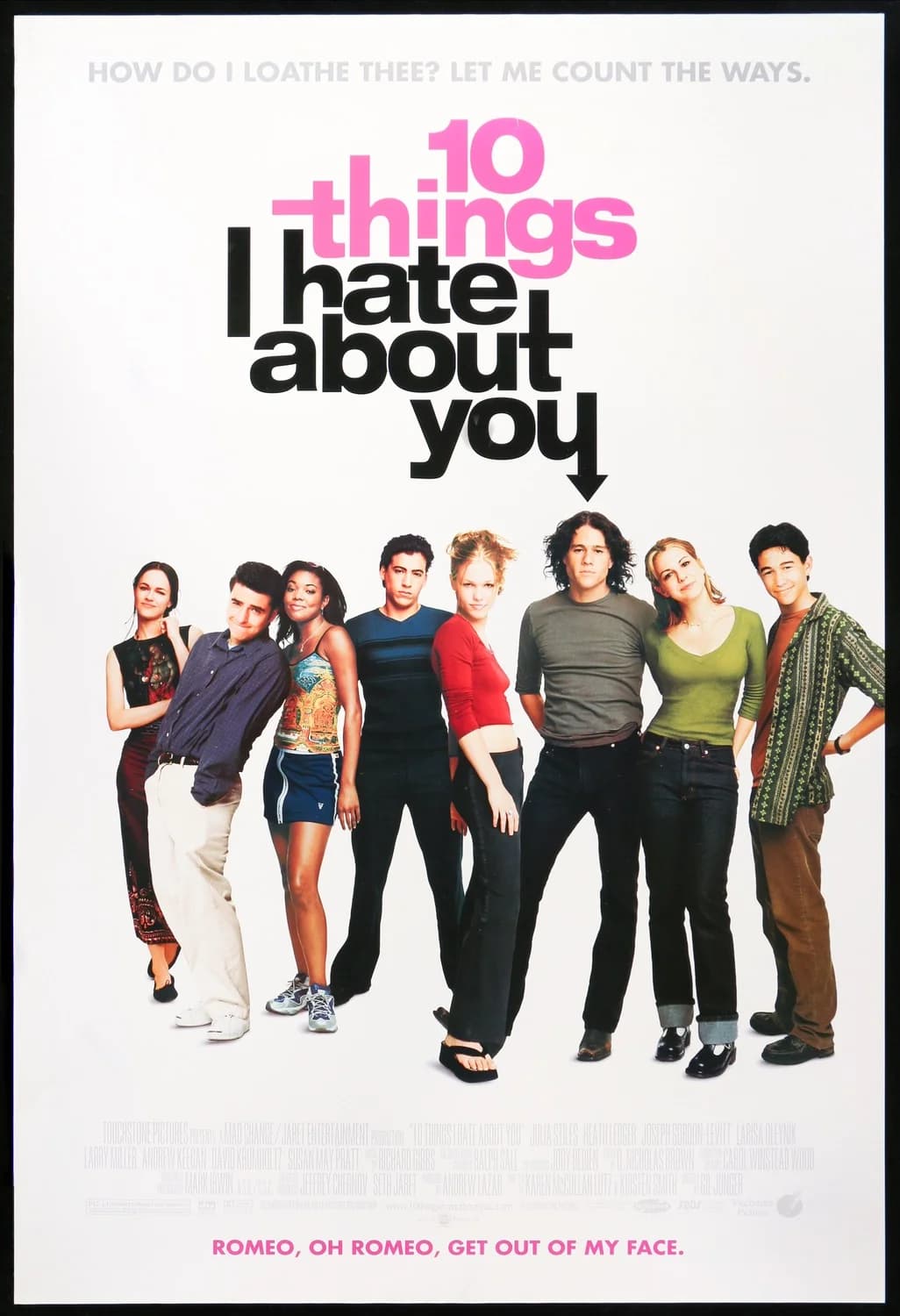
1999 // VHS
10 Things I Hate About You
Sibling rules, a rooftop serenade and one very stubborn Kat — Shakespeare in a school corridor.
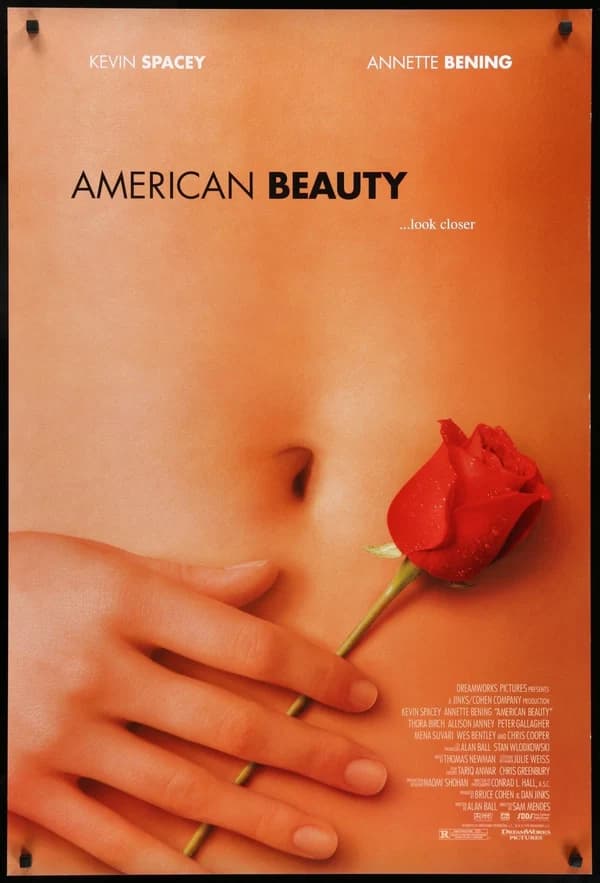
1999 // VHS
American Beauty
Lester Burnham, suburban rot and a midlife argument that still stings.
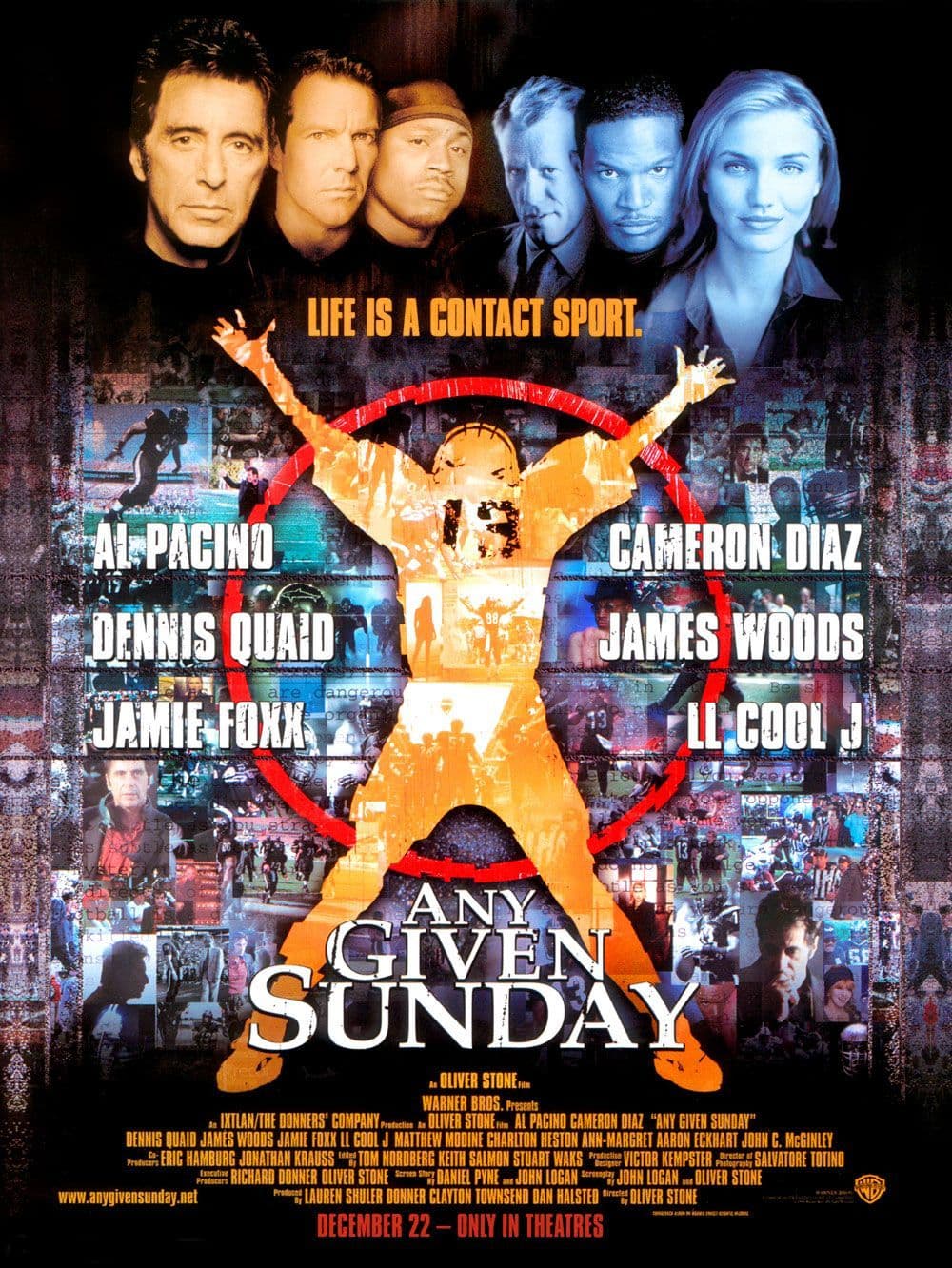
1999 // VHS
Any Given Sunday
Al Pacino's coach anchors the chaos of a film about football turned into product — loud, messy and oddly persuasive.