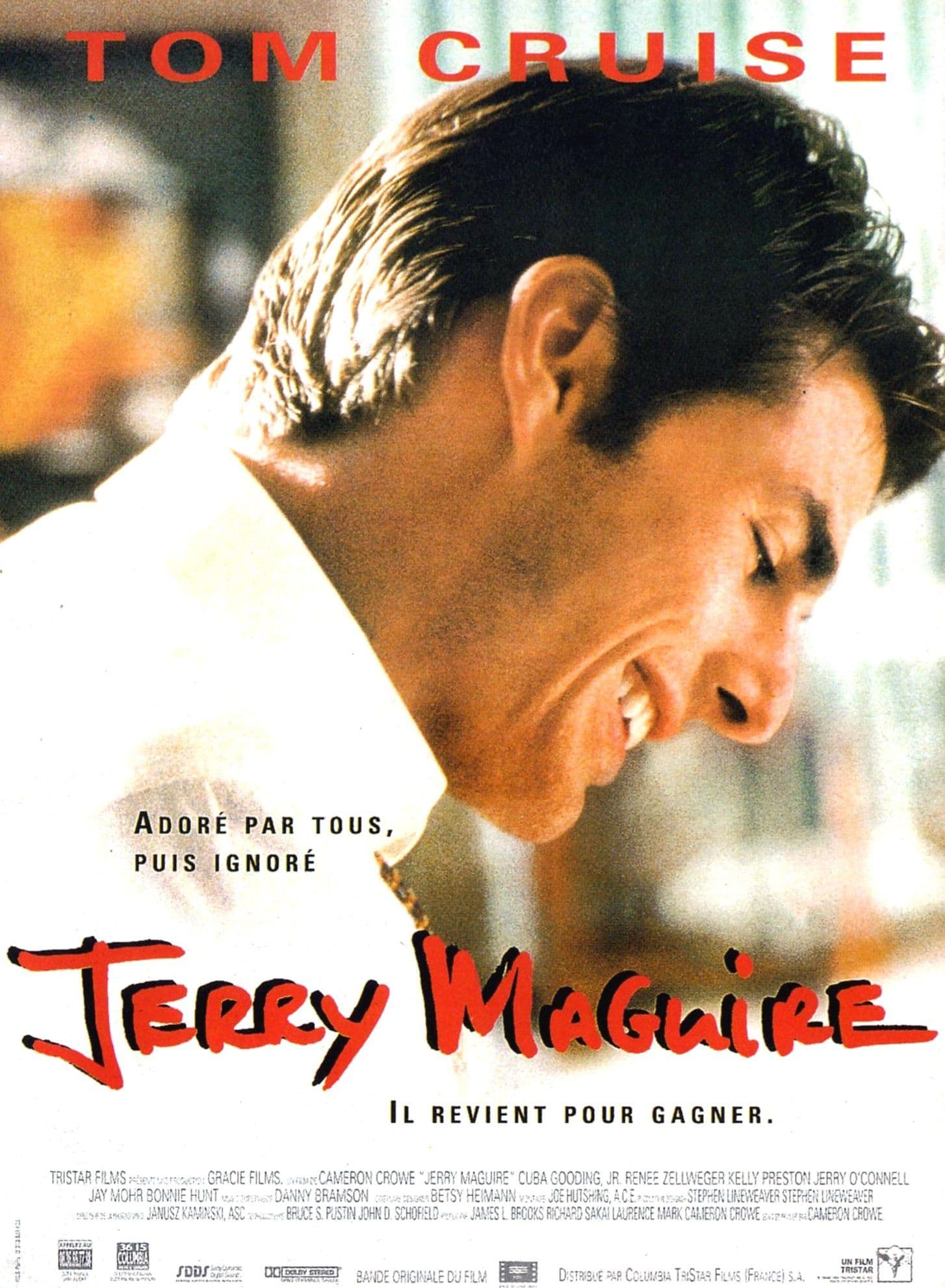
Jerry Maguire
A sports-agent rewrite of the rom-com — conscience, contracts and the courage to keep one client.
// The setup
PLAYBACK STARTED
Remember the moment a talent agent writes a brutally honest memo and promptly loses his world? That’s Jerry Maguire: a movie that insists its messy, human centre — one man’s awkward conscience — is enough to reshape a career, a relationship and a business. It still rewards viewers who like their movie drama caught between boardroom bargaining and something that feels like genuine feeling.
THE MOVIE
Jerry Maguire is still the reason this movie works
If you want the short answer to why we still talk about this film, here it is: it starts with a man having a crisis of conscience. Jerry Maguire writes a candid 'mission statement' arguing for fewer clients and more personal commitment, then sends it out and watches his world unravel.
That memo is not just a plot device; it’s the engine. The distribution of Jerry’s beliefs costs him his job and most of his clients, and the movie becomes about how someone rebuilds when the market rewards the opposite behaviour.
Cameron Crowe wrote and directed the picture, and Tom Cruise plays the agent at the centre of all the awkward courage and second chances. The film’s mix of workplace stakes, romantic complications and moral scruples is what keeps it interesting across its two-hour run.
THE SETUP
The idea that sets Jerry Maguire in motion
The movie hinges on a simple, risky proposition: Jerry decides the industry is too transactional and tries to flip the script. He writes a frank manifesto proposing fewer clients and more personal service.

Predictably, that doesn’t sit well with his firm. When Jerry is fired, his professional life collapses quickly — most of his clients leave, and he’s left picking up the pieces.
The real engine after that is pragmatic and emotional at once. Jerry attempts to rebuild as an independent agent and, crucially, manages to keep one client at his side: Rod Tidwell.
What gives the setup life are the everyday conflicts — contract negotiations, rival offers from other agents, and the slow, often difficult work of convincing people to trust you again. Those mechanics keep the film grounded even when it leans into romance and comedy.
THE CHARACTER
Why Jerry Maguire matters
Jerry is the sort of protagonist who makes the whole movie exist because he chooses to be inconvenient. His late-developing ethical impulse — the one that sets him against the commercial incentives of his agency — is not glamorous. It’s stubborn, embarrassing and oddly human.
That conflict gives the film shape. The inciting incident is literal: the mission statement he writes and sends out. It’s small in dramatic terms but enormous in consequence, and watching Jerry deal with the fallout is the film’s steady work.
He also matters because the story hooks his professional life to his personal one. What begins as a business gamble becomes tangled with family and romantic choices, which is why the theme of family keeps reappearing around him.
Most of the film’s momentum comes from him stumbling through a moral reorientation while trying to hold on to dignity and, crucially, to people who might still care.
THE PERFORMANCE
Why Cuba Gooding Jr.'s performance matters
One practical reason to revisit the film is the way Rod Tidwell’s presence lifts the story’s stakes. The performance received a very clear stamp of recognition: Cuba Gooding Jr. won the Academy Award for Best Supporting Actor for the role.

That award flags Rod as more than a foil; he’s central to the film’s bargain about loyalty and respect between agent and client. Rod’s relationship with Jerry is a through-line that forces business decisions to have emotional consequences.
Because the role was singled out at the Academy Awards, it’s fair to treat Rod as one of the film’s engines — the player whose career matters to Jerry’s moral and professional rehabilitation.
Even stated simply, the chemistry of the agent–client relationship is part of what makes Jerry’s decisions mean something in practice rather than just sounding noble on paper.
UNDER THE SURFACE
Jerry Maguire has more on its mind than the plot suggests
At face value the film is about contracts and client lists; underneath it’s about trying to be a better person where the system rewards the opposite. Put bluntly: redemption and moral reorientation happen inside a commercial industry.
Loyalty is another steady drumbeat. The emotional work of keeping one client and proving you’ll fight for them turns business decisions into personal ones, and the film uses that to examine accountability.
There’s also a running concern with work–life balance. Jerry’s choices force him to negotiate ambition against family and the everyday demands of parenting and relationships.
Finally, family and parenthood act as stabilisers — reminders that the stakes are not just commissions but people’s lives. Those themes keep the movie feeling like more than a rom-com wrapped around sports.
THE FILMMAKING
How Jerry Maguire was put together
Cameron Crowe wrote and directed the film, and the crew choices behind the scenes helped shape its texture. On the technical side, the editing credits include Joe Hutshing and David Moritz, a detail that matters because the film moves constantly between boardroom tension and quieter domestic beats.
That editorial rhythm — switching from negotiation scenes to more intimate moments — is central to how the movie balances its mixed-genre ambitions. The cuts and transitions let it breathe when it needs to and hurry when the business stuff gets tense.
Crowe’s dual role as writer–director also keeps the film coherent: the same sensibility that crafts the dialogue is steering the pacing and scene choices.
So, while the film’s surface mixes workplace comedy with romance and sports drama, the way it’s stitched together gives that mix a steadier pulse than the premise alone might promise.
PURE 80S
Jerry Maguire could not belong to any other decade
The story owes much to the sports-business climate of the 1990s. Crowe shadowed real-life agents and worked with a technical consultant from the industry, which roots the picture in the era’s growth of star agents and the professionalisation of athlete representation.
Released in December 1996, the film also sits comfortably in a 1990s tendency to blend romantic comedy with workplace narratives — films that wanted both heart and the mechanics of modern careers.
That background explains why the movie treats contract negotiations and client poaching as material for drama rather than just background detail; the decade’s changing sports economy makes those scenes feel immediate.
Ultimately, Jerry Maguire reads like a 1990s film because it mixes personal feeling with industry mechanics in a way that was very much of that moment.
THE LEGACY
Why Jerry Maguire still matters
There are concrete reasons people still bring the film up. It received seven Academy Award nominations and won one Oscar — Cuba Gooding Jr. took Best Supporting Actor — which underlines how the industry itself acknowledged the movie’s strengths.
It also did well commercially worldwide, which pushed it into mainstream visibility rather than leaving it as a small cult curiosity.
A handful of lines and moments entered popular conversation and even turned up on American Film Institute lists of movie quotes; those echoes keep the film in memory beyond plot summaries and box-office figures.
Finally, the picture is often referenced when people talk about 1990s films that blend sports, romance and workplace drama — a useful shorthand for a particular kind of mainstream movie from the decade.
THE VERDICT
Does Jerry Maguire still hold up?
Yes — but with a small rider. If you watch it for the idea of a flawed professional trying to put conscience before commission, the central setup still lands: Jerry’s mission statement and the firing that follows give the story a clear moral cause-and-effect that animates everything that follows.
The film earns its emotional weight because Jerry must rebuild a career while trying to form a lasting relationship with Dorothy, and because he has to prove his convictions in the marketplace of clients and rivals. That mix of business-and-heart is precisely the film’s promise.
The presence of a stand-out supporting turn (Rod Tidwell, acknowledged with an Academy Award) and a trio of leads who critics singled out at the time help the movie maintain its appeal: it’s both a character piece and, in practical terms, a convincingly domestic drama about choices.
If you’re wondering whether to revisit it, think of Jerry Maguire as a movie that still matters when you want a film where moral stubbornness meets contract negotiation — and occasionally wins.
// Featured in
More about Jerry Maguire
Share this movie
// Keep watching
More movies from the 90s
If Jerry Maguire is your kind of movie, there's plenty more on the shelves worth rewinding.

1999 // VHS
10 Things I Hate About You
Sibling rules, a rooftop serenade and one very stubborn Kat — Shakespeare in a school corridor.

1999 // VHS
American Beauty
Lester Burnham, suburban rot and a midlife argument that still stings.

1999 // VHS
Any Given Sunday
Al Pacino's coach anchors the chaos of a film about football turned into product — loud, messy and oddly persuasive.