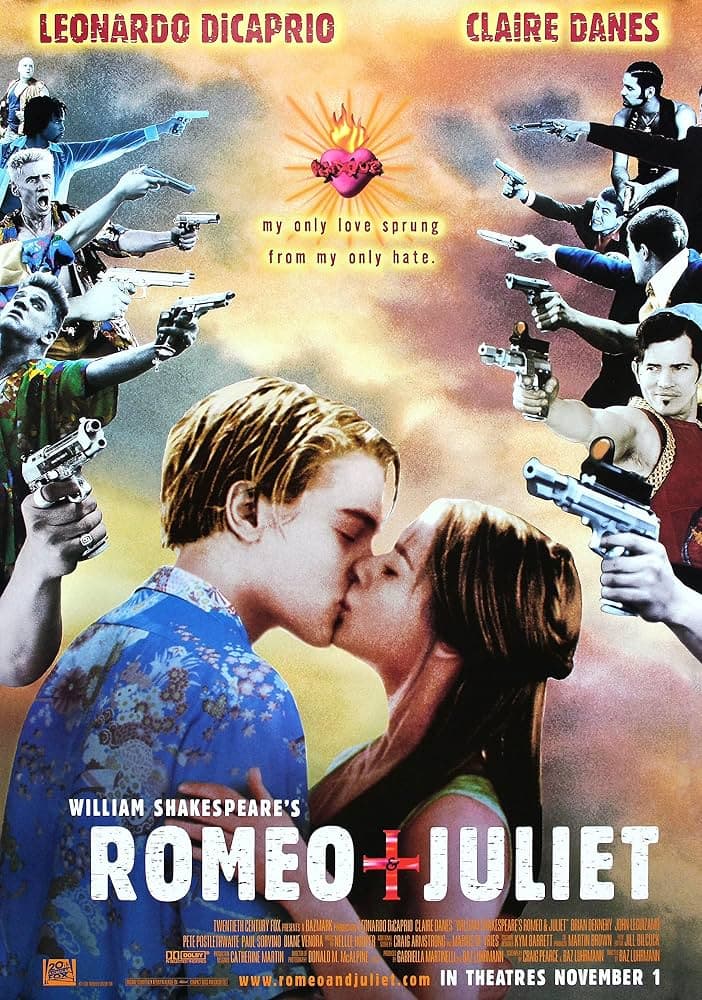
Romeo + Juliet
Verona Beach: Shakespeare with guns, pop music and teenage urgency.
// The setup
PLAYBACK STARTED
Baz Luhrmann's Romeo + Juliet straps Shakespeare into the MTV era and lets it sprint. Keeping the original language while moving the action to a stylised "Verona Beach" was a risk; casting Leonardo DiCaprio and Claire Danes as the young lovers made it feel like something urgent rather than dusty.
THE MOVIE
Romeo Montague is still the reason this movie works
There’s a simple spine to this whole exercise: take Shakespeare’s language, shove it into a different century’s visual world and watch whether the words still bite. Luhrmann transposes Romeo and Juliet to a stylised modern place called "Verona Beach" and refuses to dumb the play down; the speech remains Shakespeare’s even when the world around it screams late-20th-century spectacle.
That collision — ancient phrasing delivered across police, branded visuals and firearms replacing swords — is what makes the film feel alive. It isn’t novelty for novelty’s sake; it’s a theatre-versus-television stunt with real dramatic teeth, because the lovers’ risk now reads like youth culture crashing into adult power.
And at the centre of that collision is Romeo Montague, played by Leonardo DiCaprio, opposite Claire Danes as Juliet. Their casting turns the modernised chaos into something centred and recognisably human: the movie can be loud and showy, but the story still moves because Romeo wants, acts and crashes into consequence.
THE SETUP
The idea that sets Romeo + Juliet in motion
At its core the film keeps the original engine of the play: two young people from warring families fall in love, marry in secret and then watch events cascade out of control. That simple throughline still provides the emotional logic even when the surrounding details change.
Luhrmann modernises the mechanics so the feud reads like high-stakes contemporary power: swords become firearms, political authority is recast as police and the families behave like corporate or mafia empires. Those swaps aren’t just visual gags — they give the story up-to-date levers that make the conflict feel plausible in Verona Beach.
Key plot devices survive the transplant. Father Laurence arranges the clandestine marriage; a faked-death plan and a time-sensitive message create the misunderstandings that escalate the tragedy. The film keeps those structural beats while reworking how they register in a modern media-saturated world.
THE CHARACTER
Why Romeo Montague matters
Romeo is the story’s hinge: he’s poetic, quick to fall and quicker to act. Those traits are exactly what make the film’s modern choices land — a brooding young man in a loud, consumer-age city reads differently to viewers than a dimly lit Renaissance lover, but the emotional math is the same.
Leonardo DiCaprio plays Romeo Montague, and the casting places a recognisable young star at the centre of Luhrmann’s spectacle. That’s important because the movie asks you to follow one teenager’s impulses through a world that otherwise delights in spectacle and noise.
The film also leans heavily on the relationships around Romeo. Mercutio is his close friend and theatrical counterpoint whose death pushes the feud into open violence; Father Laurence is the pragmatic priest who attempts to engineer a private solution. Those supporting dynamics keep Romeo’s decisions grounded in human ties rather than abstract fate.
Finally, the family vendetta and honour code remain the story’s gravity. Romeo’s choices have consequences within that system, and the modern setting only sharpens how quickly adolescent emotions collide with adult institutions of power.
THE PERFORMANCE
Why Leonardo DiCaprio's performance matters
It’s fair to say the film’s success hinged on its leads being able to carry Shakespeare’s language through Luhrmann’s feverish world. Contemporary reviews singled out both DiCaprio and Claire Danes as central to whether the experiment worked, so the performances were part of the conversation from day one.
On the evidence of the awards circuit, the performance aspect wasn’t ignored: DiCaprio received the Silver Bear for Best Actor at the 1997 Berlin International Film Festival for his work in this film. That kind of recognition matters because it shows the modernised staging didn’t prevent critics and juries from taking the acting seriously.
Put simply: Luhrmann handed DiCaprio a lot to navigate — heightened language, big visuals, intimate beats — and the fact that reviewers discussed the leads suggests their presence helped translate the play into the film’s register.
So when you watch Romeo + Juliet now, part of what keeps the movie coherent is that the central performances were noticed and rewarded in their time; they’re the human thread through the artifice.
UNDER THE SURFACE
Romeo + Juliet has more on its mind than the plot suggests
Yes, it’s a love story — but Luhrmann’s version is as interested in how that love looks in a media-saturated age as it is in the feeling itself. The film is a modernisation of a classical text that asks what Shakespeare’s language does when it’s amplified by late-20th-century spectacle.
At its heart it remains a portrait of star-crossed youth: teenagers whose hunger and recklessness collide with fixed social structures. That tension — youthful urgency against inherited vendetta — is the emotional motor that keeps the narrative honest.
The movie is also preoccupied with media and spectacle. By threading modern branded visuals, news inserts and contemporary mise-en-scène through the play, Luhrmann makes the feud feel like a public performance, not just a private family quarrel.
Finally, the film is a practical exercise in translating language across eras. Keeping Shakespeare’s dialogue while reworking the surrounding world forces the audience to reconcile poetic lines with modern behaviour, and that friction is where the film finds its intellectual and emotional interest.
THE FILMMAKING
How Romeo + Juliet was put together
Luhrmann and Craig Pearce built a deliberately created world — Verona Beach — that mixes timeframes and visual cues. The point isn’t to imitate a real city so much as to stage a theatrical cinematic environment where classical language and modern behaviour collide.
Technically the film operates with a restless energy: it uses rapid cutting, handheld camera work and intercut news-style inserts to produce a frenetic visual rhythm. Those choices keep the film moving at a pace that matches its teenage protagonists rather than the measured tempo of tradition.
Production design and costume play a clear role in signalling family difference: the Montagues and Capulets are modernised through clothing and set choices that mark class and identity. Those visual cues help the audience read who belongs where without explanatory exposition.
Finally, the movie is part of Luhrmann’s early stylistic cycle: a heightened, music-driven aesthetic and theatrical production design link it to his other work, so the filmmaking here is consciously operatic rather than naturalistic.
PRACTICAL EFFECTS
The effects work that gives Romeo + Juliet its physical personality
The film leans on staged action and real stunt work to sell its violent moments. Gunfight set pieces and choreographed action were photographed both on constructed sets and on location, so the physicality feels rooted in practical filmmaking rather than abstract CGI spectacle.
That combination of studio and location stunt work makes the confrontations register as events in a lived environment — even when the wider world is stylised.
Photographing those sequences on set and on location also allows the movie to oscillate between intimate scenes and bigger, more public brawls without losing coherence.
In short: the film’s violent set pieces are assembled through traditional stunt and production methods rather than being purely digital constructs.
PURE 80S
Romeo + Juliet could not belong to any other decade
Romeo + Juliet is very much a 1990s product in how it sells itself: a youth-focused commercial film that pairs a contemporary pop/alternative soundtrack with MTV-style editing while daring to carry Shakespearean dialogue. That hybrid gives it a distinctive moment-in-time energy.
The casting and marketing placed the film squarely inside 1990s teen-star culture, accelerating Leonardo DiCaprio’s emergence into mainstream stardom. The movie felt like something aimed directly at young audiences who recognised the look and the music as part of their world.
Musically, the film follows a 1990s trend of hybridised scores — blending orchestral material with contemporary production — which makes the soundtrack as much a commercial product as a dramatic tool.
All of these choices anchor the film in its decade: it wears the 1990s’ appetite for fusion and spectacle on its sleeve rather than pretending to be a period piece.
WATCHING IT NOW
What has aged — and what hasn't
The film’s focus on teenagers has proved durable. As a teen drama that puts adolescent urgency front and centre, it still speaks to the way young passion can feel absolute and consequential.
The star-crossed youth theme is timeless: two people falling hard against the grain of their families’ expectations remains recognisable to modern viewers, and Luhrmann’s decision to foreground that immediacy helps the film retain emotional clarity.
The family vendetta and honour code also age well because they’re simple structural facts the movie never tries to complicate: the conflict is a force that constrains choice, and that straightforward antagonism still reads clearly.
Where the film is most of its time-specific self is in its formal flourishes — the music-driven editing and the MTV-inflected rhythm — but those are also part of its character. Whether they charm you or grate depends on taste; the story’s thematic bones remain uncomplicated and readable.
THE LEGACY
Why Romeo + Juliet still matters
The film left a measurable footprint in awards and in how people talk about modern Shakespeare on screen. Its film music won the Anthony Asquith/BAFTA award, and the production earned multiple BAFTA recognitions including Best Direction and Best Adapted Screenplay.
At the 1997 Berlin International Film Festival the movie received the Alfred Bauer Prize and Leonardo DiCaprio was awarded the Silver Bear for Best Actor — concrete markers that the industry took Luhrmann’s gamble seriously.
The soundtrack itself became a distinct commercial and cultural element: its choral/pop treatments, including notable arrangements, helped the film reach audiences that might not otherwise seek a Shakespeare adaptation.
Academically and critically, the film is commonly cited as a prominent example of late-20th-century modernising adaptations of Shakespeare and as a reference point for attempts to make the Bard speak to teen audiences.
THE VERDICT
Does Romeo + Juliet still hold up?
Yes — with an asterisk. If you’re drawn to bold staging, theatrical music-driven filmmaking and a modernised collision of language and image, Luhrmann’s Romeo + Juliet still delivers. The film keeps Shakespeare’s lines while moving the action into a glossy Verona Beach where swords become guns and family power reads like corporate or mafia empires.
The story itself — two lovers caught in a family vendetta, a clandestine marriage arranged by Father Laurence, a faked-death plot reliant on a time-sensitive message — remains structurally intact and continues to move when the leads give you something to care about.
Part of why it still works is the centre: Leonardo DiCaprio as Romeo anchors the film’s wild choices, and contemporary responses made it clear the leads mattered; the performance even won DiCaprio a Silver Bear. That recognition isn’t proof the movie suits every taste, but it shows the gamble paid off for many viewers and juries.
So watch it for the experiment: a 1996 attempt to make Shakespeare feel like pop culture, urgent and televised. It’s loud, theatrical and occasionally excessive — but it’s never timid. If you want the play dressed in a new costume that refuses to whisper, this is still worth your time.
Share this movie
// Keep watching
More movies from the 90s
If Romeo + Juliet is your kind of movie, there's plenty more on the shelves worth rewinding.
1999 // VHS
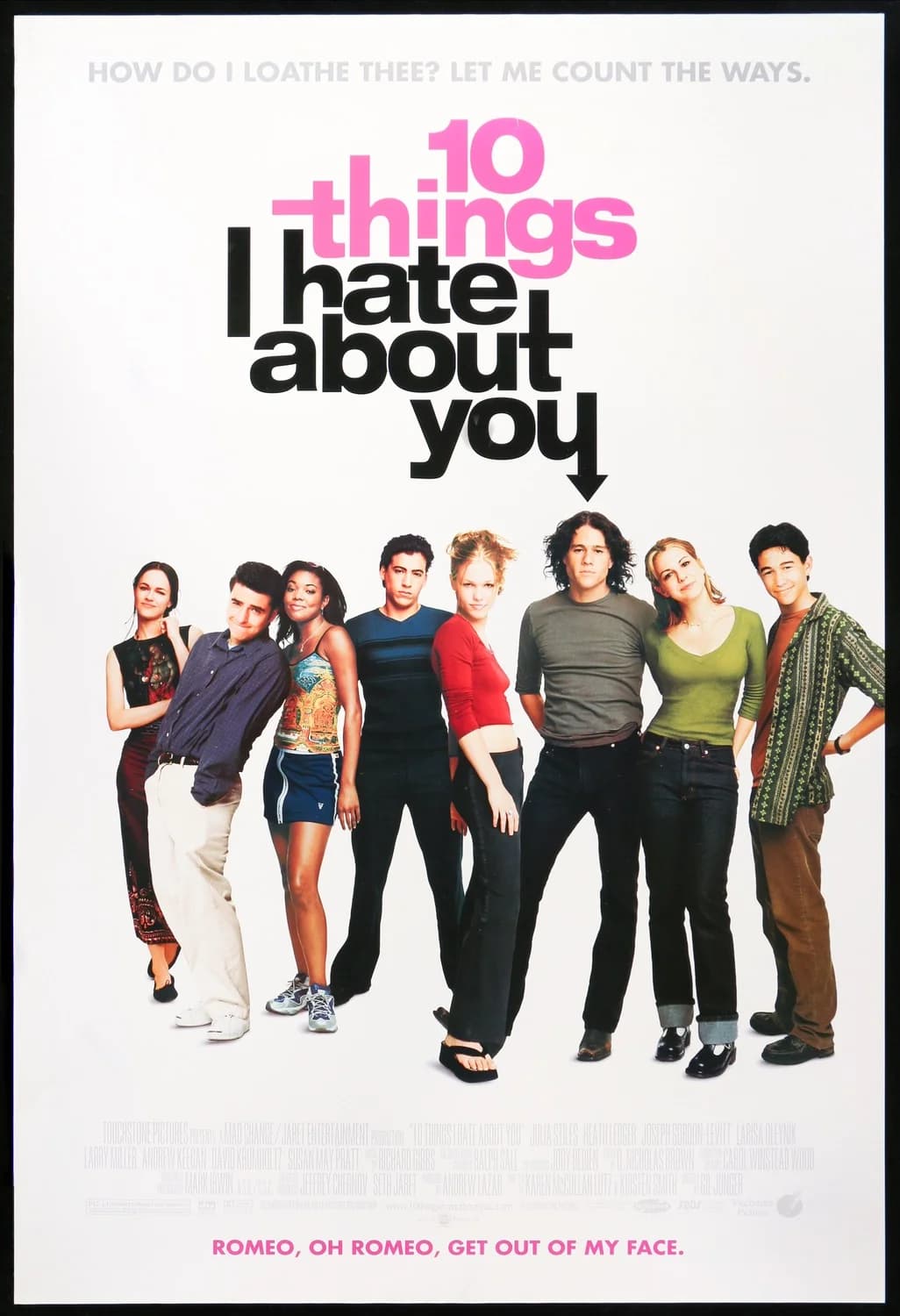
10 Things I Hate About You
Sibling rules, a rooftop serenade and one very stubborn Kat — Shakespeare in a school corridor.
1999 // VHS
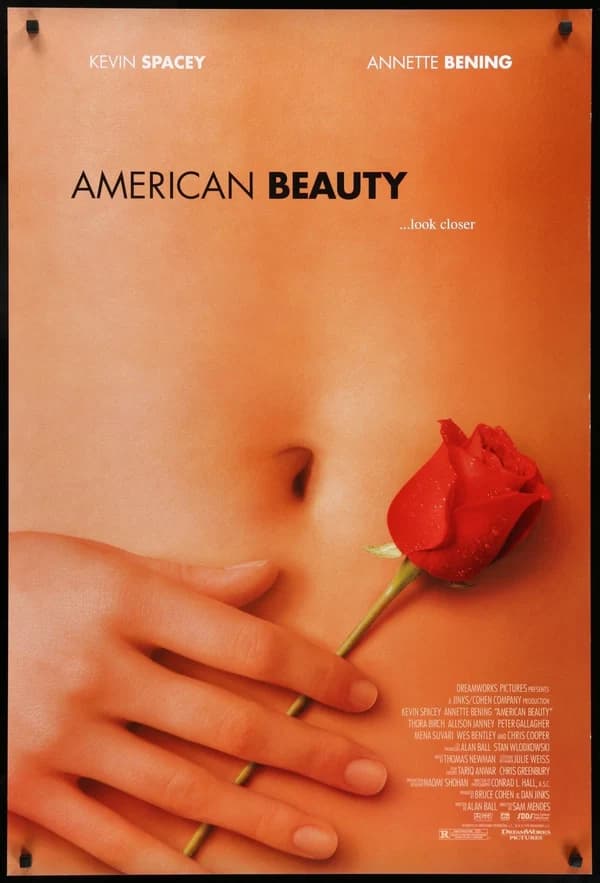
American Beauty
Lester Burnham, suburban rot and a midlife argument that still stings.
1999 // VHS
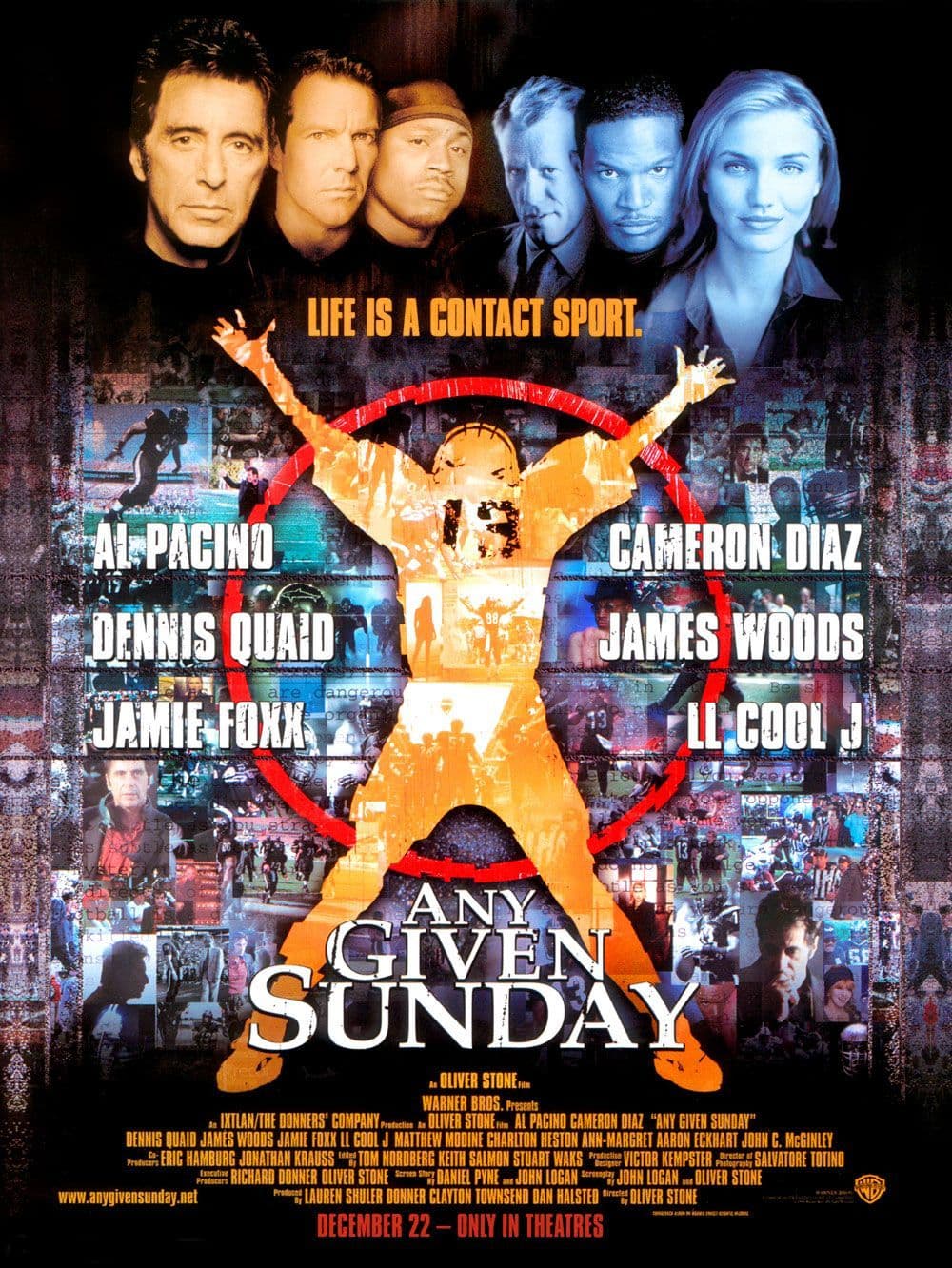
Any Given Sunday
Al Pacino's coach anchors the chaos of a film about football turned into product — loud, messy and oddly persuasive.