Species
A seductive, alarmingly literal alien — and a very 1990s panic about science, sex and containment.
// The setup
PLAYBACK STARTED
Species still hooks you with a single, bracing idea: decode a radio signal, grow an alien from DNA and then try to stop it from reproducing. It’s a summer creature movie built around an unnerving centre — Sil — and it remains worth revisiting precisely because the film makes that centre matter.
THE MOVIE
Sil is still the reason this movie works
Talk about Species and people almost always get to Sil first. That’s fair: the film’s central conceit is blunt and brilliant in its simplicity — a radio telescope intercepts a message that can be decoded into a sequence used to build alien DNA, and scientists grow a half-human, half-alien embryo called Sil.
What follows is the kind of set-up that refuses to sit politely in the lab. Early scenes show attempts to control or terminate the subject; she breaks containment, bolts toward Los Angeles and turns a scientific problem into a citywide disaster. The movie spends most of its time answering the same question: how do you stop something that doesn’t play by human rules?
Roger Donaldson directs this 1995 creature picture with an engine built around instinct. Sil is presented as an emergent, instinct-driven hybrid whose behaviour is driven by survival and reproduction, not human etiquette — and that single, uncompromising behaviour gives Species its personality and keeps the film moving for its 108 minutes.
THE SETUP
The idea that sets Species in motion
Species is economical about its premise: a decoded extraterrestrial signal furnishes a recipe for alien DNA, and scientists use that recipe to grow a hybrid they name Sil. That germ of an idea is the engine — science hands the world a problem it didn’t ask for.
To stop the threat a retrieval team is assembled. Their mandate is straightforward and grim: track, capture or, if necessary, kill Sil before she can reproduce. It’s a classic containment-versus-consequence scenario, only with sex and genetics standing in for more familiar monster-movie threats.
A nasty wrinkle is Sil’s method: she uses sexual attraction and seduction as a biological tactic to mate with human males. The plot treats that mechanism as both a horror device and a logical outgrowth of her hybrid instincts.
The film keeps flipping between lab exposition and the hunt through the city, so the ethical questions of scientific experimentation sit elbow-to-elbow with the practical business of protecting the public. That tension is what keeps the film from turning into a straightforward stalk-and-kill.
THE CHARACTER
Why Sil matters
Sil matters because the whole movie curves around her needs. She isn’t written as a villain with a manifesto; she’s an emergent organism with a biological directive. That makes her less predictable and, oddly, less human — which is exactly the point.
The cast surrounds that directive with human responses: scientists who created her, law-enforcement types trying to contain her and civilians caught in the middle. But it’s Sil’s single-mindedness — reproduction and survival — that defines every scene she touches.
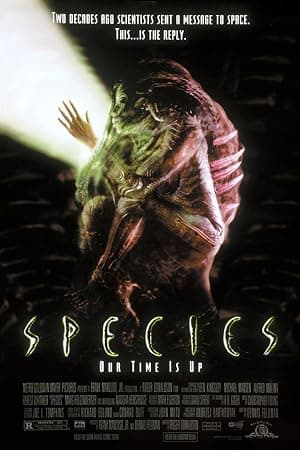
The role is played by Natasha Henstridge (with Michelle Williams as Young Sil), and the production leaned on a mix of creature design and physical effects to realise the character. H. R. Giger supplied the original design ideas, which were then translated into practical suits, prosthetics and digital work.
That blend of approaches gives Sil a physical personality: she reads as both alluring and alien, an uncomfortable hybrid whose presence forces every other character to respond — scientifically, morally or violently.
UNDER THE SURFACE
Species has more on its mind than the plot suggests
At face value it’s a flesh-and-blood monster movie. Under the surface, Species is quietly occupied with the consequences of playing God: decode a cosmic message, assemble DNA, then watch what you’ve made want things you can’t control. That ethical knot is threaded through the film’s action.
There’s a very specific strain of 1990s anxiety tied up in the film’s eroticised threat. The story treats female sexuality as a reproductive weapon — Sil’s seduction is literalised and made monstrous — and the film leans into that fear as part of its horror grammar.
Otherness and hybrid identity are central too. Sil isn’t simply ‘alien’; she’s a crossover, and the film dramatises the friction of belonging nowhere. Characters have to decide whether containment, understanding or destruction is the right response — and those decisions expose moral fault lines.
Finally, the movie asks about the ethics of force. If science creates a being that threatens humans, who gets to decide how to deal with it? The retrieval team’s mandate and the laboratory’s culpability sit in uncomfortable opposition, so violence becomes a default answer to a problem born in a lab.
THE FILMMAKING
How Species was put together
Species sits in that mid-90s moment when practical creature work and emerging digital pipelines met in the middle. The production used contemporary digital visual-effects workflows while also relying on physical creature-making to sell Sil’s presence.
Visual-effects supervision and the integration between photography and effects were significant to the film’s look, so the movie reads as an exercise in marrying different technologies rather than favouring one as inherently superior.
That hybrid technical strategy is practical storytelling: some beats need the tactile menace of a suit or puppet, others require augmentation that only digital work could provide. The choices are functional — they serve the film’s need to make Sil believable across moods and locations.
Roger Donaldson’s direction stitches those pieces together into a mainstream genre picture: it’s not coy about spectacle, but it keeps the story’s ethical and procedural questions close enough that the effects always have something to do beyond shock value.
PRACTICAL EFFECTS
The effects work that gives Species its physical personality
Creature realisation on Species was deliberately physical. Steve Johnson’s XFX produced practical suits, prosthetics and puppetry — the film uses mechanical puppets and suit elements in several sequences to give Sil a tactile presence.
Those practical pieces didn’t stand alone. Digital character work and CGI from Richard Edlund’s Boss Film Studios were used alongside the hands-on effects, so scenes could be enhanced or extended where a puppet or suit alone couldn’t quite do the job.
H. R. Giger’s original creature design provided the visual starting point, and the production translated those designs into working effects through a mix of practical fabrication and digitisation workflows.
The result is a character realised by layered techniques: Sil’s physicality is rooted in prosthetics and puppetry, with digital augmentation used when the story demanded movement or geometry impractical for on-set devices.
PURE 80S
Species could not belong to any other decade
Released in the summer of 1995, Species sits in a specific cultural moment when Hollywood was experimenting with combining hands-on creature craft and new CGI techniques. The film’s technical choices reflect that transitional period.
The premise — an extraterrestrial DNA sequence decoded from a radio signal — also taps into a distinctly 1990s set of preoccupations: genetics, SETI and biotechnology were mainstream curiosities, and the idea of an engineered being fit neatly into popular anxieties.
Because it wears its tech anxieties on its sleeve, Species reads like a document of its time: it’s a mainstream genre film using the language of contemporary science to animate its scares, rather than hiding behind purely supernatural tropes.
Those elements make the movie feel rooted in its decade: the plot is a conversation with 1990s science and the filmmaking practices of the era, rather than a story that could have been made unchanged in a different cinematic moment.
WATCHING IT NOW
What has aged — and what hasn't
Seen today, some of Species’ choices are of their moment. Commentators since release have noted that parts of the film — especially the overt sexualisation and a handful of special-effects shots — read as very mid-1990s studio horror rather than matching contemporary VFX expectations.
That said, the physicality of the creature work — the Giger-derived design realised through practical makeup and suit elements — still gives Sil a tangible menace that many purely digital creatures lack on a first pass.
Where the film might feel dated is in how it stages seduction and reproductive threat; those beats are framed in a way that reflects 1990s genre shorthand and can feel blunt to a modern viewer.
But the film’s core questions about scientific hubris and containment continue to land: the narrative still forces you to ask uncomfortable questions about responsibility, and that moral friction doesn’t age the way trendy visual effects do.
THE LEGACY
Why Species still matters
Species established itself as a 1990s science-fiction horror property: it spawned a theatrical sequel and later direct-to-TV/DVD follow-ups, which locked the title into franchise territory.
When people talk about the film now they most often return to Sil’s creature design — the Giger-y aesthetic realised by practical effects and early CGI — because that visual combination is the element that gives the film a distinctive, slightly uncomfortable texture.
Natasha Henstridge’s debut as Sil also became a notable early credit; the casting and the role’s prominence drew attention and helped fix the film’s place in pop-culture conversations around 1990s genre cinema.
So Species matters because it packaged a provocative central creature, a clear premise about science-run-amok, and production choices that made it feel of its moment — all ingredients that left a visible footprint on the decade’s genre slate.
THE VERDICT
Does Species still hold up?
Yes — with qualifications. The film’s central premise is sharp and economical: decode an extraterrestrial sequence, grow a hybrid, then scramble to capture or destroy it before it reproduces. That clear through-line keeps Species from wandering, and Sil is a compelling enough centre to justify the ride.
If you expect state-of-the-art visual effects or a subtle treatment of its sexual politics you might be disappointed: some shots and the overt sexualisation read very much as mid-1990s studio horror. But those are issues of taste and era, not of storytelling coherence.
For what it is — a 1995 science-fiction/monster/horror picture directed by Roger Donaldson that alternates laboratory exposition with a citywide hunt and rests on the problem of how to handle a being that doesn’t follow human norms — Species mostly delivers. The ethical questions about playing God and the tensions around containment give the film more to chew on than a straight creature feature.
So watch it for Sil and for the particular, slightly uncomfortable mixture of science and sex that the film sells. It won’t feel modern in all its choices, but its central idea still bites — and that, in a movie like this, counts for a great deal.
Share this movie
// Keep watching
More movies from the 90s
If Species is your kind of movie, there's plenty more on the shelves worth rewinding.
1995 // VHS
Toy Story
A pull‑string cowboy, a deluded space ranger and a small, very particular war over being loved.
1999 // VHS
10 Things I Hate About You
Sibling rules, a rooftop serenade and one very stubborn Kat — Shakespeare in a school corridor.
1999 // VHS
American Beauty
Lester Burnham, suburban rot and a midlife argument that still stings.