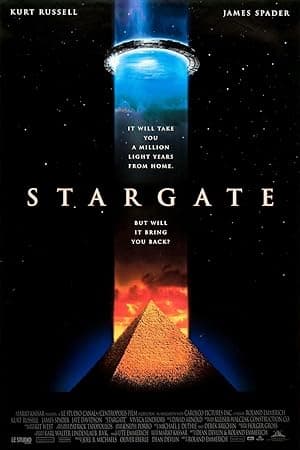
Stargate
A wormhole, a soldier who has nothing left to lose, and gods who travel by spaceship.
// The setup
PLAYBACK STARTED
Stargate is the sort of movie that hooks you with a single, irresistible idea: a circular stone portal in Giza that opens onto another world. It then pairs that sci-fi conceit with a surprisingly human centre — a soldier carrying guilt — and lets the film wobble between archaeology, military procedure and myth. If you remember the kawoosh, you remember the feeling: adventure with an edge.
THE MOVIE
Col. John "Jack" O'Neill is still the reason this movie works
Stargate begins with an image so simple it becomes a promise: a huge circular stone device in Giza that isn’t an archaeological curiosity but an actual doorway to somewhere else. That premise — ancient monument as technological portal — is the engine. It lets the story be a globe-trotting adventure while also asking a slightly cheeky question about history: what if the gods were just aliens with better kit?
The movie pairs that idea with two very different people: Daniel Jackson, the academic who cracks the gate’s symbols and insists on following where curiosity leads, and Col. Jack O'Neill, a career soldier whose willingness to step through the gate is driven by personal grief. The contrast — bookish inquiry versus military bluntness — gives Stargate its immediate human stakes and its dramatic bounce.
Roland Emmerich stages it like a blockbuster: big ideas, big sets, a clear mission. But when push comes to shove, the film earns the right to be remembered because it keeps that mission tethered to a damaged man. Walk through the gate and you don’t just get aliens and chariots; you get someone trying to find a reason to keep going.
THE SETUP
The idea that sets Stargate in motion
You don’t need a scene-by-scene recap to appreciate Stargate’s basic architecture. It’s built on one discovery: a circular stone device unearthed in Giza and traced back to an excavation many decades earlier. That’s the hook — archaeology that turns out to be a map, not a museum piece.
From there, the mechanics are simple and satisfying. An expert deciphers the symbols, figures out the gate isn’t decorative, and convinces the powers-that-be to send a team through. It’s an elegant set-up because it makes the leap from the familiar (an ancient ruin) to the unfamiliar (another world) feel logical rather than goofy.
Once the team arrives on Abydos, the stakes sharpen. The planet is populated by people descended from ancient Egyptians who live under the thumb of a technologically superior ruler. The mission shifts: it isn’t only about exploration but rescue, survival and getting home.
And because the film pairs different approaches — the scientist’s questions versus the soldier’s orders — every scene can serve two purposes. It moves the plot forward and it allows the film to test how curiosity and force answer the same mystery.
THE PERFORMANCE
Why Kurt Russell's performance matters
Kurt Russell anchors the movie in a way that the spectacle needs. Contemporary reactions singled out his portrayal of Jack O'Neill as laconic and world-weary — the kind of soldier who speaks in short sentences because long ones would force him to feel things he’d rather avoid.
That quality matters because the film’s emotional weight comes from O'Neill’s backstory: a career special-operations officer carrying guilt and resignation after a family tragedy, a fact that nudges him toward reckless choices. Russell’s version of the character makes those choices believable; you buy that he might use the gate as an escape as much as a mission.
More than filling a role, the performance shapes Stargate’s tone. When the movie needs to swing between sardonic military pragmatism and quieter moments of doubt, O'Neill provides the fulcrum. His presence keeps the film from becoming only spectacle.
Put simply: the movie’s emotional shorthand — blunt, pained, a little broken — rests on how the lead is played. Without that, Stargate would still be an interesting premise. With it, it becomes a movie that feels alive enough to care about its people.
UNDER THE SURFACE
Stargate has more on its mind than the plot suggests
On the surface, Stargate is a punchy sci-fi adventure about machines and aliens. Underneath it’s quietly wrestling with a few older, surprisingly adult concerns — starting with the ancient astronaut idea that human achievement might be explained by outside intervention. The film uses that conceit to riff on power and origin myths.
It also stages a clear tug-of-war between science and the military. Daniel Jackson’s decoding and insistence on understanding stands against O'Neill’s mission-first mentality. The interplay keeps scenes dynamic: sometimes you need caution and study, sometimes you need bullets and speed.
Personal loss and the possibility of redemption are threaded through the action. O'Neill’s willingness to go through the gate comes from a private place of pain; the story gives him chances to act differently and to carry the consequences of those choices. It’s a small but steady emotional spine beneath the adventure.
Finally, there’s a colonial subtext: an alien with superior technology dominating a human population. That layer isn’t sermonising, but it does give the film something to chew on beyond chases and reveal sequences — a question about how power and technology re-shape societies.
THE FILMMAKING
How Stargate was put together
Stargate’s visual personality leans on tangible, physical filmmaking choices. Production design — led by Holger Gross — built large-scale sets and dressed locations that sell Abydos as a lived-in place rather than a painted backdrop. Those choices make the world feel substantial.
That sense of scale is important because the film trades in big ideas. When you’re asking audiences to accept an ancient device as a cosmic doorway, you repay that leap with environments that feel concrete. The architecture and props do a lot of the heavy lifting.
Roland Emmerich’s direction keeps the pace moving: there’s an appetite for spectacle, but the film usually settles long enough on its characters for the stakes to register. It’s an approach that favours clarity — you always know what the mission is, even when the set pieces stretch.
In short, Stargate looks and feels like a film that chose physical presence over clever tricks. The production design gives the story somewhere believable to happen, and that steadiness lets the more speculative parts breathe.
PRACTICAL EFFECTS
The effects work that gives Stargate its physical personality
The Stargate’s traversal moment — that memorable surge and rip — wasn’t born in a computer. The production filmed the swirl of water inside a glass tube and composited that footage into the gate to make the 'kawoosh' effect. It’s a clever piece of old-school ingenuity that still reads clearly on screen.
That tactile thinking extends to creature and costume work. Guard costumes, Ra’s headdress and other practical designs were fabricated by the effects and creature teams, giving the film its distinctive look. These are physical pieces you can believe people could have made and worn.
Because the movie often prefers hands-on solutions, many moments feel like objects and people occupying the same space rather than layers pasted together. That gives Stargate a reassuringly physical texture.
All told, the film leans on practical craft to translate its sci-fi idea into something tangible. The tricks may be straightforward, but they make the universe feel inhabited rather than purely digital.
PURE 80S
Stargate could not belong to any other decade
Arriving in 1994, Stargate sits squarely in a wave of effects-driven science fiction that defined the mid‑90s. The period was interested in marrying spectacle with high-concept premises, and Stargate’s doorway-to-another-world fit that appetite perfectly.
For Roland Emmerich, Stargate was a visible step toward the kind of commercial filmmaking he’d soon be known for. The film’s scale and ambition signalled a director comfortable with large ideas and the audience size to carry them.
That timing matters because the movie’s balance of practical sets, physical effects and muscular plotting reflects the era’s filmmaking habits. It isn’t a small, intimate indie experiment; it’s built to be seen in a cinema with the lights down.
So, while the film is tied to its moment, that tie is more about approach than nostalgia. It’s a product of a specific phase of mainstream sci‑fi — big, bold, and willing to trade subtlety for momentum.
THE LEGACY
Why Stargate still matters
Stargate’s clearest legacy is institutional: the film launched a media franchise that migrated to television, beginning with Stargate SG-1 and branching into other series. The gate itself became less a one-off spectacle and more a premise that could sustain long stories.
The film’s music and genre recognition also left marks. Composer David Arnold received a BMI Film & TV Award for his score, and the movie earned nominations and awards from genre organisations, including recognition at the Saturn Awards.
There’s also an interesting what-if in the background: the creators initially pictured Stargate as the first part of a trilogy. When those sequels didn’t materialise, television filled the gap — a different route, but one that proved fertile.
So its importance isn’t only about what the movie did on its own screen; it’s about what the idea allowed afterwards. The Stargate became a durable premise for storytelling, not merely a single film’s set piece.
THE VERDICT
Does Stargate still hold up?
Yes — with a sensible caveat. If you’re after modern sci‑fi that interrogates its ideas in minute, deconstructive detail, Stargate isn’t that film. But as a straightforward, idea-driven adventure with a human core, it largely delivers. The premise is still neat: a ring in Giza becomes a stable wormhole and sends people — including an archaeologist and a military squad — to a world where humans live under an immortal’s rule.
What keeps the movie honest is the tension at its heart: getting the team home while arguing, in scene after scene, about how to respond to the unknown. That clash between academic curiosity and military necessity gives the film shape, and it’s a dynamic that still feels immediate.
Kurt Russell’s O'Neill — a soldier carrying real grief — gives the stakes a pulse. Contemporary observers noted his laconic, world-weary take, and that texture matters: the film’s quieter moral choices hang off a character who could easily have been a one-note action type.
If you’re choosing whether to watch it now, think of Stargate as an enjoyable, slightly old-fashioned mixture of brains and brawn. It might not aim for profundity, but it asks a few good questions and wraps them in a solid piece of cinematic craft — and it left a door open that television would walk through for years afterward.
Share this movie
// Keep watching
More movies from the 90s
If Stargate is your kind of movie, there's plenty more on the shelves worth rewinding.
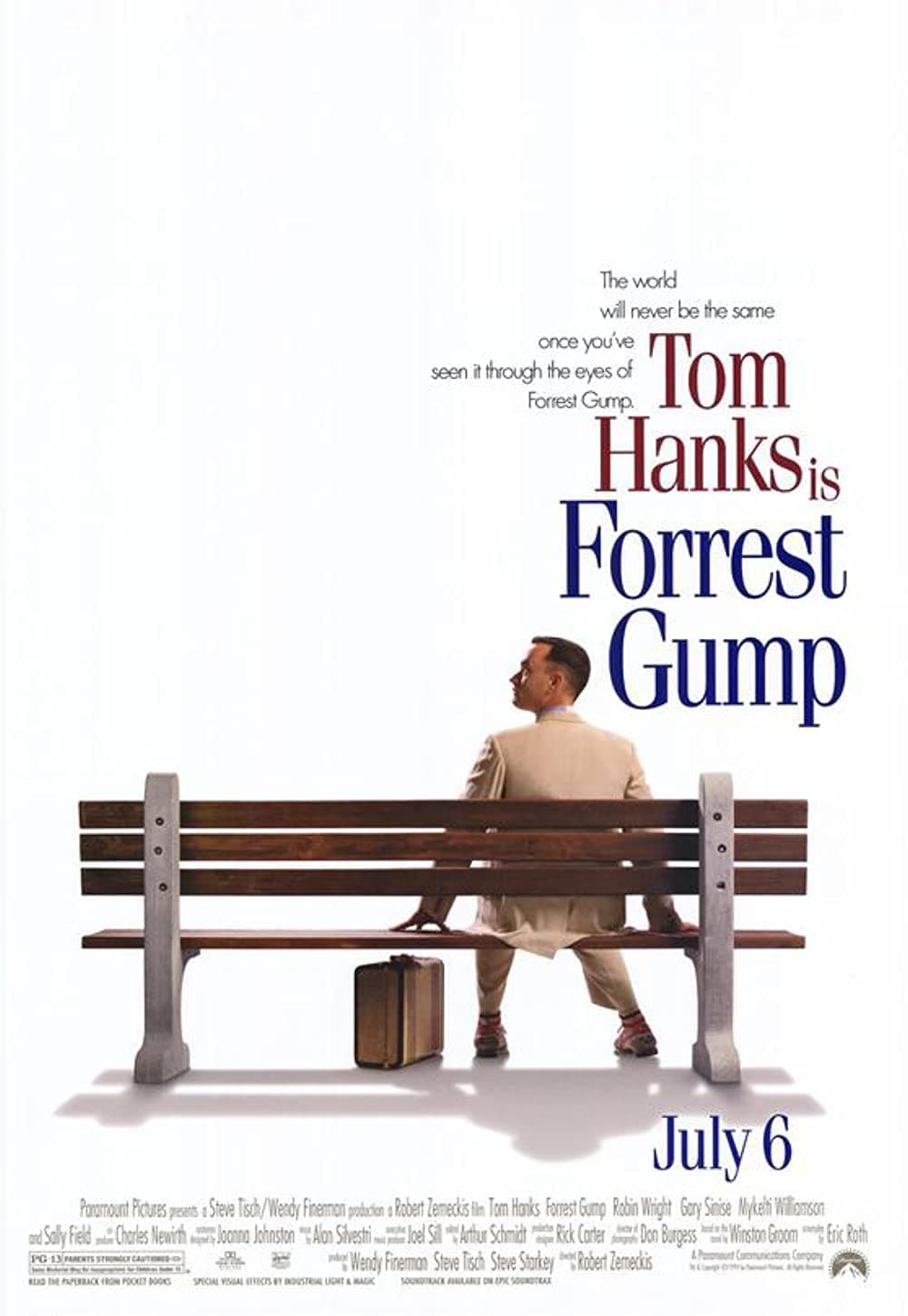
1994 // VHS
Forest Gump
A man on a bench who refuses to make history anything more complicated than a story worth telling.
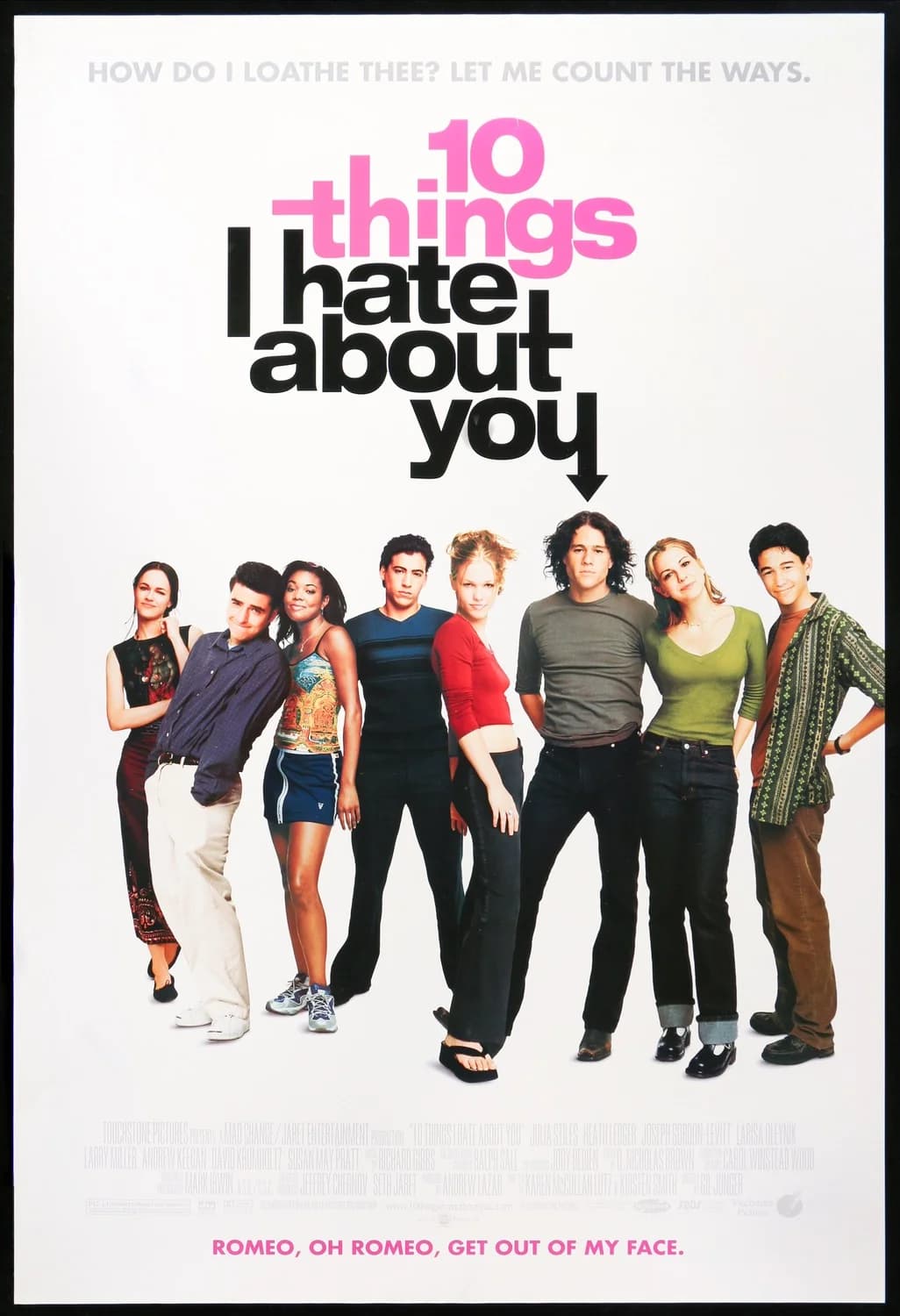
1999 // VHS
10 Things I Hate About You
Sibling rules, a rooftop serenade and one very stubborn Kat — Shakespeare in a school corridor.
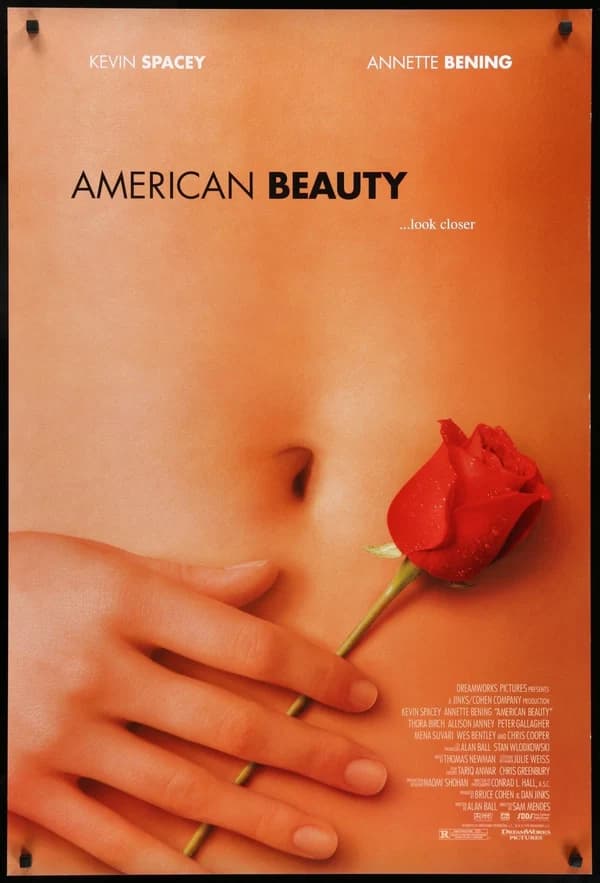
1999 // VHS
American Beauty
Lester Burnham, suburban rot and a midlife argument that still stings.