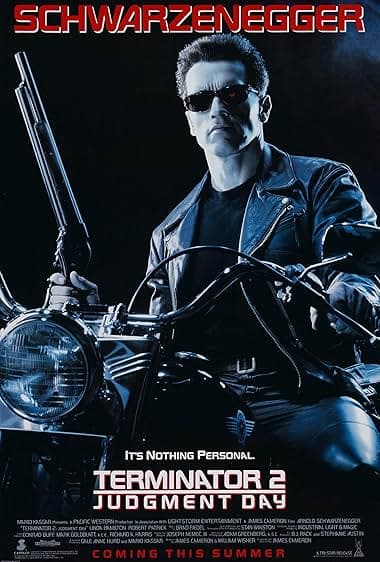
Terminator 2: Judgment Day
A killing machine learns to love, and the rest of the world tries very hard not to explode.
// The setup
PLAYBACK STARTED
There are two obvious reasons people keep coming back to Terminator 2: one is a hulking, blank-faced protector you can’t take your eyes off; the other is that the film treats apocalypse as something you can argue with. James Cameron turned a straightforward action premise — machines from the future sent to change a child’s past — into a movie that thinks about choices, guardianship and the price of progress while it’s still exciting you to the bone.
THE MOVIE
T‑800 / The Terminator (Model 101) is still the reason this movie works
People talk about Terminator 2: Judgment Day and usually mean the film where a reprogrammed Model 101 turns up in the mid‑1990s to babysit a ten‑year‑old who'll one day lead a resistance. That blunt premise — protector and assassin arriving from the future — is where the whole thing gets its teeth.
It helps that the film gives us a trio to anchor the chaos: a hardened Sarah Connor who’s seen the future and refuses to flinch, a kid who’s supposed to be the future’s hope, and the T‑800 — a supposedly unfeeling machine that, very slowly, learns how to be a guardian. Cameron keeps the movie honest by letting those relationships carry the weight beneath the stunts.
So yes: the spectacle is vivid, but what keeps people talking is the T‑800’s strange, patient presence. Not just a stunt. Not just a weapon. A model of protection that, against expectation, becomes the film’s heart.
THE SETUP
The idea that sets Terminator 2: Judgment Day in motion
At its most basic, the film is a time‑travel thriller: machines from a grim future are sent back to change the life of a child. One is a protector; one is an assassin. Simple, immediate stakes — save the boy, and you might stop the catastrophe everyone dreads.
That catastrophe, the film insists, isn’t inevitable if people act. The story locks onto a clear, practical objective: stop the development of the microprocessor technology that would give rise to that future intelligence, Skynet. It’s a big, preventable problem disguised as a sci‑fi plot device.
Time travel here isn't used for philosophical whiplash but as a functional engine: both metal men are tools with opposite briefs, and that contrast drives every breakneck set piece and quieter moment.
Crucially, the film allows the quieter idea to breathe — John teaching the protector social rules and behaviour changes the stakes. The action matters because relationships inside the machine are shifting what it is protecting.
THE CHARACTER
Why T‑800 / The Terminator (Model 101) matters
Arnold Schwarzenegger’s T‑800 starts as a blunt instrument: obedient, literal, all torque and not much tenderness. That bluntness is the setup for everything interesting the film does with a machine learning empathy.
Because the T‑800 is written to be teachable, the movie gets to play with an odd idea — a killer becoming a guardian. John’s lessons are simple ones: manners, sarcasm, limits. They reshape the machine’s behaviour and, by extension, what the audience invests in.
This dynamic gives the action emotional ballast. When the T‑800 protects John, it’s not just fulfilling a mission — it’s enacting a relationship it’s learning to value.
That learning makes the T‑800 memorable: not merely a marvel of engineering, but a surprising container for the film’s gentler questions about care and responsibility.
UNDER THE SURFACE
Terminator 2: Judgment Day has more on its mind than the plot suggests
The film loves the argument between fate and free will. That repeated line — that there’s 'no fate but what we make' — isn't a one‑liner, it’s the movie’s thesis. Cameron stages a blockbuster that keeps asking if the future is fixed or if choices still matter.
Alongside that duel sits a surprisingly tender exploration of guardianship. Sarah is relentless about protecting the future, John is its personified hope, and the T‑800 becomes a substitute parent in the most literal sense: a machine learning how to keep someone alive.
There’s also an ethical heartbeat here about technology: the film makes the point that invention isn’t neutral. The microprocessor at the story’s centre is not merely a plot MacGuffin; it represents how progress without care can become catastrophic.
Finally, redemption and humanity thread the whole thing together. The movie asks whether a machine can be taught to behave humanely, and whether people can choose a better path — both questions the action sets out to answer without ever getting sentimental about them.
THE FILMMAKING
How Terminator 2: Judgment Day was put together
The film’s shape owes something to the people who cut and framed it: editing credits list Conrad Buff, Mark Goldblatt and Richard A. Harris, while Adam Greenberg is credited as cinematographer. Those are tidy, practical facts — craftsmen who stitched the picture together.
That editorial and camera team helped keep the movie moving at the pace a summer action thriller needs. The way sequences snap from chase to quieter interior scenes feels deliberate because the film had multiple experienced hands shaping its rhythm.
Naming the creatives is not a stunt; it’s a way of recognising that Terminator 2’s identity comes as much from how it’s assembled as from the screenplay or the effects. Those choices are the scaffolding that lets the big ideas breathe amid the noise.
Put simply: this is a movie put together by people who knew how to balance spectacle and storytelling, and the credits reflect that balance.
PRACTICAL EFFECTS
The effects work that gives Terminator 2: Judgment Day its physical personality
The film’s physicality comes from a mixture of prosthetics and real‑world stunts. Stan Winston Studio provided the prosthetics, animatronics and makeup that make the Terminator world feel tactile rather than purely virtual.
That tactile work sits alongside large‑scale stunt efforts — vehicle chases, helicopters, and the steel‑mill sequences are all presented as physical stunts rather than neat digital simulations alone.
What matters about these choices is that the movie keeps one foot in the practical: when something hits the screen, you can sense a crew built the danger in front of the camera.
Those practical elements don’t oppose the digital work so much as complement it; mixing techniques gives the film a texture that many action movies of the period aimed for but few fully achieved.
PURE 80S
Terminator 2: Judgment Day could not belong to any other decade
Shot and released across 1990–1991 and opening over the Independence Day weekend in 1991, the film sits at a very particular moment: the end of one visual and genre era and the start of another.
It’s also explicitly a continuation. T2 picks up the central story laid down by James Cameron’s 1984 picture, and that continuity means the film carries forward a conversation about machines and the future that began in the 1980s.
That continuity extended beyond cinemas — the mid‑1990s even saw a theme‑park attraction that reunited the cast and creative team for a short‑form sequel experience. The film lived in the culture in more ways than one.
All of which makes T2 feel like a late‑period entry that both closes and expands a franchise conversation rooted in the previous decade.
THE LEGACY
Why Terminator 2: Judgment Day still matters
At the 1992 Academy Awards the film earned several technical Oscars — a concrete sign that its craft work was recognised by peers in sound, makeup and visual effects.
Industrial Light & Magic’s sequences for the liquid‑metal assassin are often pointed to as a watershed moment for CGI; the film’s use of those sequences marked a distinct moment when digital effects moved toward becoming a central storytelling tool.
The movie’s reach stretched beyond a single release: it became the centrepiece of a long‑running franchise and even inspired a mid‑90s theme‑park attraction that functioned as a short, licensed sequel with many of the original contributors.
Taken together, those facts explain why T2 didn’t just land as a good summer picture — it stayed in people’s conversations because its technical and commercial life ran in parallel with its story ambitions.
THE VERDICT
Does Terminator 2: Judgment Day still hold up?
Yes — and not only because it has spectacular moments. The film’s premise is smartly simple: two machines, opposite briefs, sent back to change a child’s life. That clarity gives the movie room to ask bigger questions about choice and consequence without collapsing under its own mechanics.
At the centre is the T‑800’s transformation from blunt instrument into a surrogate guardian, a change that is earned by the discovery and teaching scenes where John reshapes behaviour. Those moments anchor the chaos and give the action emotional meaning.
The film also keeps its thinking visible: the repeated insistence that there is 'no fate but what we make' turns a standard apocalypse plot into a debate you can shrug off or sit with — and the movie rewards the latter. It’s a blockbuster that wants you to disagree with it and then go along anyway.
If you’ve not seen it, watch it for the way a giant, clanking protector becomes the vehicle for questions about responsibility, technology and whether the future is negotiable. If you have seen it, it still works because those core relationships and arguments remain sharply composed beneath the spectacle.
Share this movie
// Keep watching
More movies from the 90s
If Terminator 2: Judgment Day is your kind of movie, there's plenty more on the shelves worth rewinding.
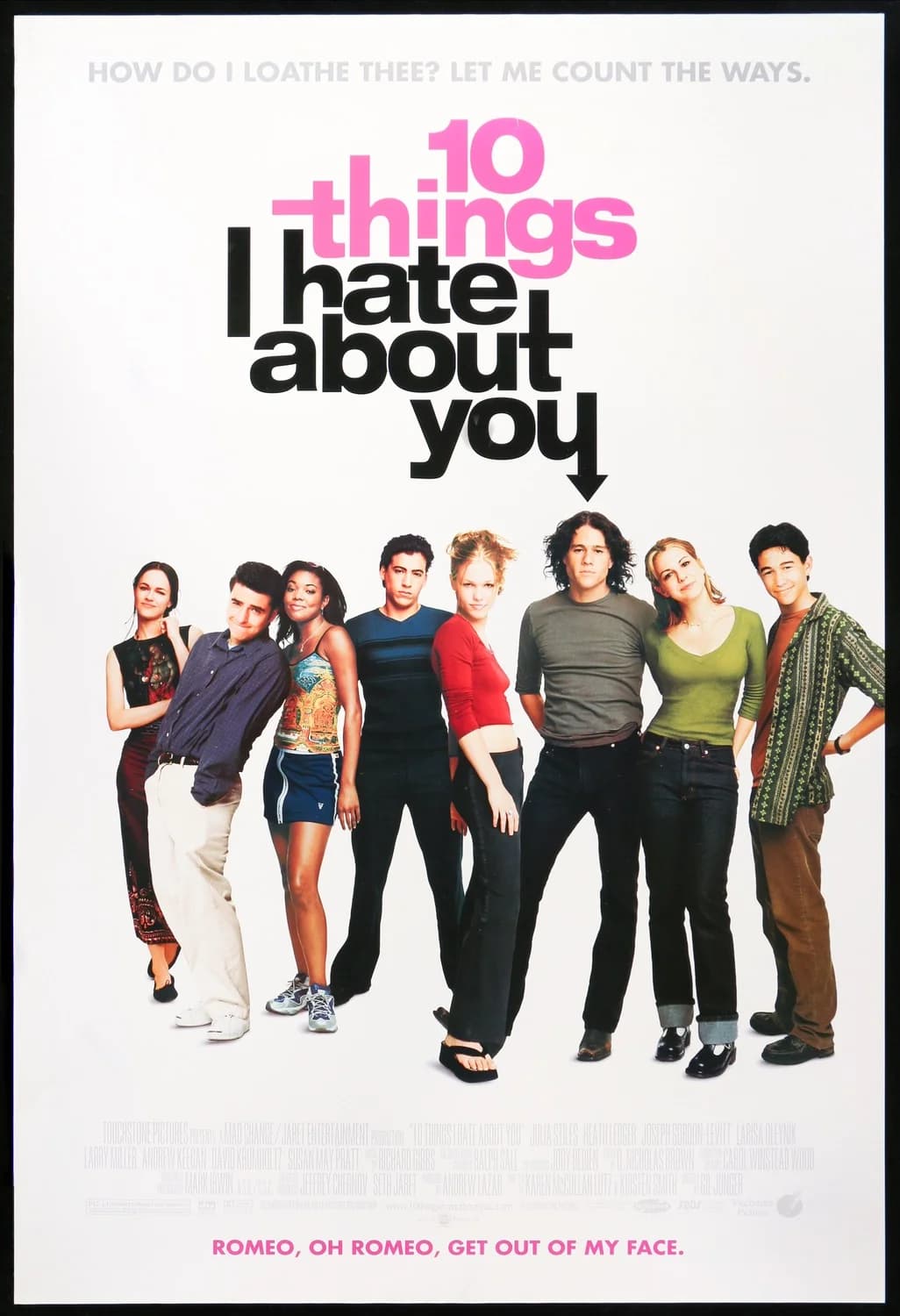
1999 // VHS
10 Things I Hate About You
Sibling rules, a rooftop serenade and one very stubborn Kat — Shakespeare in a school corridor.

1999 // VHS
American Beauty
Lester Burnham, suburban rot and a midlife argument that still stings.
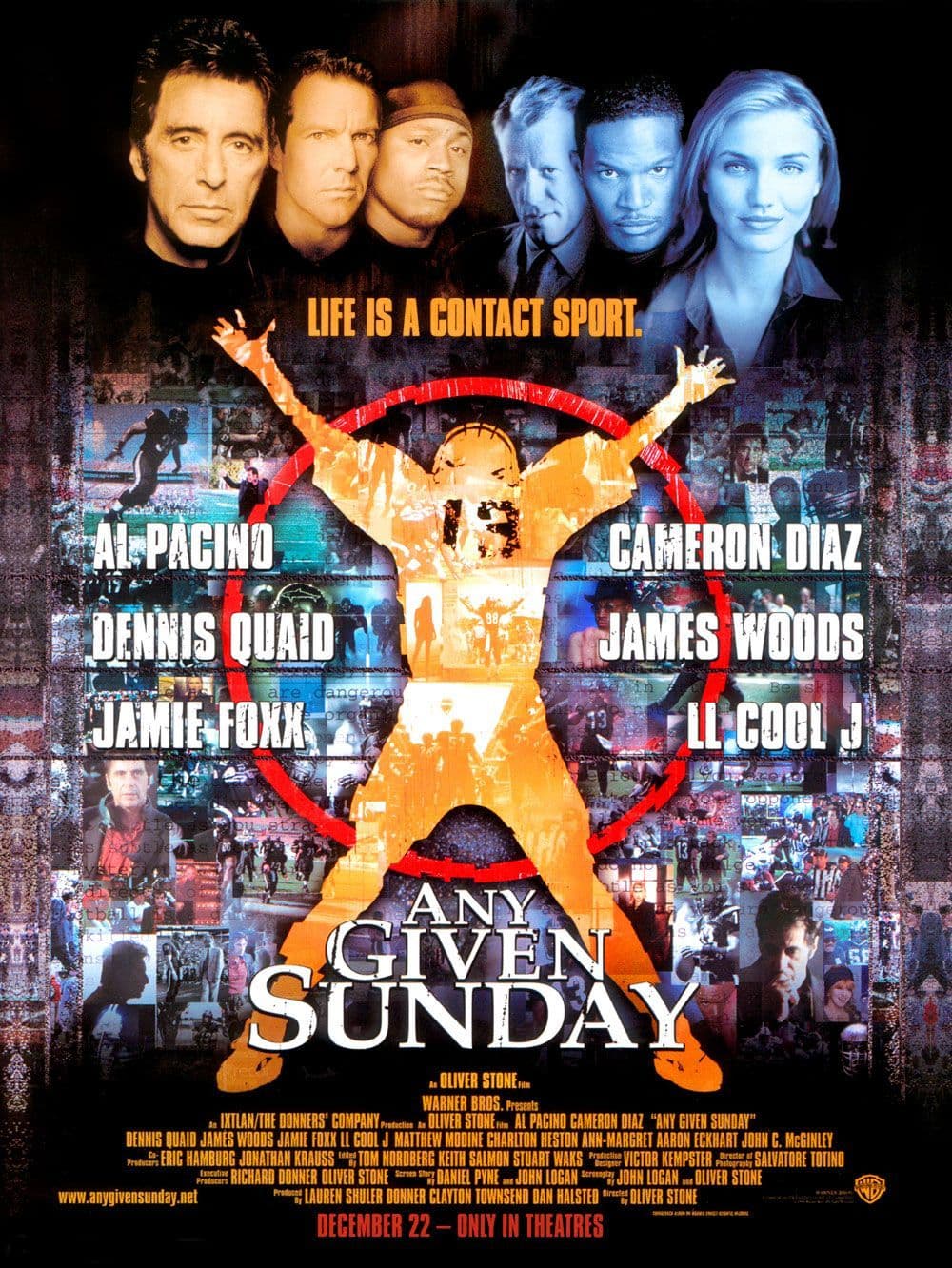
1999 // VHS
Any Given Sunday
Al Pacino's coach anchors the chaos of a film about football turned into product — loud, messy and oddly persuasive.