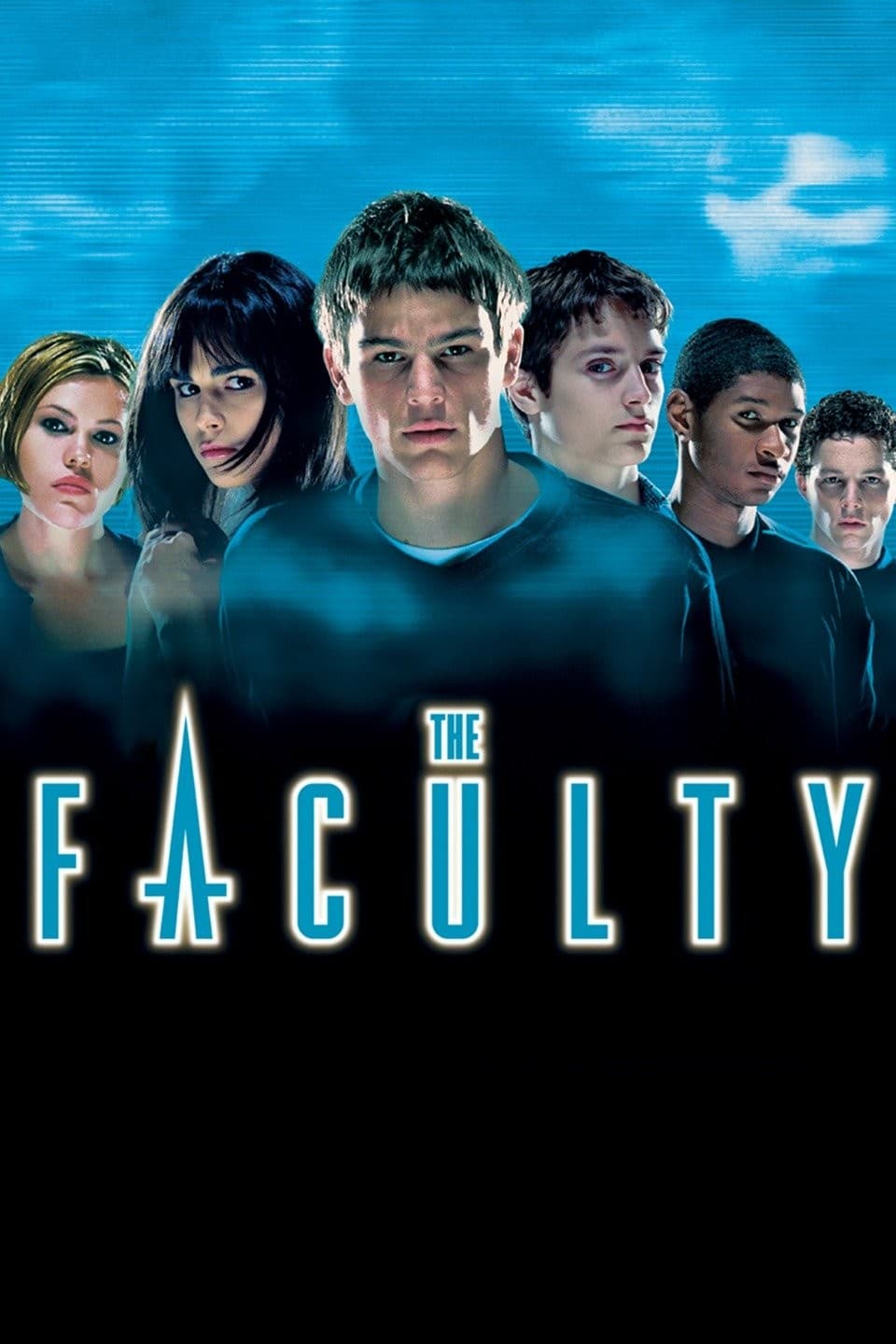
The Faculty
Teen outsiders, school staff that stop being themselves, and an alien infection that’s really about fitting in — with a very curious photographer at the centre.
// The setup
PLAYBACK STARTED
Robert Rodriguez’s The Faculty dresses up a paranoid alien‑invasion tale in high‑school uniforms and Kevin Williamson seasoning. It’s loud, clever and oddly affectionate to the kids stuck in the middle — and it’s Casey Connor, the newspaper photographer, who turns that set‑up from a neat idea into something worth following.
THE MOVIE
Casey Connor is still the reason this movie works
There’s a neat, memorable image at the heart of The Faculty: a school where the grown‑ups act like strangers and the kids have to figure out why. The film starts when teachers — people who should be safe — behave violently and inexplicably, and that jump‑start of panic sends the students hunting for answers.
That hunt lands squarely on Casey Connor, the school newspaper photographer whose outsider curiosity forces him into the middle of the mystery. Casey isn’t the obvious hero; he’s the one who notices what others take for granted, which is why the story trusts him to lead.
Robert Rodriguez directs a brisk 101‑minute take on teen horror that mixes alien‑invasion mechanics with schoolyard politics. It’s the sort of film that uses genre gags to ask a simple question: what do you lose when everyone starts behaving the same?
THE SETUP
The idea that sets The Faculty in motion
The basic bargain is tidy: students at Herrington High discover that some teachers have been taken over by parasitic extraterrestrials, and they have to stop the spread before it gets beyond the school. It’s an invasion story pared down to a manageable, terrifying location — the place where adolescents learn who to trust.
What keeps the plot moving is not a sprawling army of extras but a small, socially mixed group of students who pool their different skills and suspicions. They’re the ones doing the detective work: sneaking into faculty spaces, testing ideas, and pushing at the edges of what adults around them will admit.
Crucially, the invaders spread by mimicry and social trust — friendship and authority become the vectors. That makes ordinary school dynamics feel suddenly dangerous, because the contagion exploits how people expect each other to behave.
Kevin Williamson is credited on the screenplay, which helps explain the film’s comfortable fit in the late‑90s teen‑horror moment. The setup trades on familiar genre beats but places them in a high‑school social economy that keeps the stakes personal.
THE CHARACTER
Why Casey Connor matters
Casey Connor is not the loudest kid in the room. He’s the photographer for the school paper — the one who looks, frames, and files information. That occupational detail matters because it’s how the story justifies putting an outsider at the centre of a mystery; curiosity becomes a practical tool, not just a personality trait.
Making the investigating protagonist a kid who notices details also keeps the story rooted. The audience follows a character whose role is to observe, which is handy when the plot is about people who no longer behave like themselves.
Casting facts sit alongside story facts here: Elijah Wood plays Casey, and his family life is present in the background (Christopher McDonald appears as Casey’s father). Those elements anchor Casey as part of a living teenage world rather than a neat plot device.
In short, Casey matters because the film asks us to care what he sees. His outsider status makes him both believable and sympathetic as the one who won’t simply accept the new, uniform normal.
UNDER THE SURFACE
The Faculty has more on its mind than the plot suggests
On the surface it’s an alien‑invasion movie; under it, the threat operates by erasing difference. The invaders don’t just attack bodies — they flatten behaviour. That makes conformity feel like the real monster.
Set in a school stratified by cliques, the film uses familiar adolescent roles as the battleground. When categories like 'jock' or 'nerd' are under threat, the story asks what belonging costs and who gets to decide the rules.
There’s also a pointed distrust of authority: teachers and administrators, the adults who should keep kids safe, become the source of danger. The inversion is simple but effective — it aligns adolescent paranoia with literal threat.
Those three ideas — the cost of conformity, the fragility of teen social roles, and suspicion of authority — give the movie a surprisingly crisp backbone beneath its creature frights.
THE FILMMAKING
How The Faculty was put together
The movie carries a clear production credit for cinematography and visual effects supervision, which is handy shorthand for its look and on‑screen trickery. Those roles shape how the school and its sudden unravelling read to the audience.
Robert Rodriguez directs and edits, steering a film that sits comfortably between horror, sci‑fi and teen drama. That cross‑genre approach keeps things moving briskly; the picture rarely lingers where it doesn’t need to.
Naming names helps: the cinematography credit goes to Enrique Chediak, and Brian Jennings is credited for supervising the visual effects. Those are the practical linchpins behind the film’s mix of on‑set creature work and composited effects.
Put simply, the filmmaking is organised around making a school feel like a small world under siege — and the credited crew members are the ones who built that world on screen.
PRACTICAL EFFECTS
The effects work that gives The Faculty its physical personality
The film’s creature and make‑up work credits point to a production that leaned on hands‑on techniques. KNB EFX Group is listed for the special make‑up and creature effects — the company’s presence signals a commitment to physical prosthetics and on‑set transformation.
Mechanical effects and animatronics were handled by XFX Inc. and a practical special‑effects crew, which provided the on‑set motion and physical presence that practical work brings. That combination helps the aliens feel tangible in close encounters.
Those practical elements didn’t stand alone: the production combined make‑up and creature work with digital compositing and CGI, coordinated under visual effects supervision. The result is a hybrid approach that uses practical pieces where proximity matters and digital work where compositing is cleaner.
In short, The Faculty mixes old‑school creature craft with digital finishing rather than relying on one approach, which gives its monsters a particular physical personality.
PURE 80S
The Faculty could not belong to any other decade
The Faculty arrived at the end of the 1990s teen‑horror cycle and wears that moment on its sleeve. It was developed and marketed to tap into the audience Kevin Williamson helped define with Scream, and Williamson’s screenplay credit is part of that strategy.
That late‑90s positioning matters because the film trades on a certain kind of self‑aware teen horror — it knows the rules it’s playing with and nudges them into a high‑school setting. That wink is very much of its time.
So while it’s an alien invasion at heart, the movie is shaped by the era’s appetite for teen protagonists who talk back to genre conventions — a deciding factor in how it was packaged and promoted.
Being a 1998 release tied it directly to that cycle of youth‑targeted horror, which explains both some of its tonal choices and the audience it expected to reach.
WATCHING IT NOW
What has aged — and what hasn't
The Faculty now reads as a late‑90s artefact in a productive way: its Scream‑era self‑awareness is part of the film’s flavour, not a flaw. For viewers attuned to that moment, those winks feel period‑specific rather than accidental.
As a teen movie, its cast of high‑school types and the way they lean on each other to solve the crisis still works: making adolescents the primary protagonists keeps the stakes intimate and relatable.
The body‑possession/contagion premise — a familiar genre lineage stretching back to earlier invasion films — remains a sturdy engine for paranoia. Framing it as a teen update gives the old idea a fresh social angle.
Finally, remembering that the film was explicitly reworked and marketed to tap into the Scream audience explains a lot about its tone. That calculation both dates it and, for many viewers, remains a large part of its appeal.
THE LEGACY
Why The Faculty still matters
The Faculty made a respectable commercial splash on release, opening in wide release and earning roughly $40.3 million domestically — not a blockbuster, but enough to keep it visible in the late‑90s marketplace.
It found a place in youth and genre awards conversations the following year, collecting several nominations across Saturn, Teen Choice and youth‑oriented awards, which speaks to how it was received by its target audience.
Musically and sonically the film left material traces too: Marco Beltrami’s score and a multi‑artist soundtrack were issued and have seen subsequent commercial releases, giving the film a continued presence in collectors’ shelves and playlists.
Beyond numbers and merch, the title and concept have remained part of discussions about 1990s teen/horror hybrids; the property’s cultural stickiness is visible enough that industry reporting later treated a remake development as newsworthy.
THE VERDICT
Does The Faculty still hold up?
Yes — if you’re after a smartly packaged late‑90s teen horror that turns school politics into genuine threat, The Faculty still does the job. The central engine — students discovering that teachers have been taken over by parasitic extraterrestrials and trying to stop the spread — is straightforward but consistently effective.
The film’s focus on a small, mixed group of students doing the sleuthing keeps things personal and watchable; the mechanics of investigation, contagion and a final confrontation give the plot a satisfying forward motion without overstaying its welcome in a 101‑minute runtime.
Its themes — the cost of conformity, the precariousness of adolescent roles and a distrust of authority — are neatly realised through the invasion premise, so the movie isn’t just a string of scares: it has a consistent idea running through it.
So should you watch it? If you enjoy the late‑90s teen‑horror tone and like a genre film that treats its young protagonists as active agents, The Faculty is still worth a viewing. And if nothing else, Casey Connor’s curiosity is a useful reminder: sometimes noticing the odd things is what saves the world.
// Featured in
More about The Faculty
Share this movie
// Keep watching
More movies from the 90s
If The Faculty is your kind of movie, there's plenty more on the shelves worth rewinding.
1998 // VHS
The Wedding Singer
A love story wrapped in 1980s pop — and carried by one very earnest wedding crooner.
1998 // VHS
There's Something About Mary
Romantic obsession, awkward masculinity and a hair‑gel gag you can't unsee.
1999 // VHS
10 Things I Hate About You
Sibling rules, a rooftop serenade and one very stubborn Kat — Shakespeare in a school corridor.