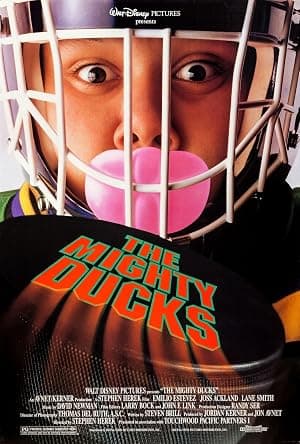
The Mighty Ducks
A lawyer's second act, a rag‑tag team and one very memorable penalty shot.
// The setup
PLAYBACK STARTED
There are sports films you remember for the final score and others you remember because one character drags the movie into being. The Mighty Ducks is definitively the latter: it’s Gordon Bombay’s story — a fallen adult who has to learn how to matter to a group of kids. Revisit it and you’ll find a tidy family underdog with a clear heart and a habit of being cheerfully sentimental when it earns the moment.
THE MOVIE
Gordon Bombay is still the reason this movie works
Say the name Gordon Bombay and most people know the setup: a successful, self-regarding Minneapolis lawyer finds himself handed 500 hours of community service coaching a struggling pee‑wee hockey team. That brusque premise is all the movie needs to get moving.
The inciting blow is simple and blunt — an arrest and a court-ordered sentence — and it forces Bombay back into a world where winning isn’t measured by money or status. He’s there out of obligation at first; the plot gives him a job and the film gives him a problem to fix.
What keeps The Mighty Ducks watchable across the years is where it takes that problem: coaching becomes a way for Bombay to confront an old missed penalty and the guilt that’s quietly run his life. Redemption, mentorship and team spirit aren’t just marketing lines here — they’re the film’s engine.
THE SETUP
The idea that sets The Mighty Ducks in motion
At its plainest, the film hands an adult with everything — Gordon Bombay — an adult problem he can’t bill his way out of: community service coaching District 5’s kids. It’s a tidy dramatic swap that flips competence into incompetence and status into humility.
From there the story does the standard but reliable work of the misfit‑team movie: from humiliating defeats the Ducks learn, improve and inch toward the city championship. That arc gives the film a predictable momentum that still sings to family audiences.
The screenplay adds a couple of key mechanics to sharpen the stakes: Bombay recruits stronger players to raise the team’s level — most notably the transfer of Adam Banks — and the whole thing folds back on itself with a late penalty‑shot moment that mirrors Bombay’s childhood failure.
Small touches matter. The team’s new name — the Ducks, after sponsor Gerald Ducksworth — makes the film about more than sport: it sets up a tension between corporate support and the idea of fair play the coach is trying to teach.
THE CHARACTER
Why Gordon Bombay matters
Gordon Bombay isn’t memorable because he’s flashy. He matters because the whole movie is structured around the idea that he must be remade. A successful lawyer turned reluctant coach gives the story someone to pull against: his pride, his guilt, his avoidance.
The one concrete piece of baggage he carries is a missed penalty from childhood — a tiny, specific failure that becomes the movie’s emotional shorthand. Coaching the Ducks forces him to face that moment, and through teaching he gets a route back to himself.
As a family film, the narrative wants Bombay to grow without making the kids adult-sized. That’s why his arc is clear and readable: he starts self-centred and, through the team, learns responsibility and the value of putting others first.
Emilio Estevez plays him; the casting gives the character a recognisable centre and keeps the film focused on that one personal turnaround rather than scattering the drama across too many subplots.
THE PERFORMANCE
Why Emilio Estevez's performance matters
Contemporary reviewers singled out Emilio Estevez’s portrayal of Gordon Bombay as central to the film’s appeal to younger viewers. That’s important because the movie asks adults and kids to accept the same emotional throughline.
Estevez provides a clear focal point for the film: Bombay’s private guilt and public grumpiness are easy for an audience to register, which keeps the story from feeling muddled.
For a family audience, clarity matters more than nuance. Reviews at the time suggested that Estevez’s presence helped make the film readable to children without flattening Bombay into a one-note figure.
Put simply: the film relies on the character working, and reviewers believed the casting helped do that work.
UNDER THE SURFACE
The Mighty Ducks has more on its mind than the plot suggests
On the surface it’s a sports underdog — kids learn to skate, cooperate and win. Underneath, the movie is quietly obsessed with redemption: an adult who needs to earn back his own self-respect by helping others find theirs.
Teamwork versus individual ambition is the film’s steady tug. Bombay arrives trained to win by himself; the Ducks only get better when individual talents are folded into a team plan.
Fair play and sportsmanship are pitched against a win‑at‑all‑costs attitude. The plot sets up rivalries and budget/influence questions so the kids learn what kind of victory actually matters.
Because it’s a family movie, these themes are kept straightforward. The simpler the moral choice, the clearer the lesson for younger viewers — and the cleaner the emotional payoff.
PRACTICAL EFFECTS
The effects work that gives The Mighty Ducks its physical personality
The film wanted believable ice and snow, and the production records show they paid for it. Crews froze a man‑made lake and trucked in snow to make locations look wintry for the on-ice scenes.
Those choices are the kind of practical decision that quietly helps a family film feel lived‑in: real cold, real slip of skate on ice, real breath in the air. It makes the games feel slightly more immediate.
It’s not flashy, showy effects work; it’s production craft that lets the hockey sequences read as actual sport rather than a stage set.
For a movie whose stakes are emotional rather than technical, that groundedness in the environment matters more than any clever trick.
WATCHING IT NOW
What has aged — and what hasn't
Critics at the time were frank: the movie is formulaic, but they also noted it lands well with children. That candid pairing — predictable structure but clear audience — still explains why people return to it.
Later retrospectives and oral histories have treated the original as a durable, family-friendly underdog story that kept the franchise going. The film’s DNA is built to be revisited: straightforward themes, an identifiable emotional hook and a neat narrative arc.
As a family picture, it doesn’t attempt to be complicated, and that’s both its strength and its limitation for modern viewers who might expect grayer edges in contemporary dramas.
Practical availability has helped too: the film left the usual home‑media trail — VHS, DVD and a Blu‑ray release — which keeps it within reach of new fans and anyone wanting a nostalgic rerun.
THE LEGACY
Why The Mighty Ducks still matters
The film’s box‑office success is part of its legacy in the most literal sense: it led to two sequels and an animated television series, so the Ducks didn’t just finish a story — they became a small franchise.
Disney’s decision to name a real NHL team after the movie — the Mighty Ducks of Anaheim in 1993 — is a concrete, unusual afterlife for any family film. It turned a movie title into something you could buy tickets to and watch in person.
There’s also a less celebratory footnote: the screenwriter later pursued legal claims against Disney seeking a share of revenues tied to merchandising and the hockey team. It’s a reminder that the line between storytelling and business can get oddly entwined.
Taken together, these points explain why the film isn’t just a one-off memory: it produced sequels, spin-off content and even a professional sports brand — all rare outcomes for a modest family sports picture.
THE VERDICT
Does The Mighty Ducks still hold up?
Yes — if you approach it on its own terms. The film’s premise is straightforward: a self-centred lawyer is ordered into community service coaching a pee‑wee team, and that sentence provides the engine for a believable redemption arc. If you want moral complexity, look elsewhere. If you want a clean, satisfying family underdog story, this delivers.
Key elements still work: the late penalty‑shot payoff mirrors Bombay’s childhood miss and gives the drama an emotional echo; recruiting a stronger player like Adam Banks creates believable tension about loyalty and winning; and the team’s renaming after their sponsor sets up a neat moral counterpoint about influence and sportsmanship.
Contemporary reviewers called it formulaic but appealing to children, and that remains an honest summary. The movie isn’t trying to be anything other than a clear, accessible lesson in teamwork, mentorship and fair play — and on those terms it largely succeeds.
So should you watch it? If you fancy a family film with a simple heart, a recognisable lead in Emilio Estevez, and a satisfying arc for both coach and kids, The Mighty Ducks still rewards the time. It’s not subtle. It doesn’t need to be. Sometimes a tidy redemption story and a raucous final game are precisely the point.
Share this movie
// Keep watching
More movies from the 90s
If The Mighty Ducks is your kind of movie, there's plenty more on the shelves worth rewinding.

1999 // VHS
10 Things I Hate About You
Sibling rules, a rooftop serenade and one very stubborn Kat — Shakespeare in a school corridor.

1999 // VHS
American Beauty
Lester Burnham, suburban rot and a midlife argument that still stings.

1999 // VHS
Any Given Sunday
Al Pacino's coach anchors the chaos of a film about football turned into product — loud, messy and oddly persuasive.