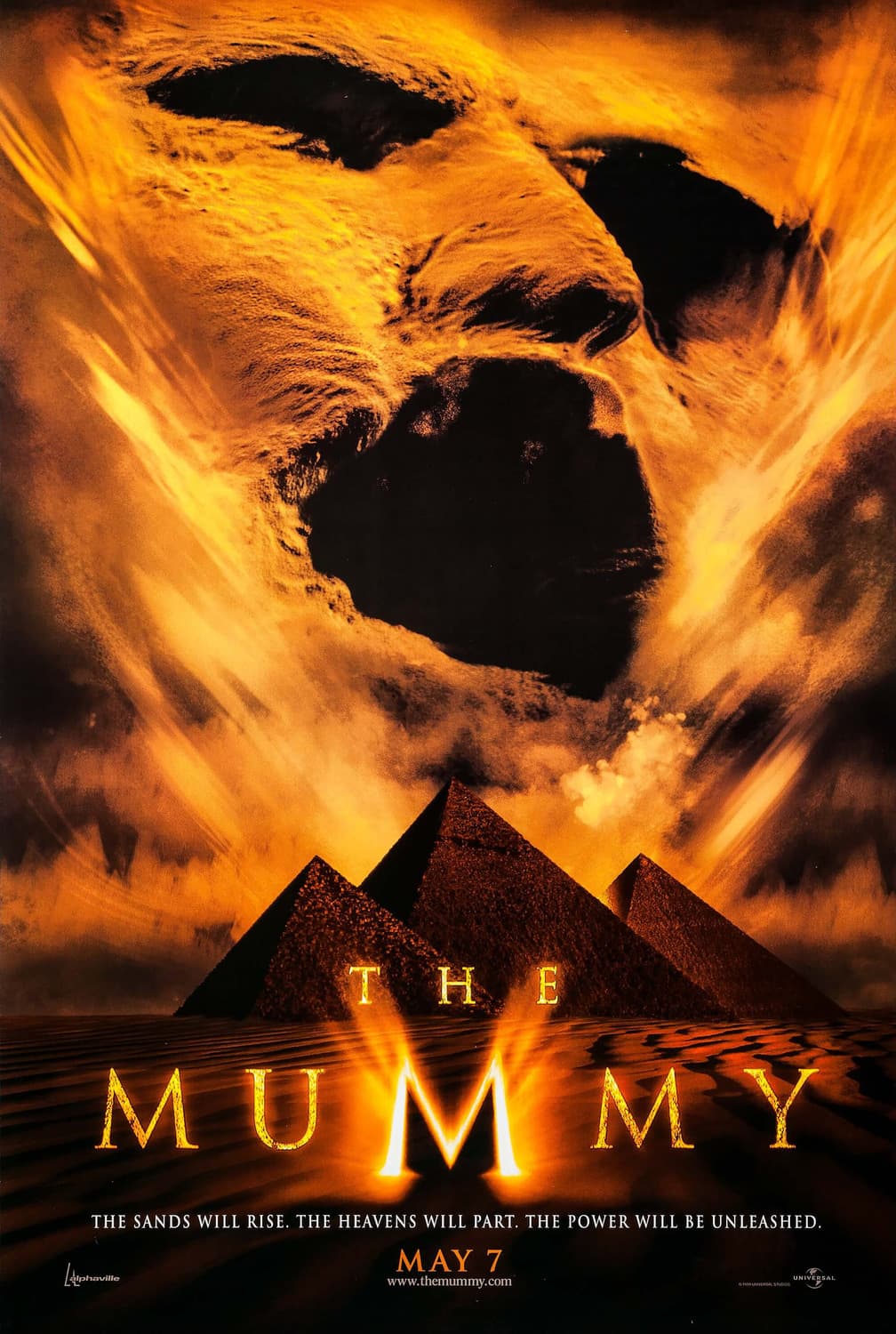
The Mummy
Swashbuckling sand, a stubborn hero and a love that won't stay dead.
// The setup
PLAYBACK STARTED
The Mummy is the kind of loud, generous spectacle that still makes you grin: it sends a practical‑minded adventurer into a cursed city, lets supernatural consequences ripple back to Cairo, and scores big on momentum. Stephen Sommers stacked genres like cards — adventure, horror, comedy — and let Rick O'Connell carry the pack.
THE MOVIE
Rick O'Connell is still the reason this movie works
People keep coming back to The Mummy because it knows what it is: a breathless, crowd-pleasing adventure centred on a straightforward, competent hero. At its heart is Rick O'Connell — a resourceful lead who walks into the City of the Dead and does the sort of practical work the plot needs done, from rescue to brawling.
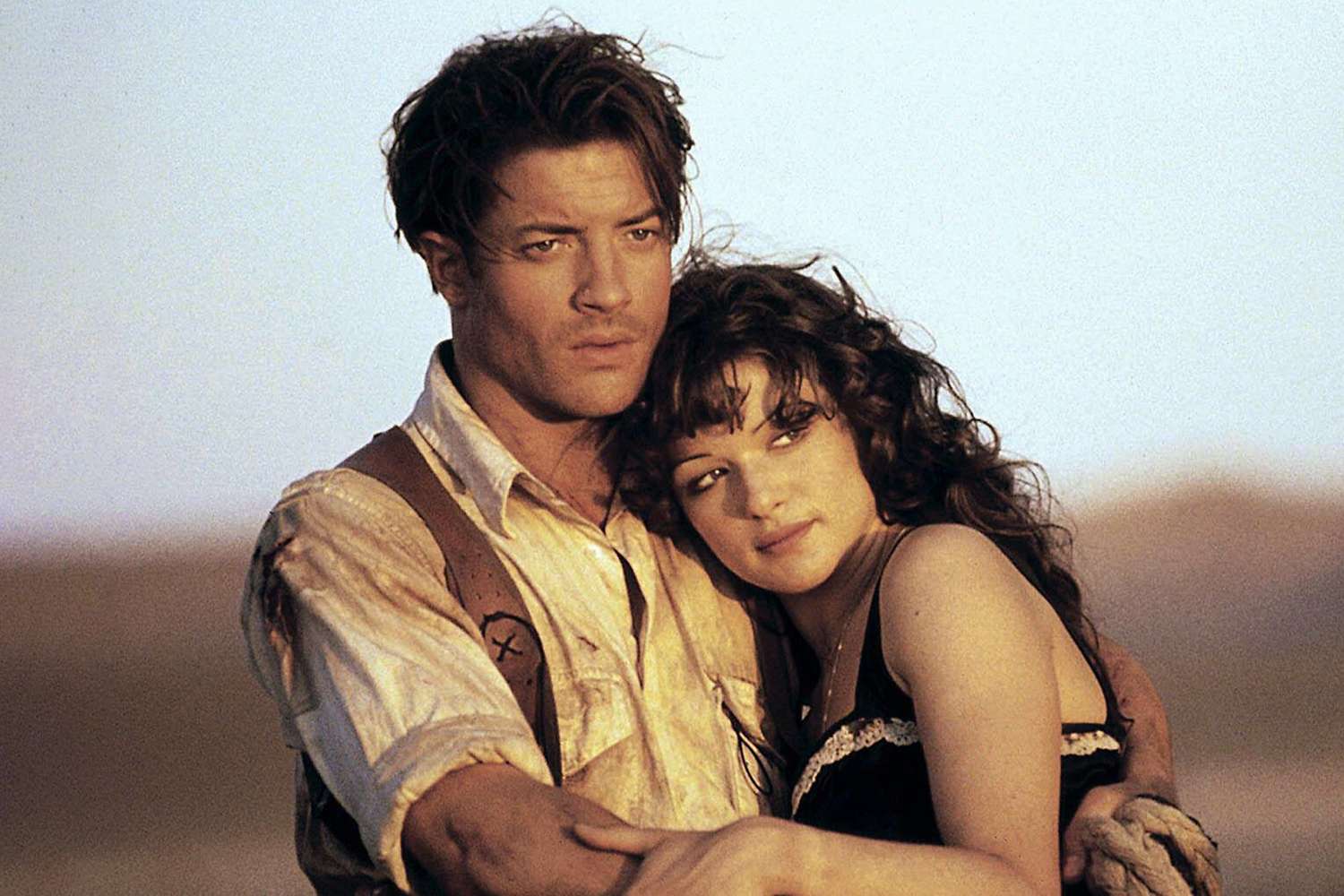
Everything that follows — the accidental resurrection triggered when Evelyn reads from the Book of the Dead, the slow, gruesome rebuilding of Imhotep's power, and the race back to Cairo — is unambiguously set up as a series of escalating obligations for that hero and his oddly matched companions.
Stephen Sommers directed and wrote the film as a 125‑minute fusion of pulp serial thrills, romance‑driven villainy and broad comic beats, and he steered it firmly in the blockbuster direction that made the late 1990s summer slate feel big and unapologetic.
THE SETUP
The idea that sets The Mummy in motion
The film keeps its engine simple: a treasure‑hunt leads three very different people into Hamunaptra, the City of the Dead, where curiosity and bad luck collide. Evelyn’s reading from the Book of the Dead is the single inciting moment that turns archaeology into an emergency.
From that point the stakes are neatly mechanical. Imhotep is gradually restored as other victims are brought back, so the story becomes a kind of countdown — stop the resurrections, or the villain becomes unstoppable.
That structure lets the movie move like a serial: clues, artifacts and set-pieces hand the plot from one location to the next, from the ruined city to Cairo, each episode raising the physical and supernatural stakes.
It’s a clean setup because it answers the essential question quickly: there is a wrong thing happening, we know how it progresses, and the protagonists have a series of practical tasks to interrupt the process.
THE CHARACTER
Why Rick O'Connell matters
Rick O'Connell matters because he does the things the script needs done and does them plainly. He’s written and staged as a former Foreign Legionnaire and treasure hunter — the sort of person who can think on his feet, take a hit and get people out of trouble.
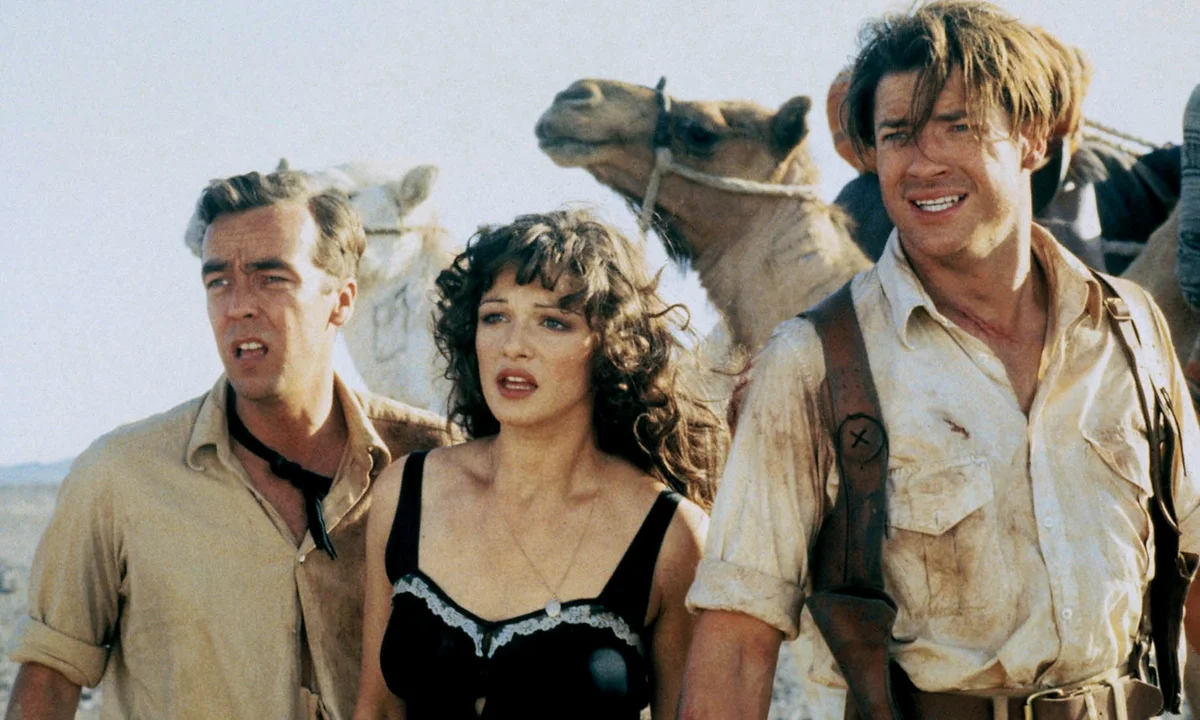
That practical clarity gives the movie a spine. When the plot threatens to tilt into melodrama — curses, resurrection, romantic obsession — Rick keeps the action grounded by being a doer rather than a theorist.
His presence also lets the film lean into spectacle without losing a human fulcrum: the audience can rely on him to move the story through its set-pieces and to make choices that pull the other characters along.
And he wasn’t written as a lone wolf; the story depends on the way his competence plays against Evelyn’s bookish curiosity and Jonathan’s more comic instincts, which makes the group feel like a functioning team rather than a cast of interchangeable types.
UNDER THE SURFACE
The Mummy has more on its mind than the plot suggests
Beneath the chase sequences and crawling scarabs there’s a trio of recurring ideas. First: romantic obsession — Imhotep’s return is driven by a desire to reunite with Anck‑su‑namun, and that mythic longing gives the villain a personal, almost tragic motive.
Second: resurrection and vengeance. The film stages returning bodies as both spectacle and fuel; each restoration strengthens Imhotep and keeps the protagonists scrambling, which keeps the emotional temperature constantly rising.
Third: treasure‑hunting versus stewardship. The story constantly asks who has the right to disturb ancient places and whether adventure is a form of respectful exploration or reckless plunder.
All of that sits inside a pulp‑serial pastiche: the movie knows it’s riffing on old adventure serials, so it amplifies character types and set-pieces rather than smothering them in irony.
THE FILMMAKING
How The Mummy was put together
A lot of the movie’s identity comes from how physical its world feels. Production designer Allan Cameron and his art department built a sprawling Hamunaptra exterior in a horseshoe‑shaped crater and then matched those elements on U.K. soundstages.
That decision — make an ambitious, tangible set and then extend or replicate it in the studio — gives the film a consistency between location work and controlled production sequences.
The tangible scale of the sets lets the story sell itself: when a sequence needs to feel ancient and dangerous, the environment is already doing half the convincing.
It’s a pragmatic approach: big, believable pieces that the camera and actors can move through, rather than relying entirely on shot construction or after‑the‑fact composites.
PRACTICAL EFFECTS
The effects work that gives The Mummy its physical personality
The Mummy deliberately mixed hands‑on makeup with digital trickery. Makeup supervisor Nick Dudman built multiple prosthetic mummy suits and creature pieces that were actually on set, and some of those suits were later scanned to be augmented digitally.
The production also used live animals and other practical elements — rats, locusts and prosthetic wounds — to give several sequences a tactile grossness that CGI alone can struggle to sell.
At the same time Industrial Light & Magic applied motion‑capture and digital face/body replacement to create the regenerating mummy moments, blending live performance and computer work rather than choosing one camp’s aesthetic.
The result is a hybrid: effects that sometimes feel palpably physical because something was really there, matched to digital sequences that do the impossible movements and transformations the story requires.
PURE 80S
The Mummy could not belong to any other decade
The Mummy is very much a product of the late 1990s: it sits in that transitional moment when filmmakers married practical production values with increasingly confident CGI workflows born after Jurassic Park.
It was launched as a big summer tentpole in 1999, part of a strategy to reframe Universal’s classic monster stable as action‑adventure franchises for a new generation.
Technically and commercially it reflects the era’s appetite for spectacle — not only building large practical sets and shooting on location but also leaning on digital augmentation to deliver moments audiences had never seen before.
In short: it carries the late‑90s studio playbook in its bones — scale, hybrid effects and franchise thinking — which is why it reads so clearly as a movie of its moment.
WATCHING IT NOW
What has aged — and what hasn't
Two practical facts shape how the film reads today. First, it spawned a continuing franchise — including the Scorpion King spin‑off — which means this story was explicitly designed to be expandable rather than self‑contained.
Second, Universal has kept the movie available in modern home formats (Blu‑ray and 4K), so it’s easy for viewers now to revisit the film in a presentation that preserves its production values.
Taken together, those points mean the film hasn’t been left to fade: it’s still findable, and its world remains part of a larger narrative that continued beyond 1999.
As a consequence, watching it now is less about archaeological curiosity and more about deciding whether you enjoy the kind of muscular, hybrid spectacle it represents.
THE LEGACY
Why The Mummy still matters
The Mummy endures largely because it became more than a single movie: it launched a multimedia franchise with sequels and spin‑offs, which kept its characters and ideas in circulation.
At the time of release its visual effects — especially the regenerating mummy and large digital swarms — were seen as a technical benchmark and set a bar that subsequent franchise entries chased.
Jerry Goldsmith’s orchestral score also carved out a recurring musical identity for the series, a touchstone that the franchise returned to on later entries.
Finally, the film’s ongoing availability through modern catalogue releases has kept it present in the marketplace, so it remains a living reference for late‑90s blockbuster storytelling.
THE VERDICT
Does The Mummy still hold up?
Yes — if what you want is a robust, old‑school adventure with a supernatural spine. The film’s premise is clean: a treasure hunt wakes a cursed high priest and the protagonists must race to stop his progressive resurrection, which gives the story a relentless forward motion.
That motion is what keeps the runtime humming. The mechanics — Book of the Dead, canopic jars, and the ‘resurrection as countdown’ device — make the plot urgent in a way spectacle alone cannot.
Brendan Fraser’s Rick O'Connell is central to that engine: he’s written as the practical, physically resourceful lead whose choices and actions drive the rescue and combat scenes. Contemporary critics singled out his charm and physicality as part of why the film landed for audiences.
So should you watch it now? If you enjoy energetic pulp pastiche, a clear hero to root for and the specific late‑90s mix of practical sets and digital augmentation, The Mummy still delivers. It’s not a subtle picture, but it knows its pleasures and goes after them.
Share this movie
// Keep watching
More movies from the 90s
If The Mummy is your kind of movie, there's plenty more on the shelves worth rewinding.
1999 // VHS
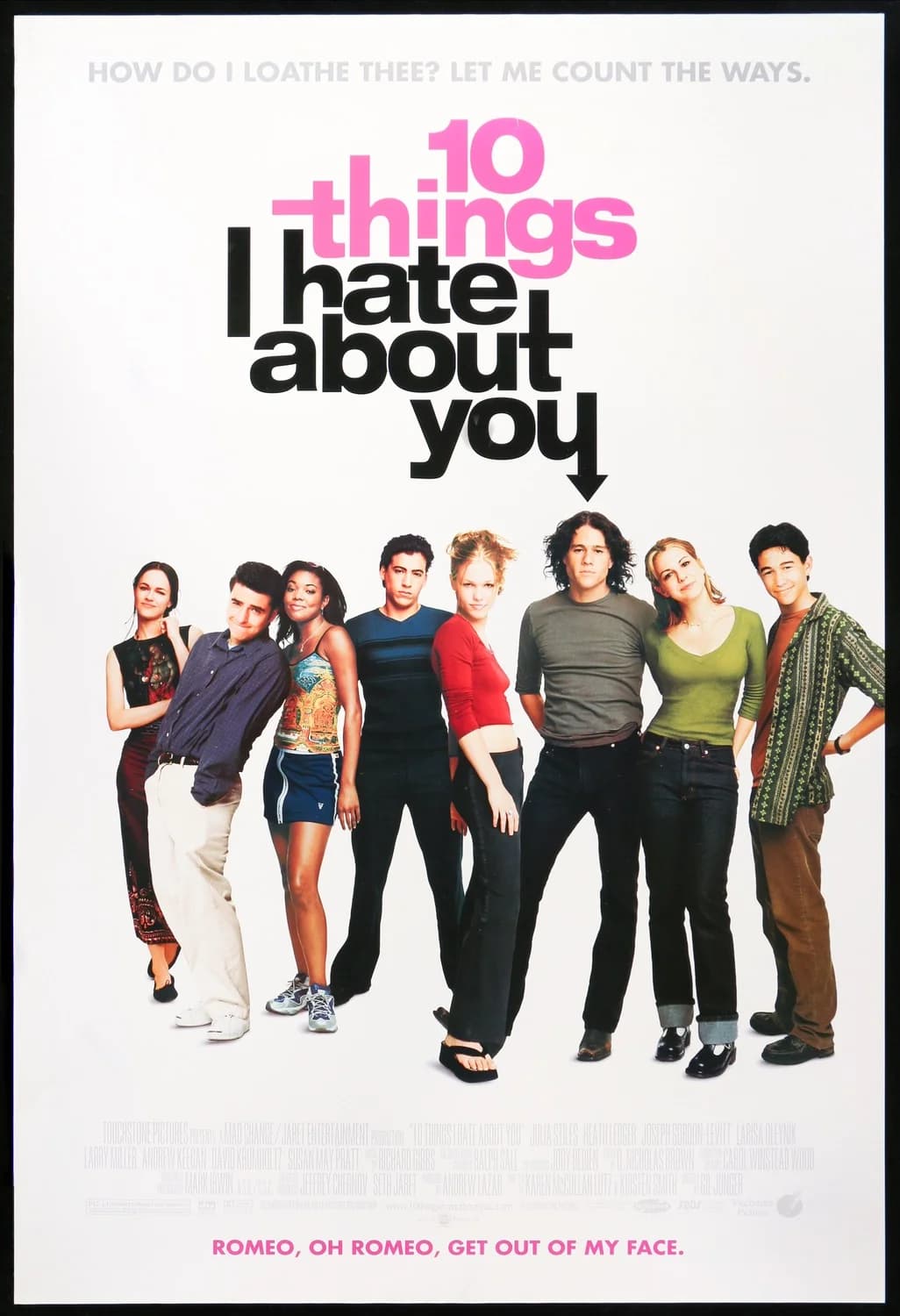
10 Things I Hate About You
Sibling rules, a rooftop serenade and one very stubborn Kat — Shakespeare in a school corridor.
1999 // VHS
American Beauty
Lester Burnham, suburban rot and a midlife argument that still stings.
1999 // VHS
Any Given Sunday
Al Pacino's coach anchors the chaos of a film about football turned into product — loud, messy and oddly persuasive.