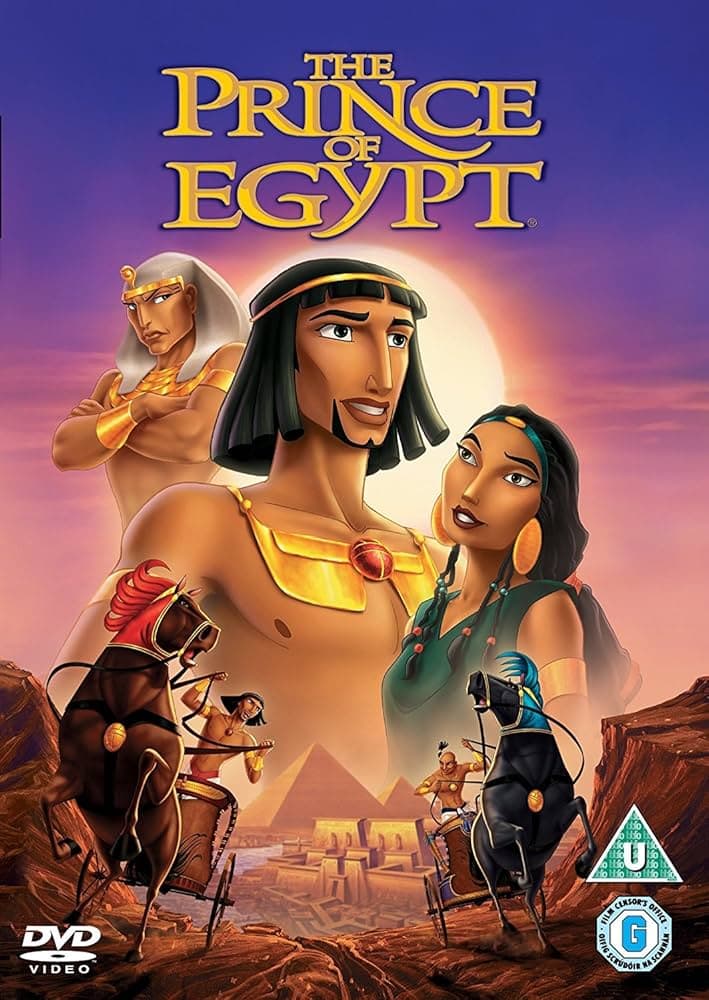
The Prince of Egypt
A biblical blockbuster that thinks like a coming-of-age story — and still asks who we are when everything we know is taken away.
// The setup
PLAYBACK STARTED
The Prince of Egypt is the kind of animated film that treats the Exodus as both spectacle and a personal journey. It follows Moses from royal adoption to exile and back again, folding brotherhood, faith and musical set-pieces into a 99-minute sweep that aimed to make the Bible feel like an intimate, human story.
THE MOVIE
Moses (adult; voice) is still the reason this movie works
If you remember one thing about The Prince of Egypt, it’s probably Moses’ journey from palace life to the desert and back — the discovery of his Hebrew origins and the violent moment that forces him into exile. That turning point is the engine: it turns a biblical saga into a coming-of-age story with a personal cost.
DreamWorks set out to tell that story on a big canvas. The film compresses the Exodus into a lean, 99-minute musical drama where family ties and political rivalry sit at the heart of the action. It’s an ambitious move: a religious epic dressed as an animated feature.
And the casting underlines it. Val Kilmer is the adult voice of Moses, supported by a roster of familiar names, and three directors — Brenda Chapman, Steve Hickner and Simon Wells — shepherd the production toward something that wants to feel both grand and intimate.
THE SETUP
The idea that sets The Prince of Egypt in motion
At its simplest, the film asks: what happens when the person raised to inherit power learns they belong to the people they’re meant to rule? That discovery drives Moses away from Egypt and, later, back into direct conflict with the man on the throne.
The opposing figure is Rameses, Moses’ adoptive brother who becomes Pharaoh. Their relationship shifts the Exodus from distant myth to an argument between two men who once shared a childhood — which keeps the stakes emotionally immediate.
The movie leans on song to move the story along. Musical set-pieces aren’t just interruptions; they’re where characters change and where the audience is asked to feel those shifts. At the same time, the narrative builds outward: a pattern of escalating pressure culminating in the plagues gives the personal story a headline-grabbing public cost.
Contemporary reviewers noticed the scale. The production pairs broad, sweeping visuals with that close-up sibling drama, so the film constantly switches between intimate and operatic.
THE CHARACTER
Why Moses (adult; voice) matters
Moses is written as someone torn between two worlds. He’s an adopted Egyptian prince whose discovery of a Hebrew birthright forces a reorientation: suddenly his identity isn’t only about privilege, it’s about responsibility and belonging.
That internal tug — who he is versus what he’s meant to do — is the movie’s beating heart. The story treats Moses’ choices as moral and spiritual turning points rather than just plot moves, so the moments where he doubts or accepts his role carry weight.
There’s also a maternal thread in the film: the presence of his biological mother, represented in the soundtrack and voice casting, quietly underlines the idea that identity has roots you can’t entirely leave behind.
Framing Moses primarily as a family figure — a son, a brother, a reluctant leader — keeps the Exodus recognisably human and makes the film’s themes of brotherhood and belonging the engine of the drama.
THE PERFORMANCE
Why Ralph Fiennes's performance matters
Ralph Fiennes supplies the voice of Rameses, the adoptive brother who grows into Pharaoh. Contemporary reviews singled out his vocal work as lending tragic weight to the character’s arc, which matters because the film asks us to feel compassion and frustration for a man who believes he’s defending a civilisation.
That critical note is important: by treating Rameses as a character with interior life rather than a cardboard villain, the movie turns the political into the personal. The casting choices across the board — big-name voices in lead parts — underline DreamWorks’ aim to make an adult-sized animated drama.
So when Rameses refuses Moses and doubles down on Egypt’s traditions, the consequences feel like an interpersonal rupture as much as a political clash.
UNDER THE SURFACE
The Prince of Egypt has more on its mind than the plot suggests
Beneath the chariots and the plagues, the film is very much about becoming. Coming-of-age is no metaphor here; it’s literal. Moses’ arc traces the practical and spiritual decisions that turn a confused young man into someone who accepts a vocation larger than himself.
Brotherhood and rivalry are the emotional shorthand that allow that transformation to feel immediate. By making Rameses a former friend, the film anchors enormous events in a relationship you can recognise — the tension between loyalty and principle.
Faith and vocation are threaded through those personal dynamics. Moses’ struggle isn’t just political expediency; it’s about a calling that redefines his sense of purpose. That framing lets the film talk about liberation from oppression while staying focused on the choices of one man.
Put together, these ideas keep the movie from being merely an illustrated sermon; it’s a human story about identity and belonging dressed up in epic clothes.
THE FILMMAKING
How The Prince of Egypt was put together
DreamWorks wanted the sweep of an epic while keeping it recognisably animated. To do that the production combined traditional hand-drawn character animation with computer-generated imagery for large environments and tricky camera moves. The result is a film that can widen out to a crowd or close in on a face without losing momentum.
Production design leaned on visual cues from ancient Egyptian architecture and frieze motifs to give the settings a sense of weight and history. Those choices keep the world grounded even as the story operates at operatic scale.
In the cutting room, modern digital tools helped shape the pacing: the team used Avid story reels as part of the editing and development process to sculpt scenes and musical numbers.
Contemporary commentary on the film often pointed to this technical blend: reviewers noticed how the movie stitched traditional animation to newer computer techniques in service of large, cinematic set-pieces.
PRACTICAL EFFECTS
The effects work that gives The Prince of Egypt its physical personality
The film’s big moments — chariot sequences, the Exodus crowd scenes, sweeping vistas — were built by marrying 2-D character animation to computer-generated sequences. That mix allowed complex camera choreography and large structures to feel believable without abandoning the hand-drawn faces at the story’s centre.
Production notes and reviews describe techniques that animate Egyptian friezes and use layered compositing to achieve the movie’s sweeping set-pieces. Those optical techniques are what let small, intimate moments sit alongside genuinely cinematic spectacles.
It’s an effects approach that’s careful not to shout: the digital elements exist to expand the world rather than distract from the characters who carry the narrative.
PURE 80S
The Prince of Egypt could not belong to any other decade
The Prince of Egypt arrived at the tail end of the 1990s animation boom, a moment when studios were making animated work that aimed at older eyes as well as children's. DreamWorks positioned the film as part of that push — a picture that wanted spectacle, seriousness and emotional complexity.
That late‑90s context helps explain choices like the star-heavy voice cast, the mix of traditional and digital techniques, and the appetite for large-scale, adult themes. The film wears its ambition openly: it’s trying to expand what an animated movie could be in the marketplace of the time.
Seen this way, the film’s hybrid personality makes sense: it’s an attempt to give animation the gravitas of an epic without losing the clarity a family audience needs.
So the movie feels of its moment because it was consciously designed to be: part family entertainment, part grand statement.
WATCHING IT NOW
What has aged — and what hasn't
One obvious modern note: the film takes liberties in service of a compact, emotionally readable story. Making Moses and Rameses brothers is a deliberate adaptation choice that humanises the conflict but simplifies certain biblical details — a late‑90s storytelling priority that some viewers now point to as a concession to accessibility.
That choice still works if you accept the film’s aim: it wants to make the Exodus legible as a character drama rather than a dense theological text. If you come to it expecting a literal retelling, the trimming can feel brisk; if you come for a cinematic interpretation, it’s coherent.
The film’s themes — brotherhood, identity, belonging — remain straightforward and emotionally direct. That clarity is a strength for viewers who want a clear through-line rather than ambiguity for ambiguity’s sake.
In short: the story’s compression and humanising choices mark it as a product of its era, but those same choices are why it still connects with audiences who prefer emotion over exhaustive detail.
THE LEGACY
Why The Prince of Egypt still matters
The film carries an Oscar credit: Stephen Schwartz’s song "When You Believe" won the Academy Award for Best Original Song, giving the movie a concrete, recognisable honour that keeps it in cultural conversations.
Beyond the trophy, The Prince of Egypt is often mentioned as DreamWorks Animation’s early prestige picture — the studio’s argument that animation could aim for adult-sized themes and not just fairy-tale comedy. It’s regularly returned to in discussions about non‑Disney animated epics and religious adaptations.
The soundtrack’s afterlife also matters: songs from the film were later adapted for a stage musical, which is a tidy indicator that its music and storytelling retained enough life to be reshaped for another medium.
THE VERDICT
Does The Prince of Egypt still hold up?
Yes — with a caveat. If you want a faithful, exhaustive retelling of Exodus as scripture, this isn’t it. The filmmakers shaped the story into a personal coming-of-age journey: Moses’ discovery of his Hebrew origins, the exile that follows, and his eventual return are structured as choices about identity, duty and faith rather than as a literal chronicle.
That means the film is strongest when seen as a human drama in epic clothes. The sibling conflict with Rameses keeps the stakes recognisably emotional, musical set-pieces move story and character, and the plagues function as the pressure-cooker that forces the final confrontations.
You’ll get plenty of ambition — Hans Zimmer’s score elements paired with Stephen Schwartz’s songs, a star-led voice cast and a production that wanted scale — and some storytelling shortcuts that date it to its late‑90s moment. Ralph Fiennes’ turn as Rameses was singled out at the time for adding tragic weight to the antagonist, which helps the theatrical punch land.
So should you watch it now? If you’re after big, earnest animated storytelling that treats biblical material as drama to be interpreted, absolutely. If you require doctrinal exactness, be prepared for adaptation. Either way, the film still makes a convincing case that a personal story can carry a miracle.
Share this movie
// Keep watching
More movies from the 90s
If The Prince of Egypt is your kind of movie, there's plenty more on the shelves worth rewinding.
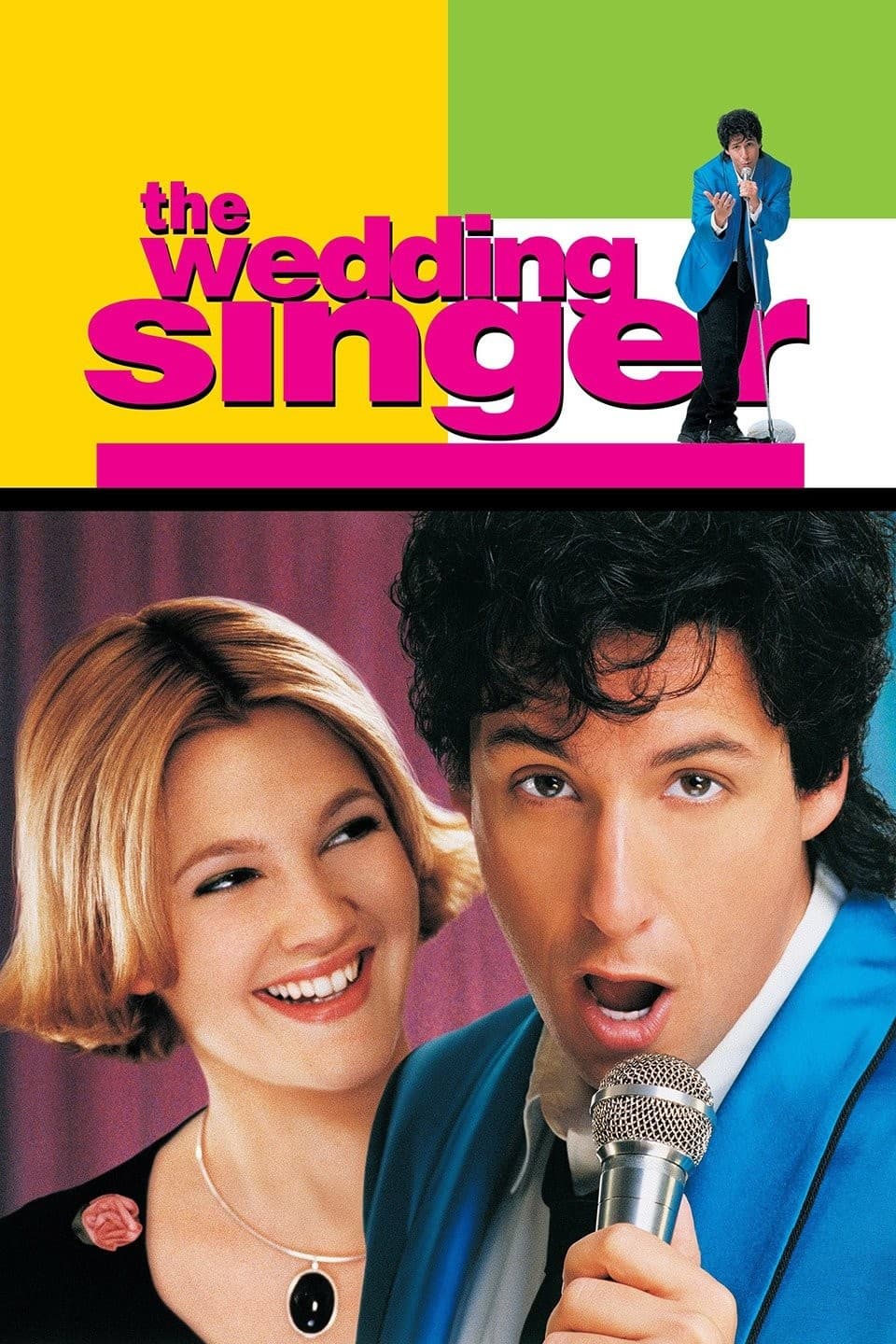
1998 // VHS
The Wedding Singer
A love story wrapped in 1980s pop — and carried by one very earnest wedding crooner.

1998 // VHS
There's Something About Mary
Romantic obsession, awkward masculinity and a hair‑gel gag you can't unsee.

1999 // VHS
10 Things I Hate About You
Sibling rules, a rooftop serenade and one very stubborn Kat — Shakespeare in a school corridor.