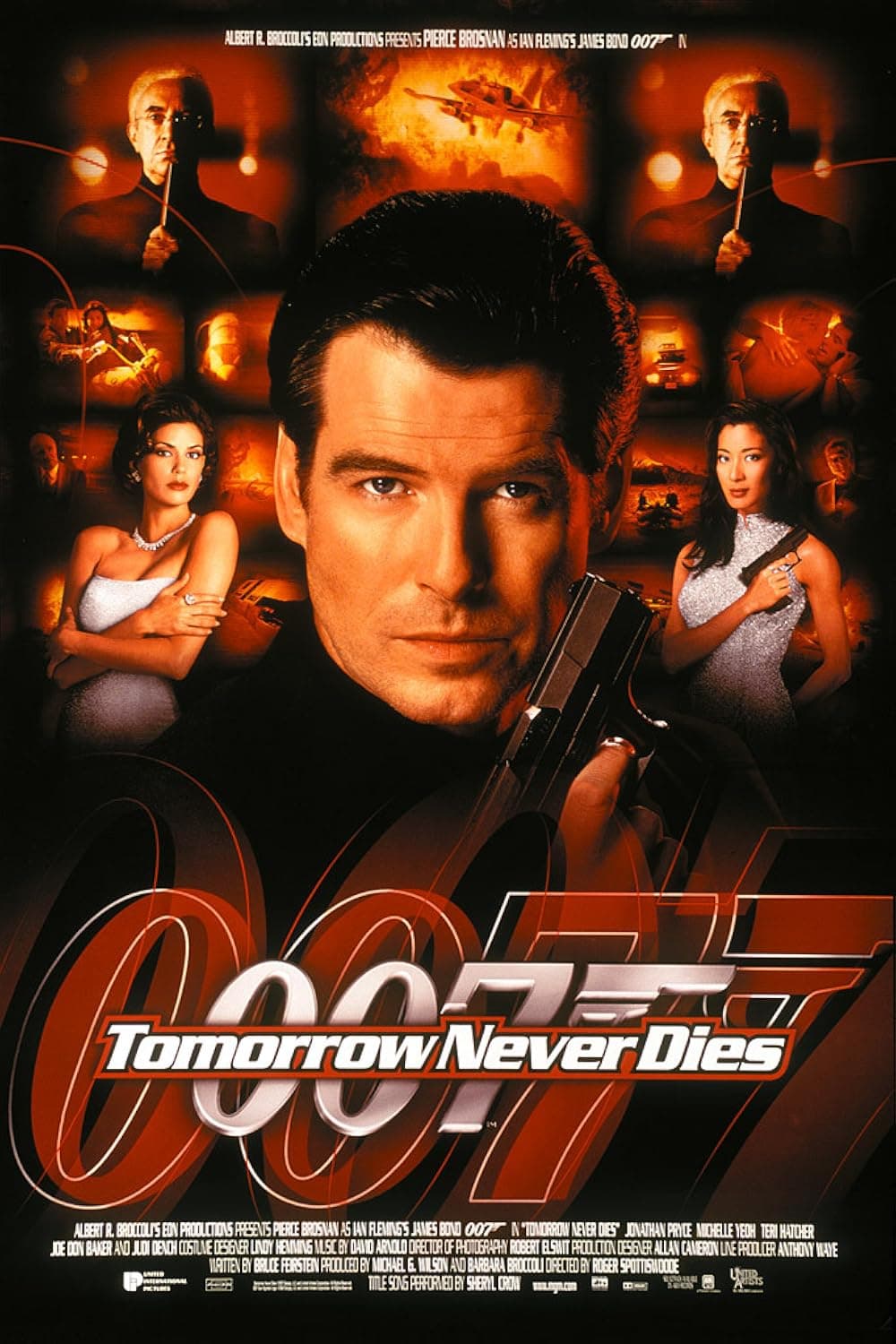
Tomorrow Never Dies
A media mogul sells conflict as headlines — Bond sells the interruption.
// The setup
PLAYBACK STARTED
Tomorrow Never Dies is one of those Bond films that feels less interested in gadget fetishism than in who gets to tell the story. Roger Spottiswoode's 1997 thriller places a press baron at the centre of a geopolitical plot and asks how news becomes a weapon. It still makes for an entertaining, oddly prescient evening in front of the telly.
THE MOVIE
James Bond is still the reason this movie works
Tomorrow Never Dies sets a neat, modern hook from the start: the villain doesn’t want territory or treasure so much as control of the broadcast. Elliot Carver’s business plan is outrage as inventory, and that shifts the film away from straightforward villainy into something more comfortable for a late‑90s thriller.
The story pivots on a very specific piece of sabotage — navigation data is tampered with and the Royal Navy frigate HMS Devonshire is sent off course. That single act of technological deceit is the kind of tidy engine the movie needs; it makes the global feel mechanical and the stakes immediate.
And at the centre of it all is Bond. Pierce Brosnan’s 007 plays the state’s counterclaim: a problem-solver with MI6 access, gadgets and an instinct for who to trust. Under Roger Spottiswoode’s direction, the film rides that tension between manufactured headlines and a man trying to stop the next manufactured incident.
THE SETUP
The idea that sets Tomorrow Never Dies in motion
The film’s premise is refreshingly schematic: a media magnate engineers crises to sell exclusive coverage, and someone has to trace the tampering back to him. That someone is James Bond, who follows the breadcrumbs from an arms bazaar through Europe to the South China Sea.
At the centre of the plot mechanics sits a stolen GPS encoder. It’s used to falsify navigation data and, crucially, to turn routine naval movement into a diplomatic incident. Once you accept that a piece of tech can be weaponised into a headline, the plot’s logic snaps into place.
Bond’s investigation is not purely professional. There’s a personal knot — his seduction of Paris Carver — which lets him into Elliot Carver’s orbit and raises the cost of the mission. It’s the small, interpersonal price that keeps the thriller from feeling like a boardroom puzzle.
Those elements — manufactured conflicts, sea lanes turned into chessboards and a mix of personal access with cold technology — give the set‑up clarity. It doesn’t overcomplicate itself, and that helps the action land.
THE CHARACTER
Why James Bond matters
Pierce Brosnan’s Bond is the film’s organising force. He’s not merely a spectacle-delivery system; in this story he’s the practical answer to a problem of information — someone who can pursue clues, lean on MI6 resources and use Q-branch kit to catch up with a story that has become a weapon.
That role matters because the movie’s antagonist weaponises the public sphere. Bond is the state’s corrective: move quickly, find the proof, blunt what’s being sold as news. It gives Brosnan’s Bond a clear procedural purpose beyond punching the henchmen.
The film also changes its rhythm by pairing Bond with another capable agent. Wai Lin’s objectives align with his, and that team-up converts what could have been a lone‑wolf exercise into a two‑agent operation. It alters how Bond works — less solo star and more collaborator when it counts.
And there’s Paris Carver: a personal connection that opens doors and costs Bond something in return. That emotional complication keeps the stakes local even when the plot sprawls across oceans and satellite links.
UNDER THE SURFACE
Tomorrow Never Dies has more on its mind than the plot suggests
If you look past the set pieces, the film is quietly fascinated by how news becomes a commodity. The villain’s playbook is simple and terrifying: create incidents and then sell the exclusive coverage. That’s the film’s central idea, dressed up in spy movie clothes.
Once that premise is accepted, manufactured conflict becomes the predictable consequence — incidents staged not for political advantage but for commercial gain. It changes the moral arithmetic of the story: wars and near‑wars become product lines.
Technology is the means by which this economy operates. GPS and satellite communications are not background details here; they’re the plumbing that lets someone falsify navigation and then turn a shipping error into international headlines.
All of this happens on and around the sea — chokepoints, stealth ships and naval movement. The maritime setting underlines that a single altered instruction can ripple into diplomatic chaos, which makes the film’s tech paranoia feel concrete rather than abstract.
THE FILMMAKING
How Tomorrow Never Dies was put together
The film reads as a professionally assembled blockbuster, which isn’t surprising given the names attached. Roger Spottiswoode directs a team that includes Robert Elswit behind the camera and editors Michel Arcand and Dominique Fortin shaping the pace.
Those credits matter because this is a movie that depends on controlled motion: chases, handoffs, the clearance of information. A cinematographer and editors who know how to keep clarity in action sequences are part of why the plot never feels accidentally muddled.
Producers Michael G. Wilson and Barbara Broccoli and production designer Allan Cameron are also part of the equation; their involvement keeps the production firmly within the series’ established scale and expectations.
In short, the film’s technical crew supplies the craft this particular Bond story needs: a steady machine that can carry a modern‑threat premise without getting lost in it.
PRACTICAL EFFECTS
The effects work that gives Tomorrow Never Dies its physical personality
The film relies on large, tangible set operations to sell its big moments. The stealth‑boat sequences were built and run at Baja Studios, which gives those scenes a physical heft — the action feels like it’s happening in real metal and water, not only on a soundstage.
The opening snow sequence shows the production’s practical problem-solving. When weather wouldn’t cooperate, artificial snow and on‑location logistics were used; the scene exists because the crew were prepared to manufacture the right conditions.
There’s also old-fashioned engineering on display: aircraft were dismantled, transported and reassembled to create the pre‑credit location work in the Pyrenees. That kind of logistical muscle gives the opening its breath and plausibility.
Taken together, these practical operations underline the production’s appetite for doing things physically whenever the story benefits — a useful quality for a movie that trades in real‑world sabotage and naval movement.
PURE 80S
Tomorrow Never Dies could not belong to any other decade
Released in 1997, the film sits at a moment when satellite news and globalised media were felt to be changing the world. Its central antagonist and the plot’s reliance on communications tech reflect late‑1990s anxieties about who controls information.
Musically the film marks a pivot for the series: it was David Arnold’s first Bond score, the start of a new musical direction that the franchise would continue to use. That shift in tone helps the film feel like a bridge between eras.
So while it doesn’t scream decade stereotypes, Tomorrow Never Dies is very much of its time in subject matter: global broadcast networks, faster communications and the idea that news cycles could be engineered for profit.
That context gives the movie a clearer identity than a generic action picture — it’s a 90s Bond thinking about the 90s media world it belongs to.
THE LEGACY
Why Tomorrow Never Dies still matters
Part of the film’s lasting footprint is simply its place in the Bond sequence: it’s the 18th official Eon picture and the second to feature Brosnan, which cements it as a chapter in the modernisation of the franchise.
Musically it’s notable as David Arnold’s debut in the series. That first score opened a musical thread Arnold would continue with Bond and related projects, which gives the film a certain continuity in the franchise’s sound.
The story also travelled beyond cinemas: there was a 1997 novelisation by Raymond Benson and a PlayStation game released in 1999. Those extensions underline how the film’s narrative worked well enough to be adapted across media.
Finally, the production dedicated the movie to Albert 'Cubby' Broccoli and premiered it at the Odeon Leicester Square in December 1997 — small, formal markers of the film’s place in the franchise and its moment.
THE VERDICT
Does Tomorrow Never Dies still hold up?
Yes — with a caveat. The film’s central conceit (a media mogul manufacturing incidents and using a stolen GPS encoder to cause diplomatic fallout) still reads clearly, and that clarity keeps the plot from collapsing under its own machinery.
The action has a late‑90s sheen, and Bond’s path — from an arms bazaar to Hamburg and then the South China Sea, where he teams with a capable ally to track a stealth ship — gives the narrative forward momentum. The personal cost introduced through Paris Carver adds a human note when the stakes risk becoming abstract.
Thematically it feels oddly timely. Concerns about commodified news, manufactured conflict and the power of communications technology were topical in 1997 and remain resonant now; the movie handles those ideas without making the picture feel like a lecture.
So if you want a Bond film that combines procedural clarity with thematic teeth — a spy movie that treats headlines as a problem to be solved — Tomorrow Never Dies is still worth a watch. It’s less about nostalgia and more about watching a thriller that understood, before it was obvious to everyone, that information could be ammunition.
Share this movie
// Keep watching
More movies from the 90s
If Tomorrow Never Dies is your kind of movie, there's plenty more on the shelves worth rewinding.
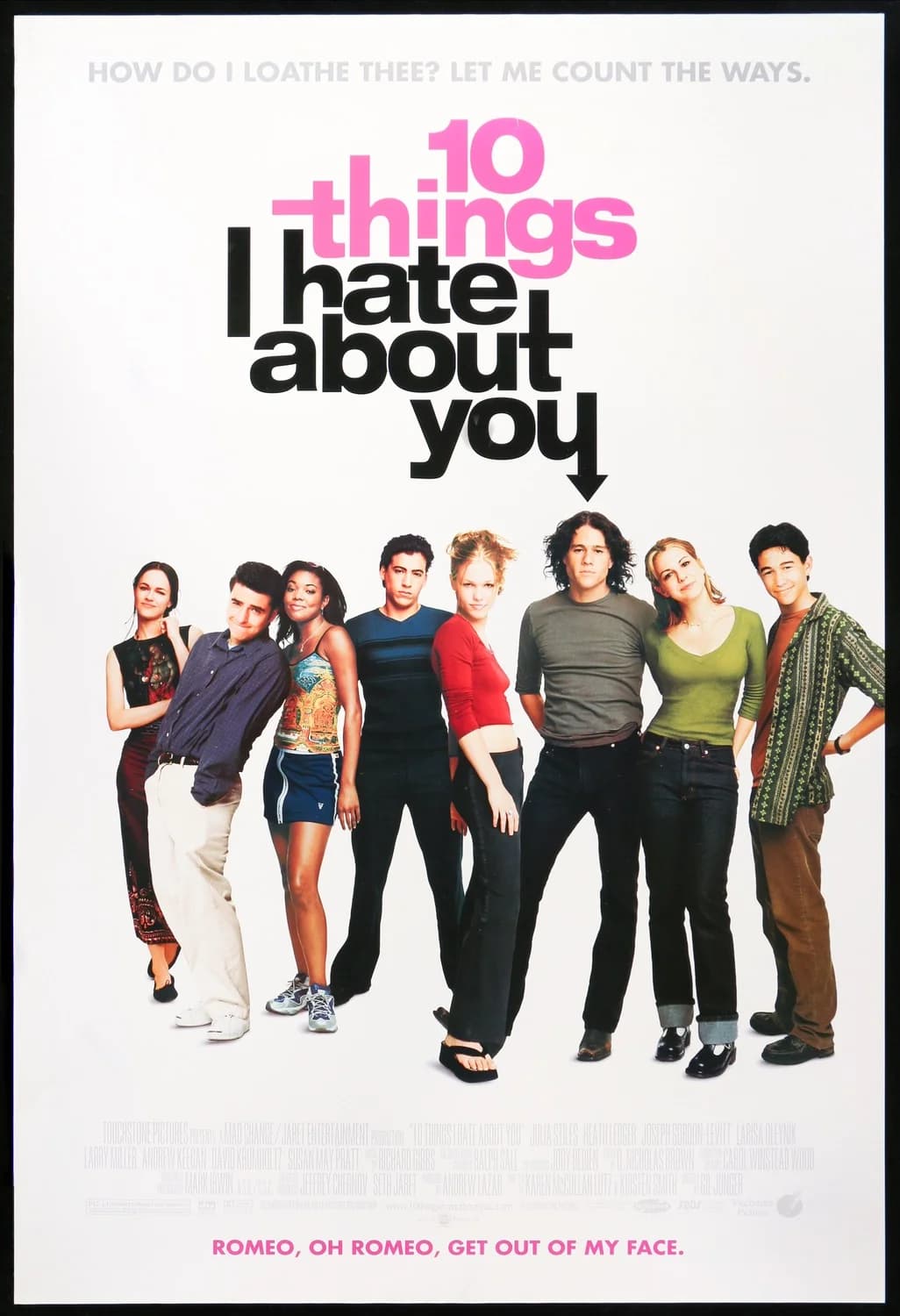
1999 // VHS
10 Things I Hate About You
Sibling rules, a rooftop serenade and one very stubborn Kat — Shakespeare in a school corridor.

1999 // VHS
American Beauty
Lester Burnham, suburban rot and a midlife argument that still stings.
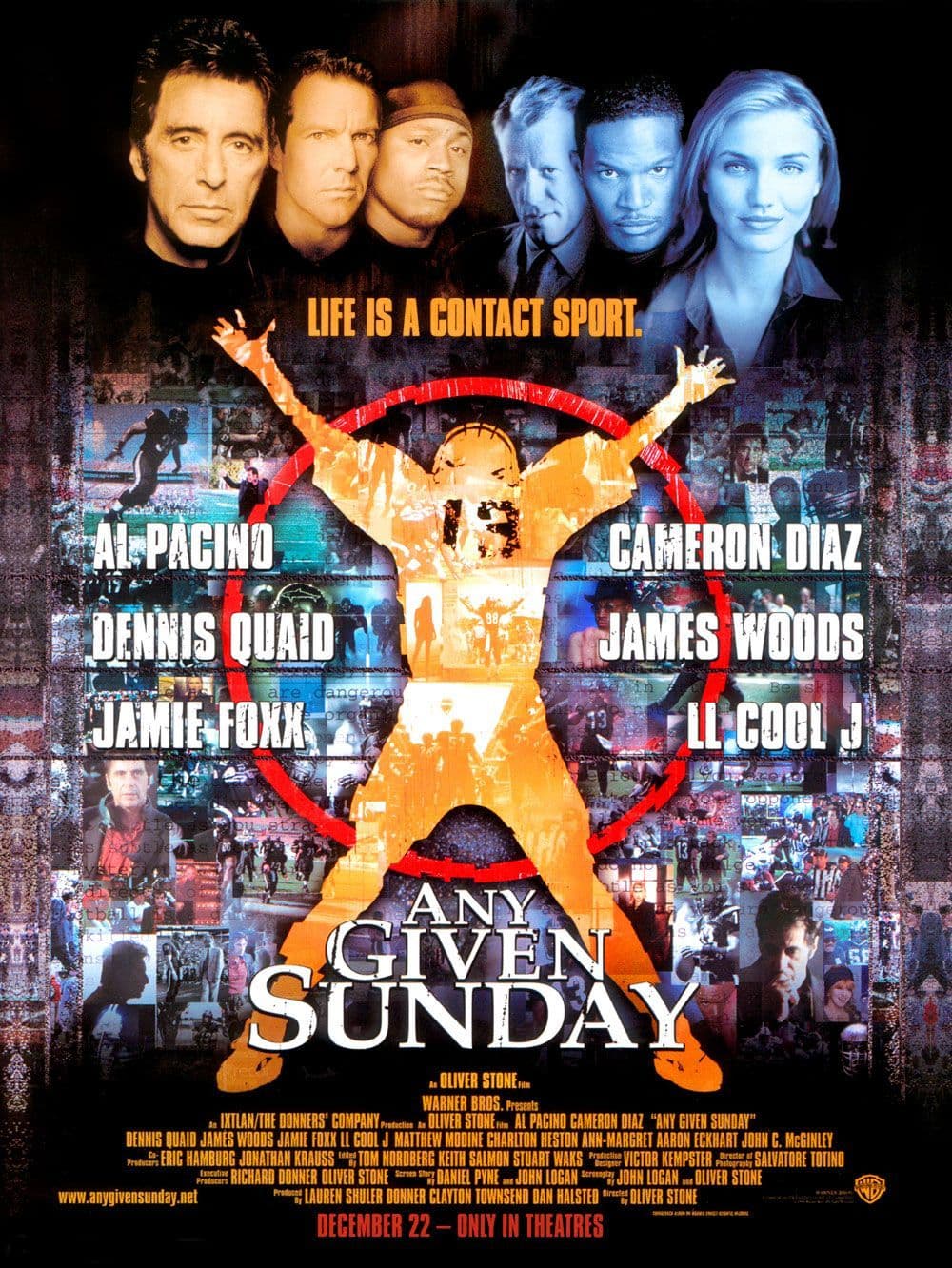
1999 // VHS
Any Given Sunday
Al Pacino's coach anchors the chaos of a film about football turned into product — loud, messy and oddly persuasive.